Many people want to create and sell online courses, but they feel stuck because building a course from scratch takes a lot of time, effort, and skill.
This is where Private Label Rights Courses can help, but many beginners do not understand how they work or how to use them correctly. Some people also choose low-quality courses and struggle to make sales.
In this blog post, you will learn what Private Label Rights Courses are, how to choose high-quality ones, and how to customize and sell them step by step, so you can start your online business faster and with less stress.
Choose High-Quality PLR Content Carefully
When you dive into Private Label Rights (PLR) courses, the first and most important step is to pick good stuff. Think of it like shopping for groceries.
You wouldn’t just grab the first thing you see, right? You check the labels, look at the ingredients, and make sure it’s fresh. It’s the same with PLR.
I always tell people to be super picky. Don’t just settle for anything. The quality of the PLR content you choose directly impacts your own brand and what your customers think of you.
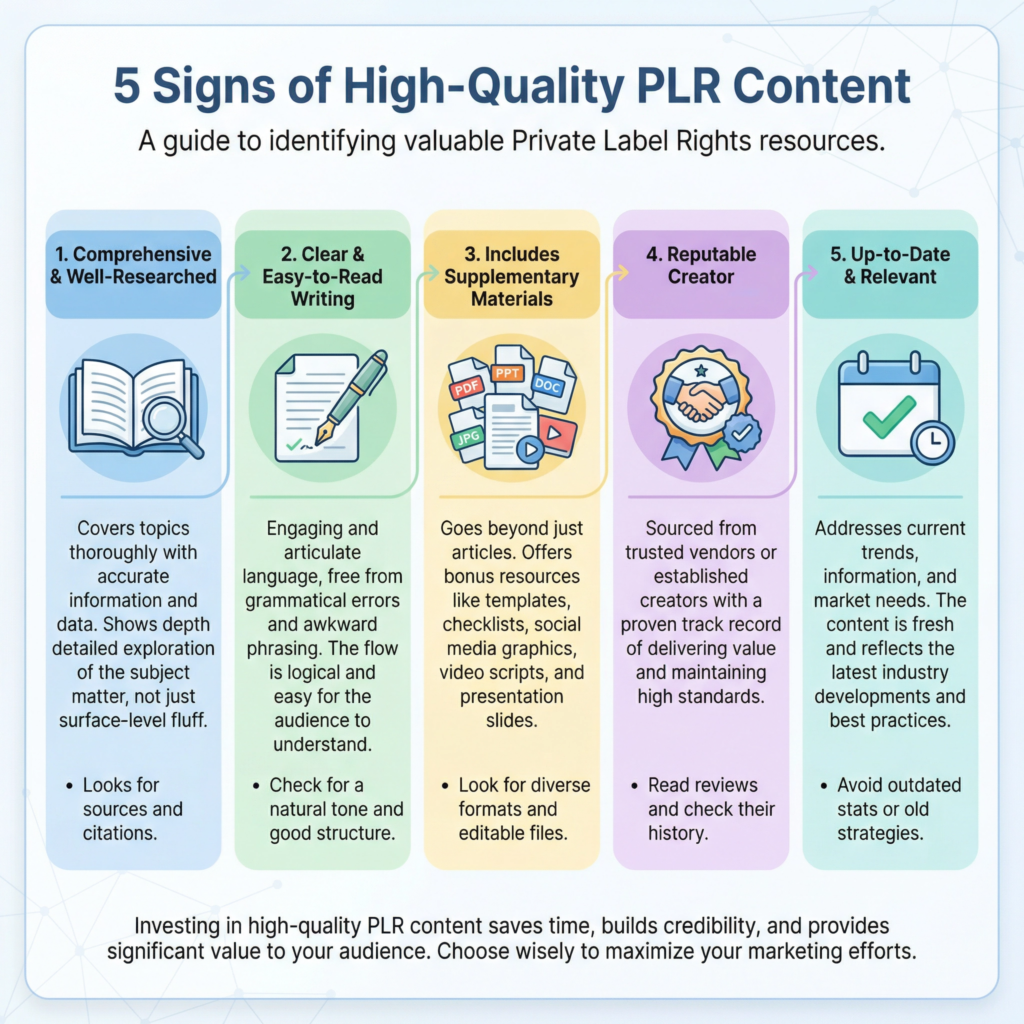
I look for content that feels complete and well-researched. Does it cover the topic in depth? Is the information accurate and up-to-date?
I’ve seen a lot of PLR out there that’s just a quick rehash of old ideas. That’s not what we want. We want something that genuinely helps people.
If the content is thin or full of errors, it will reflect poorly on you. Your customers will notice, and they might not trust your other products.
Another big thing I check is the writing style. Is it clear and easy to read? Does it flow well? Sometimes, PLR content can be a bit clunky or sound like it was written by someone who doesn’t speak English as their first language.
That’s okay, but it means you’ll have a lot more work to do to make it sound professional and like your voice.
I try to find content that’s already pretty polished. This saves me a ton of time on editing and rewriting.
I also consider the format. Is it just a plain text document, or does it come with slides, worksheets, or other helpful materials? The more resources included, the better.
These extra bits make it easier for me to turn the PLR into a full-fledged course. They also add more value for my students.
I always think about how I can make the course experience the best it can be, and a good PLR often provides a great starting point with these additional assets.
Finally, I check who created the PLR. Do they have a good reputation? Are they known for producing quality content? A quick search can often tell you a lot.
If the creator has a history of putting out solid products, I feel much more confident using their PLR. It’s all about building a strong foundation for your own business.
Choosing high-quality PLR content carefully is not just a suggestion; it’s a must-do for long-term success. It sets the stage for everything else you’ll do with it. Your brand deserves the best, and so do your students.
Redefine the Target Audience
When you buy a Private Label Rights (PLR) course, it usually comes with a broad audience in mind. The creator wants to sell it to as many people as possible.
But if you want to be successful, you need to do the opposite. You need to redefine the target audience. I always tell my students that if you try to speak to everyone, you end up speaking to no one.
You need to pick a specific group of people and tailor the content just for them. This makes your course feel much more valuable and personal.
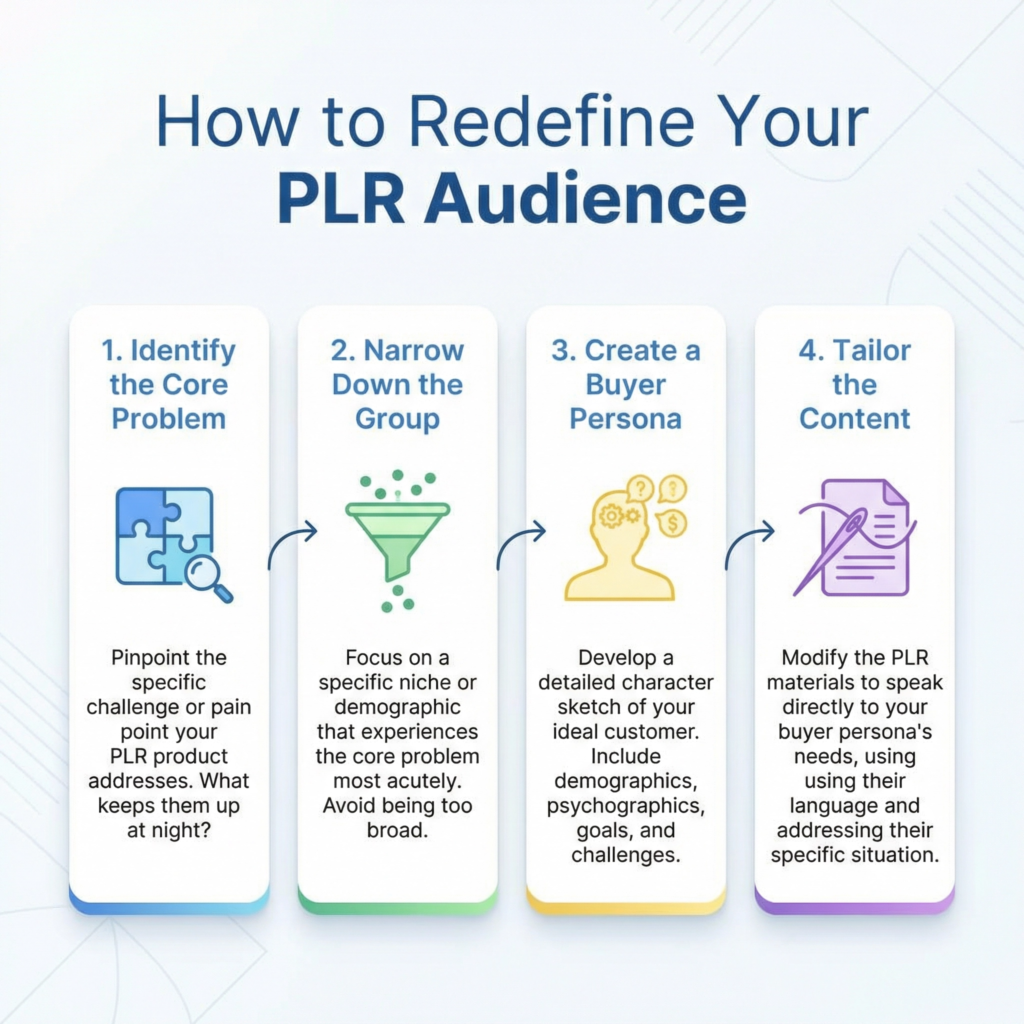
Think about the problem the PLR course solves. Now, think about who has that problem most urgently.
For example, if you have a PLR course on “Time Management,” don’t just sell it to “everyone who wants to save time.” Instead, redefine it for “busy stay-at-home moms who want to start a side hustle” or “new freelance writers struggling with deadlines.”
Can you see the difference? The second group will feel like you are talking directly to them. They will be much more likely to buy from you because they feel understood.
I like to create a “buyer persona” for my redefined audience. I give them a name, an age, and a specific set of challenges.
I ask myself: What are their biggest fears? What are their goals? What keeps them up at night?
Once I know these things, I can go through the PLR content and change the examples, the stories, and the language to match.
This turns a generic course into a specialized solution. It’s like taking a one-size-fits-all shirt and getting it tailored to fit someone perfectly.
Redefining your audience also helps you with your marketing. You will know exactly where to find your customers.
You can join the Facebook groups they hang out in, use the hashtags they follow, and speak their language in your ads. It makes everything so much easier.
You aren’t shouting into a void anymore. You are having a conversation with people who actually need what you have. This focus is the secret to making PLR work for your brand.
Rewrite and Improve the Content
Once you have your PLR course, the real magic happens when you rewrite and improve the content. Think of the PLR as a rough draft or a skeleton. It’s a great start, but it needs your unique touch to make it shine.
I always tell my students that you should never just use PLR exactly as it comes. If you do, your course might look just like everyone else’s.
To stand out, you need to add your own voice, your own stories, and your own expertise. This is how you turn a generic product into something truly special.
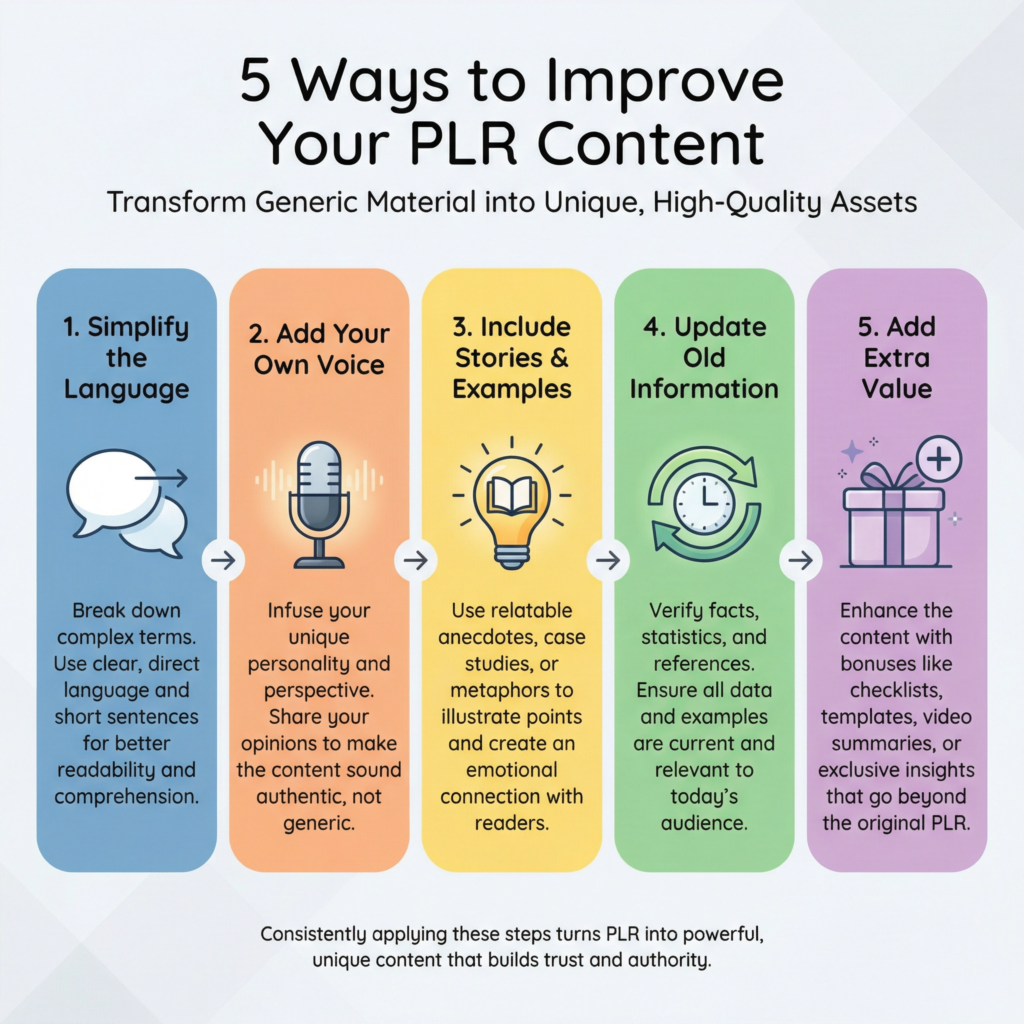
I start by reading through the entire course. As I go, I look for places where I can make the language simpler or more engaging. If a sentence is too long, I break it into two. If a word is too technical, I find a easier one.
My goal is to make the information as easy to understand as possible. I also look for gaps in the information. Is there something important missing? If so, I do a little research and add a new section. This adds extra value that your customers won’t find anywhere else.
Adding your own examples and case studies is another great way to improve the content. People love stories.
They help to illustrate complex points and make the information more relatable. If you have a personal experience that relates to the topic, share it!
This builds trust with your audience and shows them that you actually know what you’re talking about. It moves you from being just a “reseller” to being a “teacher” and an “authority” in your niche.
Don’t forget to update any outdated information. The digital world moves fast, and PLR can sometimes become old quickly.
Check all the links, the statistics, and the references to make sure they are still correct. If the PLR mentions a tool that no longer exists, find a better one to recommend.
This shows your customers that you care about providing high-quality, current information. It’s these small details that make a big difference in the long run.
Rewriting isn’t just about changing words; it’s about making the content better for your specific audience.
Add Bonus Materials
One of the best ways to make your Private Label Rights (PLR) course stand out is to add bonus materials. Bonuses are extra items you give to your customers for free when they buy your course. They add massive value and make your offer much more exciting.
I always tell my students that a good bonus can sometimes be the reason someone decides to buy from you instead of someone else. It shows that you are willing to go the extra mile to help them succeed.
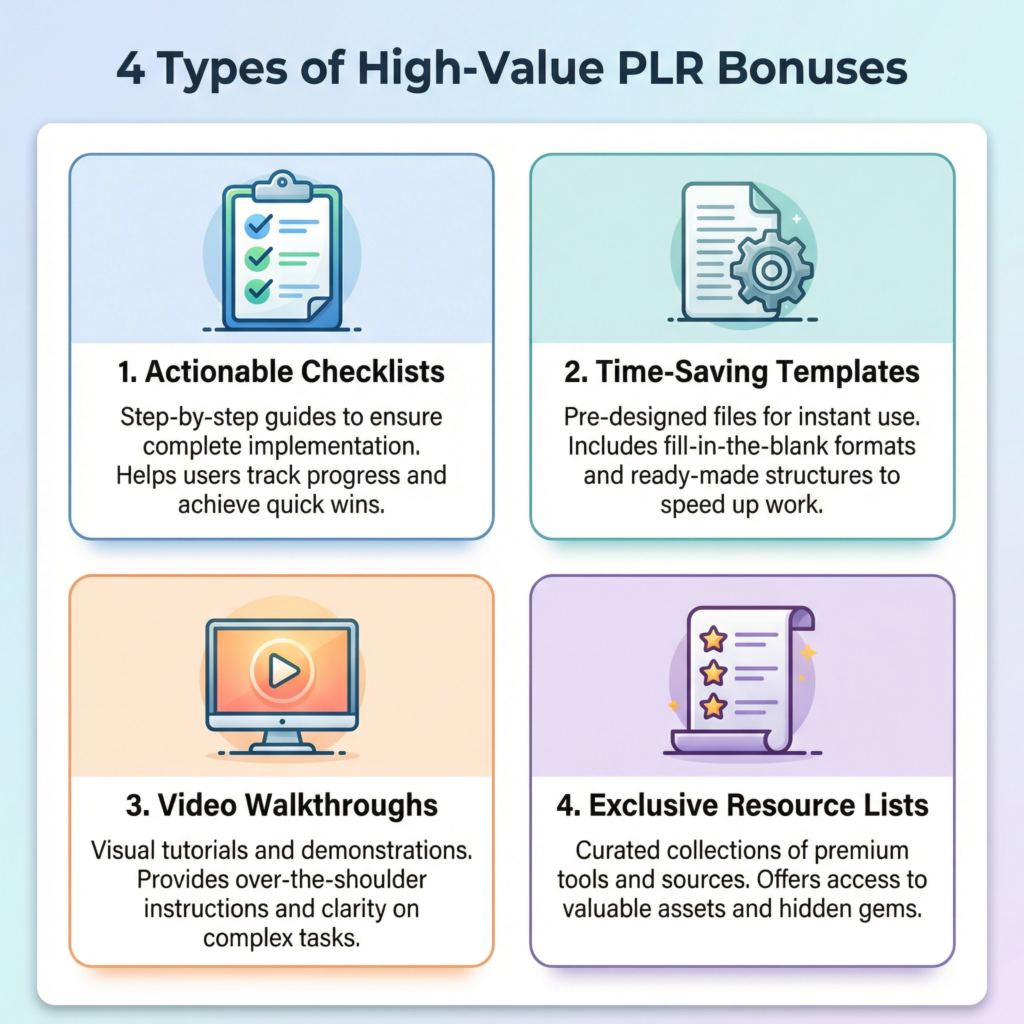
Think about what your students might need to help them complete the course faster or easier. For example, if your PLR course is about “Starting a Blog,” you could add a bonus checklist of the top ten plugins every blogger needs.
Or, you could include a template for a “First Blog Post.” These are simple things to create, but they are incredibly helpful for a beginner. They solve a small problem that your students will face as they go through your main training.
I like to use different formats for my bonuses. You could create a short PDF guide, a video walkthrough, or even a simple spreadsheet.
The key is to make it useful. Don’t just add filler content. If the bonus doesn’t help the student reach their goal, it’s not a good bonus.
I often look at what other people in my niche are offering and try to create something even better. This helps me to position my course as the “premium” option in the market.
Adding bonuses also helps you to increase your price. When people see all the extra value they are getting, they are often willing to pay a bit more.
It turns a simple course into a complete “success kit.” You can even use your bonuses in your marketing. Mention them in your emails and on your sales page.
Use bold text to highlight how much they are worth. This creates a sense of urgency and makes your offer feel like a “no-brainer.”
Record New Video Lessons
Recording your own video lessons is the best way to turn a basic PLR course into a premium product. Most PLR packages come with text or slides, but adding your voice and face builds a real connection with your students.
I always tell my students that people don’t just buy information; they buy from people they trust.
When they see you on camera or hear your voice explaining the concepts, you become their mentor. This instantly makes your course more valuable than a generic text-only version.
You don’t need a professional movie studio to get started. A simple webcam or even your smartphone can work perfectly.
The most important thing is that your audio is clear. I recommend using a basic external microphone if you can.
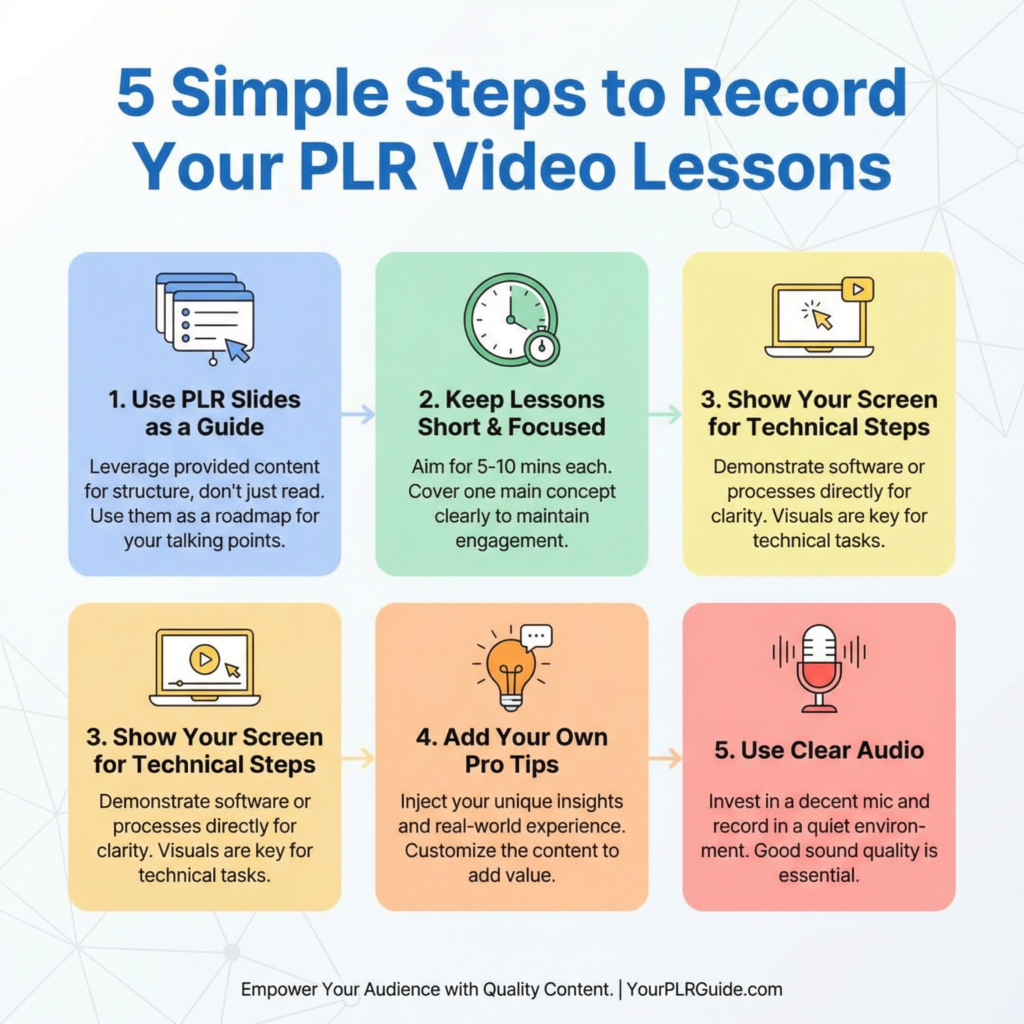
I start by using the PLR slides or text as my script. I don’t read it word-for-word, though. I use it as a guide and explain the points in my own way.
I like to add my own “pro tips” and personal stories as I talk. This makes the lesson feel fresh and unique to my brand.
I find that shorter videos work best for modern learners. I try to keep each lesson between five and ten minutes long. If a topic is very big, I break it into two or three smaller videos.
This makes the course feel less overwhelming for your students. They can watch one quick lesson, take action, and then come back for the next one. It creates a sense of progress that keeps them motivated.
I also like to show my screen if I’m teaching a technical skill. This “over-the-shoulder” style is very helpful for beginners.
Once your videos are recorded, you can host them on platforms like YouTube (as unlisted), Vimeo, or directly on your course platform.
Adding your own videos also protects your business. It’s much harder for someone to “copy” your course when you are the one teaching it. It establishes your authority and makes your brand memorable.
Remember, you are the expert now. Recording your own lessons is the final step in making the PLR content truly yours.
Create a Unique Brand and Positioning
Creating a unique brand and positioning is how you make your PLR course stand out in a crowded market.
When you buy a PLR course, remember that other people might have bought the same one. If you all sell it with the same title and the same look, you are just competing on price. That is a race to the bottom.
Instead, you need to wrap the content in your own unique brand. I always tell my students that your brand is the “promise” you make to your customers. It’s what makes them choose you over everyone else.
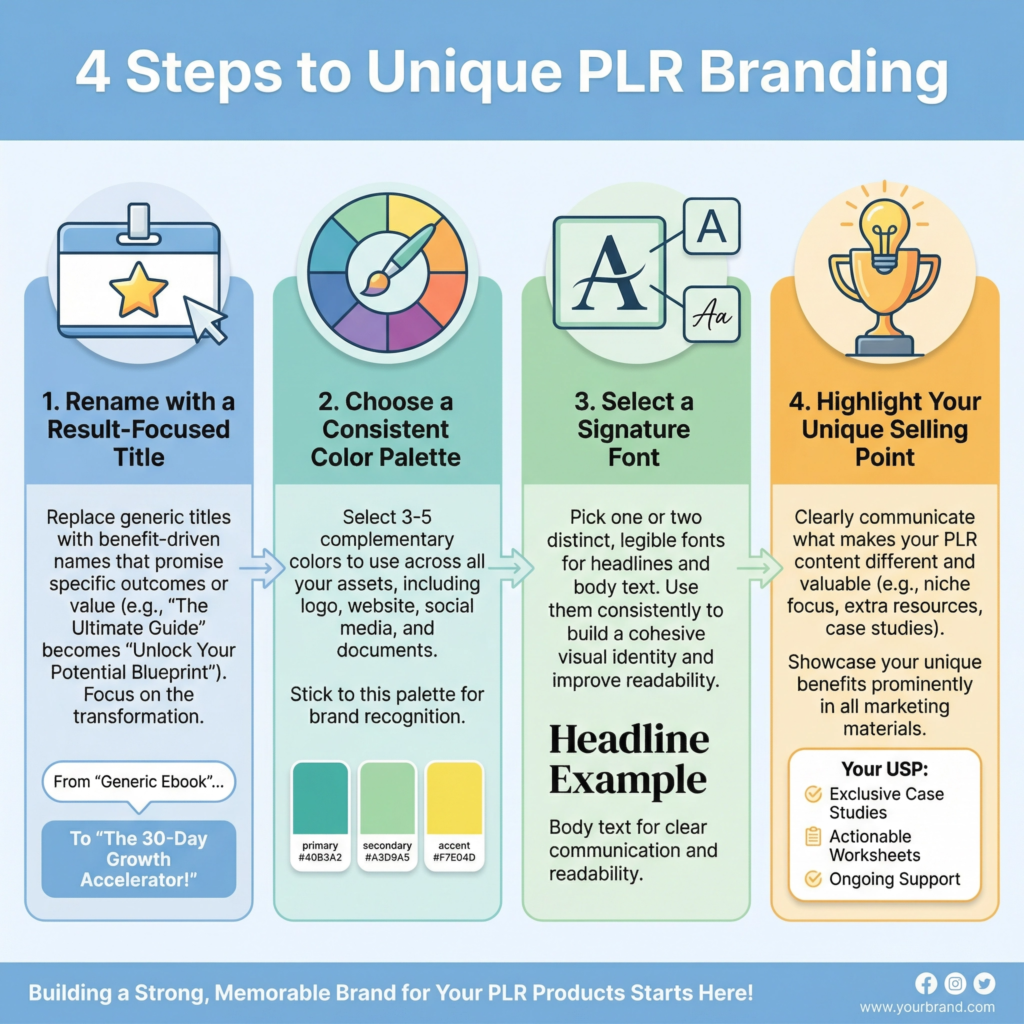
Start by giving your course a new, catchy title. Don’t use the generic one that came with the PLR package. Think about the specific benefit your course provides and use that in the name.
For example, instead of “Time Management for Beginners,” you could call it “The Stress-Free Week: 5 Days to Total Productivity.” This new title immediately tells people what they will get and makes it feel fresh. It positions your course as a specific solution to a common problem.
Next, think about your visual branding. This includes your logo, your colors, and the fonts you use.
You want everything to look professional and consistent. If your brand is helpful and friendly, use warm colors and soft fonts. If it’s high-energy and corporate, use bold colors and clean lines.
When your course materials match your brand, it builds trust. Your students will feel like they are learning from a real professional, not just someone reselling a digital file. This consistency is key to building a long-term business.
Positioning is also about how you talk about your course. What makes it different? Maybe it’s your personal experience, or a unique bonus you added, or the way you structured the lessons.
Highlight these differences in your marketing. You want to be the “only” person who offers this specific combination of value.
When you have a strong brand and clear positioning, you don’t have to worry about competition. You are in a league of your own. Your brand becomes your most valuable asset.
Build a Smart Marketing System
Once your PLR course is ready, you need a smart marketing system to sell it. You can have the best course in the world, but if no one knows about it, you won’t make any sales. A smart system is one that works for you even when you are sleeping.
I always tell my students that marketing isn’t just about shouting; it’s about building a path for your customers to follow. You want to lead them from being a stranger to being a happy student.
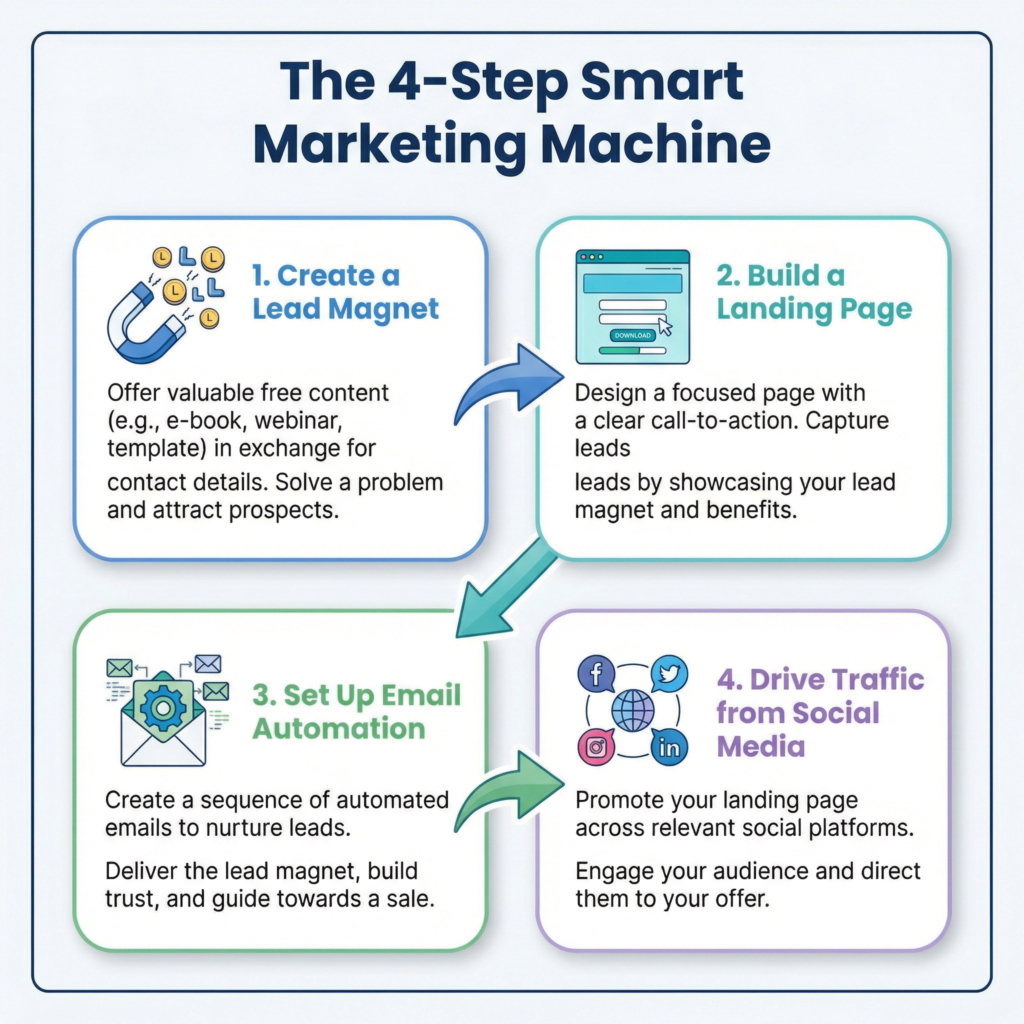
I start by creating a simple “lead magnet.” This is a free piece of value that relates to your course. It could be a short PDF, a checklist, or a free video lesson. You give this away in exchange for someone’s email address. This is the first step in your system. It lets you start a conversation with people who are actually interested in your topic.
Once you have their email, you can send them helpful tips and tell them more about your main course. This builds trust and shows them that you are an expert.
Next, I set up an automated email sequence. This is a series of emails that go out automatically after someone signs up for your lead magnet.
In these emails, I share more value, answer common questions, and explain how my course can solve their problems. I don’t just sell in every email. I focus on being helpful first.
By the time they get to the email where I ask them to buy, they already know, like, and trust me. This makes the sale feel natural and easy.
Finally, I use social media to drive people to my lead magnet. I don’t try to be everywhere at once. I pick one or two platforms where my target audience hangs out. I share helpful posts, stories, and videos that talk about the problems my course solves.
I always include a clear link to my free gift. This creates a steady stream of new people entering my marketing system.
A smart marketing system is like a machine. Once you build it and turn it on, it keeps working for you day after day.
Conclusion
Turning Private Label Rights (PLR) content into a successful online course is one of the smartest ways to grow your business.
We have covered the essential steps to make sure your course stands out and provides real value.
We started by learning to Choose High-Quality PLR Content Carefully, because a strong foundation is everything.
We then discussed why you must Redefine the Target Audience to speak directly to a specific group of people who need your help.
To make the course truly yours, we explored how to Rewrite and Improve the Content with your own voice and stories.
We also looked at the power of Adding Bonus Materials to delight your customers and increase your course’s value.
For those who want to reach the next level, we talked about why you should Record New Video Lessons to build a deeper connection with your students.
Finally, we covered how to Create a Unique Brand and Positioning and Build a Smart Marketing System to ensure your course gets the attention it deserves.
Each of these steps helps you move from being just another reseller to being a trusted authority in your niche.
By putting in the extra effort to customize and improve your PLR, you are building a real asset for your brand.
You aren’t just selling information; you are providing a transformation for your students. This is the key to long-term success and happy, loyal customers.
What Next?
Ready to Build a Brand That Gets Results?
Don’t let opportunities pass you by because people don’t know who you are or what you offer.
Learn how to define your unique value, grow your online presence, and build credibility that attracts customers and clients.
Start building your personal brand today—download your copy now!