Content repurposing strategies solve a common problem many creators and businesses face: spending hours creating content that gets used once and then forgotten. Producing fresh content consistently can be exhausting, time-consuming, and expensive. Without a clear repurposing plan, valuable blog posts, videos, or podcasts fail to reach their full potential.
If you’re a digital marketer, I’m sure you can relate. The pressure to constantly feed the content beast is immense. But what if I told you there’s a way to get off that treadmill? A way to multiply your results without multiplying your workload? That’s where powerful content repurposing strategies come in. It’s the secret that top marketers use to maximize their reach, reinforce their message, and get a massive return on their initial content investment.
In this guide, I’m going to show you how to think like a content alchemist, turning one great piece of content into a dozen different assets. We’ll explore the data-backed benefits, dive into real-world examples, and I’ll give you my personal framework for making content repurposing a core part of your marketing DNA. Let’s stop working so hard and start working smarter.
What Are Content-Repurposing-Strategies, Really?
Think of your best piece of content like a Thanksgiving turkey. You spend hours preparing it, and it’s the star of the show on the big day. But you wouldn’t just throw away the leftovers, would you? Of course not! You’d use them for sandwiches, soup, and casseroles for the rest of the week. You’re taking that one core asset and transforming it to create multiple new meals.
That’s exactly what content repurposing is. It’s the art and science of taking one piece of existing content and transforming it into new formats to expand its reach and extend its lifespan. It’s not about being lazy or just copy-pasting the same thing everywhere. It’s a strategic approach to getting the absolute most out of the time, effort, and creativity you’ve already invested.
And it’s a strategy that’s widely adopted. One HubSpot report found that 48% of social media marketers already share repurposed content across different platforms. It’s a proven method for increasing efficiency and impact.
Why Content Repurposing Is a Game-Changer for Your Marketing ROI
Before we get into the “how,” let’s talk about the “why.” Understanding the profound benefits of content repurposing is what will motivate you to make it a non-negotiable part of your workflow. This isn’t just a nice-to-have; it’s a critical strategy for modern marketing success.
1. It Dramatically Increases Your Reach
Your audience isn’t a monolith. Some people love reading long-form blog posts. Others prefer watching short-form videos on TikTok. Some listen to podcasts during their commute, and others love scrolling through infographics on Pinterest. If you only create one type of content, you’re only reaching one segment of your potential audience.
By repurposing your content into different formats, you can meet your audience where they are. A single research report can become a series of blog posts, a handful of YouTube videos, a deck of social media carousels, and an email mini-course. This multi-channel approach is essential for casting a wider net and capturing attention in our fragmented media landscape.
2. It Boosts Your SEO Efforts
From an SEO perspective, content repurposing is a powerhouse. When you turn a blog post into a video, you can embed that video on the original page, increasing time-on-page—a key ranking signal for Google. When you create an infographic, you create a highly shareable asset that can earn you valuable backlinks.
Furthermore, by creating multiple assets around a central topic, you’re signaling to search engines that you are an authority on that subject. This can help your entire topic cluster rank higher, driving more organic traffic to your site. It’s no surprise that top B2B brands cite their website, blog, and SEO efforts as their number one channel for ROI.
3. It Reinforces Your Core Message
Have you ever heard of the marketing “Rule of 7”? It’s the idea that a potential customer needs to see or hear your message at least seven times before they take action. Content repurposing is the perfect way to put this rule into practice without sounding like a broken record.
When someone sees your key message in a blog post, then hears it on a podcast, then sees it visualized in an infographic, it starts to stick. This repetition builds familiarity and trust, which are essential for converting a prospect into a customer. It’s about making your message inescapable, but in a helpful, multi-faceted way.
4. It Saves You an Insane Amount of Time and Money
This is the most obvious benefit, but it’s worth repeating. Creating high-quality content from scratch is incredibly time-consuming and expensive. Content repurposing allows you to maximize your return on that initial investment. Instead of spending 10 hours creating one piece of content, you can spend 12 hours creating one core piece and five or six repurposed assets from it.
This efficiency is crucial for small teams and solo marketers who are trying to compete with larger brands. It allows you to maintain a consistent presence across multiple channels without burning out or breaking the bank.
10 Powerful Content-Repurposing-Strategies to Try Today
Now that you’re sold on the “why,” let’s get practical. Here are ten of my favorite, battle-tested content repurposing strategies that you can start implementing right away. I’ve used these exact tactics to help clients and my own brand get exponential results from a single piece of content.
1. The “Pillar to Pieces” Strategy
This is the foundational strategy of content repurposing. You start with a large, comprehensive piece of content—a “pillar” post, an ultimate guide, a research report, or a webinar—and you break it down into smaller “pieces” for different channels.
- How it works: A 3,000-word blog post can be turned into:
- 5-7 short social media posts
- A 10-slide carousel for Instagram or LinkedIn
- A 2-minute explainer video
- A checklist or cheat sheet lead magnet
- A 3-part email newsletter series
- Real-World Example: The Content Marketing Institute is a master of this. They’ll release a massive annual research report, and then for the next several months, they’ll slice and dice that report into blog posts, webinars, infographics, and social media updates.
2. The “Video to Everything” Workflow
If you’re comfortable on camera, video is one of the best places to start your content creation process. Why? Because video is the richest media format. It contains visuals, audio, and text (when transcribed). This makes it incredibly easy to repurpose.
- How it works: A 20-minute YouTube video can be repurposed into:
- A podcast episode (just strip the audio)
- A full-length blog post (using a transcription service like Rev or Descript)
- Multiple short-form videos for TikTok, Reels, and Shorts
- Quote graphics for social media
- An email newsletter with the video embedded
- Real-World Example: Gary Vaynerchuk is the king of this strategy. He has a team that follows him around and records everything. They then take that raw footage and turn it into a massive volume of content for every platform imaginable.
3. The “Webinar to Lead Magnet” Funnel
Webinars are a fantastic way to generate leads and connect with your audience in real-time. But the value of a webinar doesn’t have to end when the live event is over. In fact, that’s just the beginning.
- How it works: After you host a live webinar, you can:
- Gate the recording behind a landing page and use it as a lead magnet.
- Break the webinar down into a series of short video tutorials.
- Turn the slide deck into a shareable presentation on SlideShare.
- Create a blog post that summarizes the key takeaways.
- Real-World Example: Livestorm, a webinar platform, regularly turns their own webinars into on-demand resources and blog posts, extending the life and reach of their live events [4].
4. The “Blog Post to Infographic” Transformation
Is one of your blog posts particularly data-heavy or process-oriented? That’s a perfect candidate to be turned into an infographic. Infographics are highly shareable and can make complex information much easier to digest. In fact, some studies show they are 30 times more likely to be read than text articles [5].
- How it works: Take the key stats, steps, or concepts from your blog post and work with a designer (or use a tool like Canva or Piktochart) to create a visually appealing infographic.
- Real-World Example: HubSpot frequently takes the data from their marketing reports and creates beautiful, shareable infographics that get a ton of social media engagement and backlinks.
5. The “Podcast to Social Media Gold” Method
If you have a podcast, you’re sitting on a goldmine of potential social media content. Each episode is packed with quotable moments, interesting stories, and valuable insights.
- How it works:
- Use a tool like Headliner or Wavve to create audiograms (short video clips with your audio and a waveform graphic).
- Pull out the most powerful quotes and turn them into text-based images.
- Create short video clips of the most interesting moments.
- Run a poll on Twitter or LinkedIn related to the episode’s topic.
- Real-World Example: The “My First Million” podcast does an excellent job of this. They pull out the most interesting business ideas and stories from each episode and share them as short clips on TikTok and YouTube, driving new listeners back to the full-length show.
6. The “Case Study to Story” Arc
Case studies are powerful sales tools, but they can often be a bit dry. By repurposing them into more engaging formats, you can bring the customer’s story to life.
- How it works:
- Turn a written case study into a video testimonial.
- Create a blog post that tells the customer’s story in a more narrative, emotional way.
- Pull out the most impressive results and create a social media graphic.
- Use the case study as the basis for a webinar presentation.
- Real-World Example: SaaS companies like Slack and Asana have entire sections of their websites dedicated to customer stories, showcasing how real companies use their products in a variety of engaging formats.
7. The “Internal Data to Industry Report” Play
Do you have access to unique data that no one else has? This could be data from your own product, surveys you’ve conducted, or insights from your customer base. This is one of the most valuable types of content you can create, and it’s ripe for repurposing.
- How it works:
- Compile your data into a comprehensive, gated report.
- Write a series of blog posts that each focus on one key finding.
- Create a webinar to present your findings.
- Pitch your data to journalists and media outlets to get press coverage.
- Real-World Example: Okta, an identity and access management company, releases an annual “Businesses at Work” report that analyzes how people use different apps and tools. This report gets a ton of media attention and positions them as a leader in their industry.
8. The “Old Content to New Content” Refresh
Content repurposing isn’t just about creating new formats; it’s also about updating and improving your existing content. This is a huge, often-missed opportunity.
- How it works:
- Identify your top-performing blog posts from a year or two ago.
- Update them with new information, stats, and examples.
- Add a content upgrade (like a checklist or template) to capture more leads.
- Re-promote the updated post as if it were brand new.
- Real-World Example: Brian Dean of Backlinko is famous for this. He’ll take an old post, completely overhaul it with new information and visuals, and often see a huge boost in traffic and rankings.
9. The “Guest Appearance to Content Hub” Strategy
Have you been a guest on a podcast or spoken at a virtual summit? Don’t let that content live only on someone else’s platform. You can and should repurpose it for your own channels.
- How it works:
- Embed the podcast player or video on your own website.
- Get a transcript and turn it into a blog post.
- Pull out key quotes and share them on social media.
- Thank the host and tag them in your social posts to tap into their audience.
- Real-World Example: Tim Ferriss often posts transcripts of his podcast episodes on his blog, making the content accessible to people who prefer to read rather than listen.
10. The “Community Conversations to FAQ Content” Loop
Your customers and audience are a constant source of content ideas. The questions they ask in your community forum, on social media, or in customer support tickets are the exact questions that other potential customers are searching for.
- How it works:
- Compile the most common questions you receive.
- Create a comprehensive FAQ page or a series of “How-To” blog posts that answer those questions.
- Create short videos that answer one question at a time.
- Use these questions as prompts for your next webinar or podcast episode.
- Real-World Example: Ahrefs, an SEO tool, has a fantastic blog and YouTube channel that is almost entirely dedicated to answering their customers’ most common questions about SEO and their product.
My 4-Step Framework for Building a Content Repurposing Machine
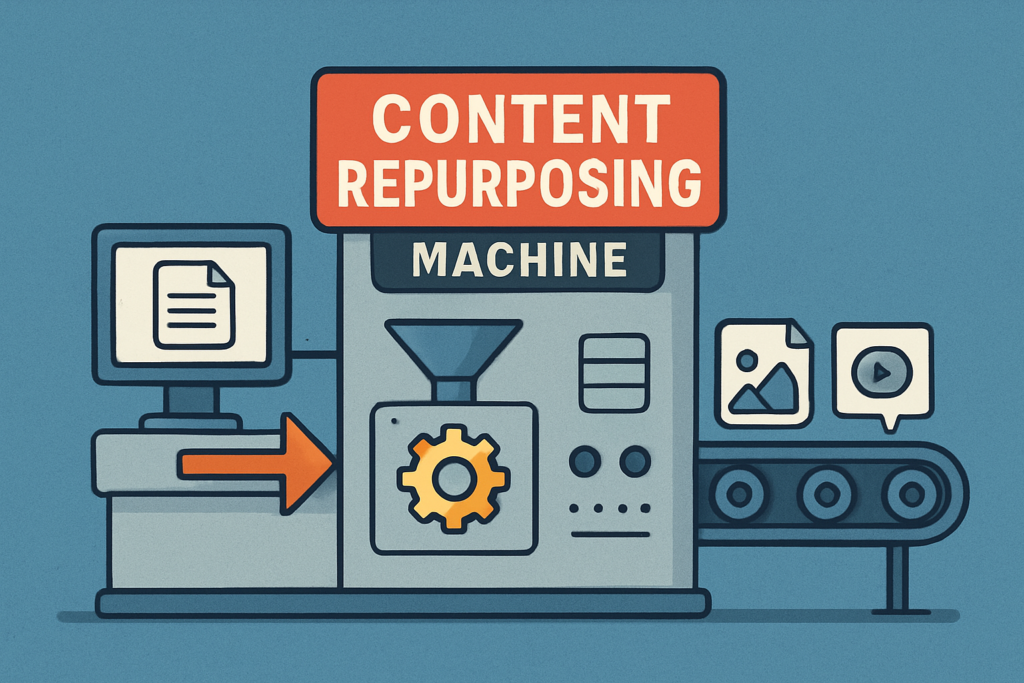
Okay, that was a lot of ideas. But ideas are useless without execution. So, how do you actually make content repurposing a seamless part of your workflow? This is the 4-step framework I use to build a “content repurposing machine” that runs on autopilot.
Step 1: Identify Your Pillar Content
Not all content is created equal. Your first step is to identify your “pillar” content—the big, foundational pieces that are most worthy of being repurposed. These are typically your most comprehensive, valuable, and evergreen assets.
- What to look for:
- High-performing blog posts: Look at your analytics. Which posts get the most traffic, engagement, and conversions?
- Comprehensive guides or reports: These are natural pillars because they are packed with information.
- Webinars or long-form videos: As we discussed, video is a fantastic starting point.
- Popular podcast episodes: Which episodes have the most downloads and shares?
I recommend starting with just one or two pillar pieces. Don’t try to repurpose everything at once. Focus on your best-performing content first.
Step 2: The “Atomization” Brainstorm
Once you’ve chosen your pillar piece, it’s time for what I call the “atomization” brainstorm. The goal is to break that pillar down into its smallest possible “atoms” of value. Think of every stat, every quote, every key takeaway, every step in a process.
- How to do it:
- Read through or watch your pillar content with a fresh pair of eyes.
- Use a notepad or a whiteboard and list out every single potential micro-piece of content you can find.
- Don’t filter yourself at this stage. Just get all the ideas down.
For a 3,000-word blog post, you might end up with 30 or 40 different “atoms.” These are the raw materials for your repurposed content.
Step 3: Map Atoms to Channels
Now that you have your list of atoms, it’s time to map them to the appropriate channels and formats. This is where you think about your audience and where they hang out.
- How to do it:
- Create a simple spreadsheet with columns for the “atom” (the core idea), the “channel” (e.g., Instagram, Twitter, LinkedIn), and the “format” (e.g., single image, carousel, short video).
- Go through your list of atoms and decide the best way to package each one for each relevant channel.
- For example, a powerful statistic could become a text-based tweet, a visually striking graphic for Instagram, and a talking point in a short video.
This step is crucial for ensuring that you’re not just copy-pasting, but truly tailoring your content for each platform.
Step 4: Schedule and Batch Create
Finally, it’s time to create and schedule your repurposed content. The key to making this process efficient is to batch your work. Don’t try to create one piece of repurposed content at a time. Do it all at once.
- How to do it:
- Set aside a block of time (e.g., half a day) dedicated solely to creating your repurposed assets.
- Use your spreadsheet from Step 3 as your guide.
- Create all of your social media graphics at once. Write all of your social media copy at once. Edit all of your short video clips at once.
- Use a social media scheduling tool (like Buffer, Hootsuite, or Later) to schedule all of your repurposed content in advance.
By batching your work, you get into a creative flow and can be incredibly efficient. This is how you build a system that allows you to be “everywhere” without spending all of your time on content creation.
Final Thoughts: The End of the Content Treadmill
Adopting a mindset of content repurposing has been one of the most profound shifts in my marketing career. It’s allowed me to break free from the relentless pressure of the content treadmill and focus on creating quality over quantity. It’s a strategy that allows you to be more creative, more strategic, and ultimately, more effective.
Don’t think of this as a one-time task. Think of it as building a new muscle. The more you do it, the easier and more natural it will become. Start small. Pick one blog post. One video. One podcast episode. Take it through the 4-step framework and see what happens. I promise you’ll be amazed at how much mileage you can get from a single piece of content.
The goal isn’t to just create more noise. It’s to amplify your best ideas and deliver them to your audience in the format and on the channel they prefer. It’s about working smarter, not just harder. It’s about building a sustainable, scalable content engine that drives real business results.
So, take a look at your content library. What hidden gems are just waiting to be rediscovered and repurposed? Your next great marketing campaign might not be a brand new idea, but a brilliant new take on an old one.
We’ve barely scratched the surface of content repurposing strategies, with it having much more going on. There’s a reason it made it onto our digital product guide and we highly recommend you check it out.