


Have you ever created something amazing but didn’t know where to sell it? I’ve been there too. Finding the bestt platform to sell your digital products can feel confusing with so many options out there.
But here’s the good news: I’m going to make it simple for you. In this post, I’ll walk you through the best platforms where you can sell your digital creations, from easy-to-use stores to massive marketplaces with millions of buyers already waiting.
Whether you’re selling eBooks, courses, or templates, I’ll help you find the perfect home for your products and start making real money today.
Gumroad – Best Platforms to Sell Digital Products

Gumroad was founded in 2011 with a simple mission: to make it ridiculously easy for creators to sell their work directly to their audience. And they’ve absolutely nailed it. Unlike other e-commerce platforms that can feel complicated and overwhelming, Gumroad is designed to be as straightforward as possible. You don’t need to be a tech wizard to use it. You don’t need to know how to code. You just need something to sell.
The platform’s popularity has exploded in recent years, especially with the rise of the creator economy. In 2020 alone, creators on Gumroad earned a staggering $142 million, a 94% increase from the previous year. This isn’t just a platform for hobbyists; it’s a place where creators are building real, sustainable businesses. In fact, the average seller on Gumroad earns around $1,820 per month. That’s a life-changing amount of money for many people.
What I love most about Gumroad is its philosophy. It’s a platform built by creators, for creators. They understand the struggles and the triumphs of putting your work out there. They’re not trying to be another Amazon or Etsy. They’re focused on empowering individual creators to make a living doing what they love. This creator-first approach is evident in every aspect of the platform, from its simple pricing to its powerful features.
When you think about the best platforms to sell digital products, you need to consider not just the features, but the community and support. Gumroad excels in both areas. The platform has built a thriving community of creators who support each other, share tips, and celebrate each other’s successes. This sense of community is something that many other platforms lack, and it’s one of the reasons why creators keep coming back to Gumroad.
What Can You Sell on Gumroad?
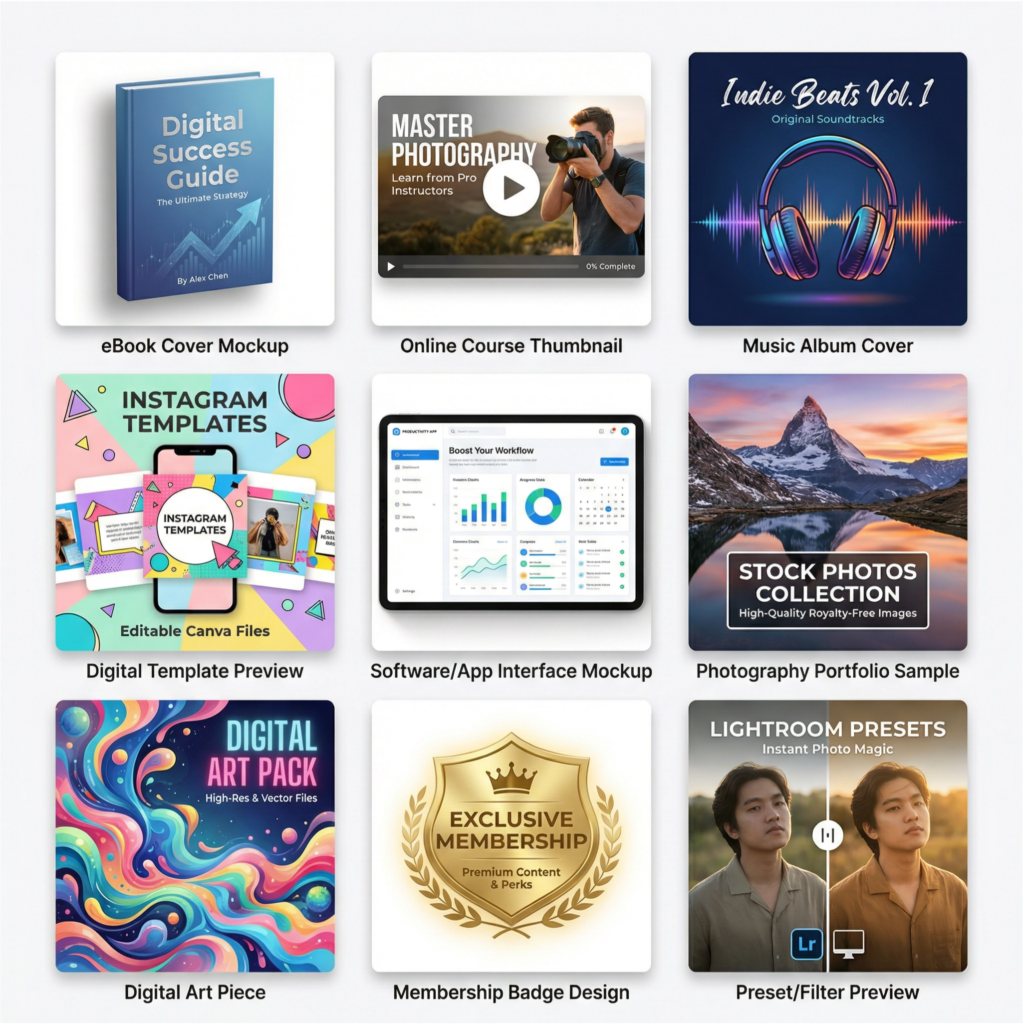
The short answer is: almost anything digital! Gumroad is incredibly versatile, which is one of the reasons it’s among the best platforms to sell digital products. Here’s a taste of what you can sell:
- eBooks and Guides: Share your knowledge, your stories, or your expertise in a beautifully formatted eBook. Whether you’re writing a novel, a self-help guide, or a technical manual, Gumroad makes it easy to get your words out into the world.
- Online Courses and Tutorials: Teach a skill with video lessons, downloadable worksheets, and interactive content. You can bundle multiple lessons together and charge a one-time fee, or set up a subscription so students get access to new content every month.
- Templates: From social media graphics and website themes to Notion templates and resume designs, people love templates that save them time. Templates are particularly popular because they require minimal effort to produce but can generate significant revenue.
- Music and Audio: Sell your albums, singles, podcasts, or audiobooks directly to your fans. Musicians especially love Gumroad because it allows them to keep a much higher percentage of their earnings compared to traditional music platforms.
- Software and Apps: If you’re a developer, you can sell your software, plugins, or apps on Gumroad. You can even set up recurring billing for software as a service (SaaS) products.
- Photography and Art: Offer stock photos, digital prints, Procreate brushes, or any other digital art you create. Artists have found tremendous success selling digital assets on Gumroad.
- Memberships and Subscriptions: Build a recurring revenue stream by offering exclusive content to your subscribers. This is one of the most powerful features on Gumroad because it creates predictable, ongoing income.
The top-performing categories on Gumroad are educational content, digital templates, and eBooks. But don’t let that limit you. If you can create it digitally, you can probably sell it on Gumroad. The platform’s flexibility is one of its greatest strengths.
Gumroad’s Pricing Plans
This is where Gumroad really shines, especially for beginners. Unlike many other platforms that charge a monthly subscription fee, Gumroad has a simple, pay-as-you-go model.
You only pay when you make a sale. This means there’s zero upfront cost to get started. You can set up your store, list your products, and you won’t pay a dime until you start making money.
Here’s the breakdown of the fees:
- 10% + $0.50 per transaction: This is the fee for any sales you make through your own website, social media, or direct links. It’s a flat 10% fee, which is incredibly simple and transparent. Let’s say you sell a product for $20. Your fee would be $2 (10%) plus $0.50, totaling $2.50. You’d keep $17.50.
- 30% per transaction: This fee applies when a new customer discovers and buys your product through Gumroad’s “Discover” marketplace. While this fee is higher, it’s essentially a marketing cost. Gumroad is actively promoting your product to its audience, and you’re paying for that exposure.
One of the biggest advantages of Gumroad is that as of January 1, 2025, they are a Merchant of Record. This is a huge deal. It means that Gumroad handles all the sales tax obligations for you, worldwide. You don’t have to worry about VAT, GST, or any other complicated tax stuff. This is a massive headache that Gumroad takes off your plate, allowing you to focus on creating and selling.
When comparing Gumroad to other best platforms to sell digital products, the pricing is definitely competitive, especially for beginners and low-volume sellers. At higher volumes (if you’re making over $900 per month), you might find that platforms with a flat monthly fee are more cost-effective. But for most creators, Gumroad’s transparent, pay-as-you-go pricing is hard to beat.
Etsy – Best Platforms to Sell Digital Products

Etsy isn’t just another e-commerce platform; it’s a global marketplace with a massive, built-in audience. In 2023, Etsy had over 96 million active buyers. That’s nearly 100 million people who are actively looking to buy unique and creative products. When you set up a shop on Etsy, you’re not starting from scratch. You’re tapping into a river of traffic that’s already flowing.
Think of it like this: building your own website is like opening a shop in the middle of a desert. You have to do all the work to get people to come to you. Setting up a shop on Etsy is like opening a boutique in a bustling, world-famous market. The customers are already there, browsing and ready to buy. Your job is to create a beautiful storefront and amazing products that will catch their eye.
The numbers speak for themselves. Some Etsy sellers are making a full-time income from digital products alone. I’ve seen stories of sellers earning $93,000 in a single year from digital planners, and others who consistently make over $2,000 a month from their digital creations. One Etsy coach even reported that her students have earned a collective $3.3 million from digital downloads. This isn’t just a side hustle; it’s a legitimate business opportunity.
What Kinds of Digital Products Can You Sell on Etsy?
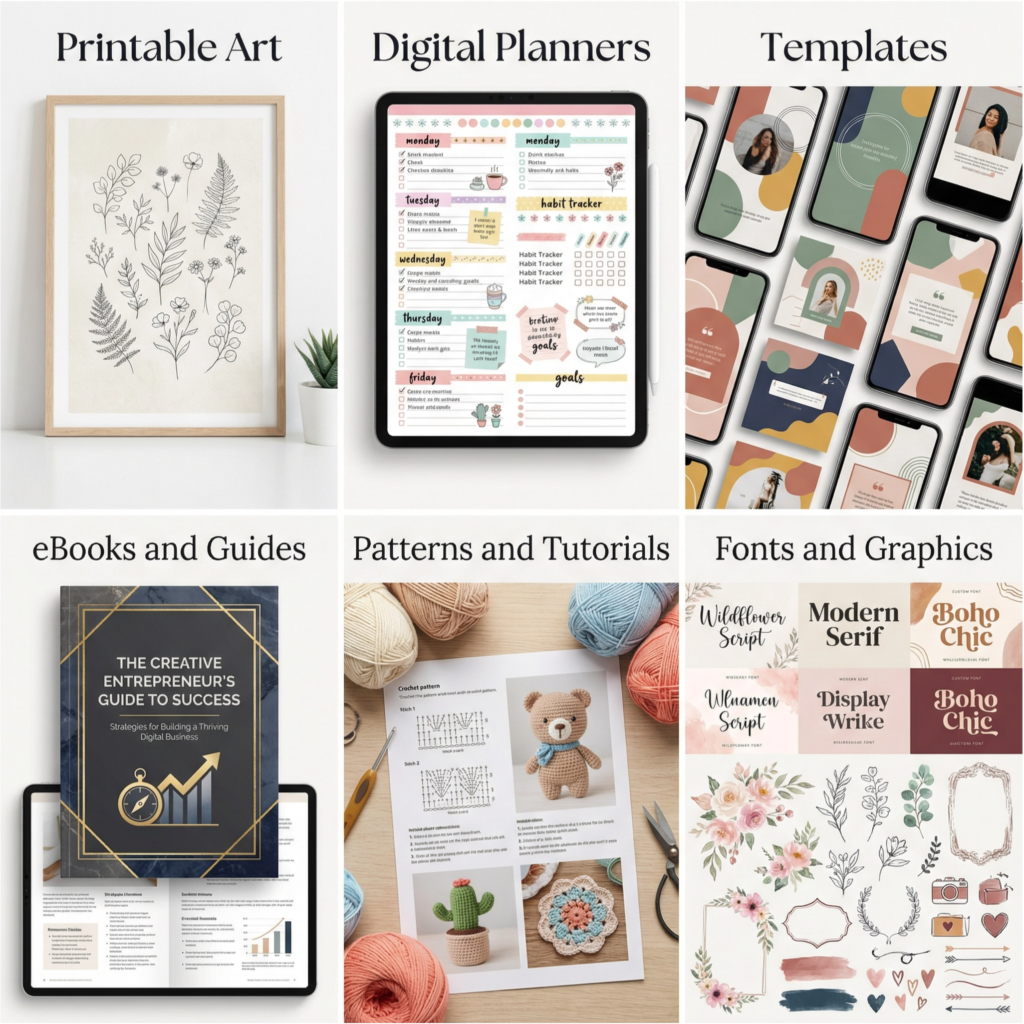
The beauty of Etsy is the sheer variety of digital products you can sell. If you can create it on a computer, you can probably sell it on Etsy. Here are some of the most popular categories to get your creative juices flowing:
- Printable Art: This is a huge category on Etsy. People love to buy beautiful, affordable art that they can print and frame themselves. From minimalist line art to vibrant watercolor paintings, the possibilities are endless.
- Digital Planners and Journals: The planner community is massive, and they’re always looking for new and creative ways to organize their lives. You can sell everything from daily planners and budget trackers to fitness journals and meal planners.
- Templates: People are willing to pay for templates that save them time and effort. This includes social media templates, resume templates, wedding invitations, and business card designs.
- eBooks and Guides: If you have expertise in a particular area, you can package your knowledge into an eBook or a guide. This could be anything from a cookbook to a guide on how to start a small business.
- Patterns and Tutorials: If you’re a crafter, you can sell your patterns and tutorials. This is a great way to monetize your skills without having to sell physical products. Think crochet patterns, sewing patterns, or woodworking plans.
- Fonts and Graphics: If you’re a designer, you can sell your own fonts, clipart, and other design assets. Other creators are always looking for unique graphics to use in their own projects.
How Etsy’s Fees Work for Digital Products
Before you start selling, it’s important to understand how Etsy’s fees work. The fee structure for digital products is the same as for physical products, with the obvious exception of shipping fees.
Here’s a breakdown:
- Listing Fee: It costs $0.20 to list a product on Etsy. This listing is active for four months, or until the item sells. For digital products, the listing automatically renews after each sale, so you’ll be charged the $0.20 renewal fee each time someone buys your product.
- Transaction Fee: Etsy charges a 6.5% transaction fee on the total price of the item. This is a percentage of the price you set for your product.
- Payment Processing Fee: This fee varies by country, but in the US, it’s 3% + $0.25. This fee is for processing the payment through Etsy Payments.
Let’s look at an example. If you sell a digital planner for $10, here’s what the fees would look like:
- Listing Fee: $0.20
- Transaction Fee: $0.65 (6.5% of $10)
- Payment Processing Fee: $0.55 (3% of $10 + $0.25)
- Total Fees: $1.40
- Your Profit: $8.60
While the fees can seem like a lot, remember that you’re paying for access to Etsy’s massive audience and user-friendly platform. For many sellers, the trade-off is well worth it.
Shopify – Best Platforms to Sell Digital Products

Shopify is more than just a website builder; it’s a complete e-commerce solution that powers over a million businesses worldwide. And while it’s known for being a powerhouse for physical products, it’s also an incredibly versatile platform for selling digital goods.
The digital products market is booming, expected to reach a staggering $848 billion by 2030, and Shopify is perfectly positioned to help you claim your piece of the pie.
What sets Shopify apart is the level of control it gives you. You’re not just a seller in someone else’s marketplace; you’re the owner of your own online store. This means you can customize your website to match your brand, build a direct relationship with your customers, and keep a much larger portion of your revenue.
The profit margins for digital products on Shopify can be as high as 90% after fees, which is significantly higher than what you’ll find on most marketplaces.
I’ve seen incredible success stories from Shopify sellers. One couple is making $600,000 a year selling digital products, and others are consistently earning $70,000 to $150,000 a month.
These aren’t outliers; they’re examples of what’s possible when you combine a great product with a powerful platform like Shopify.
What Kinds of Digital Products Can You Sell on Shopify?
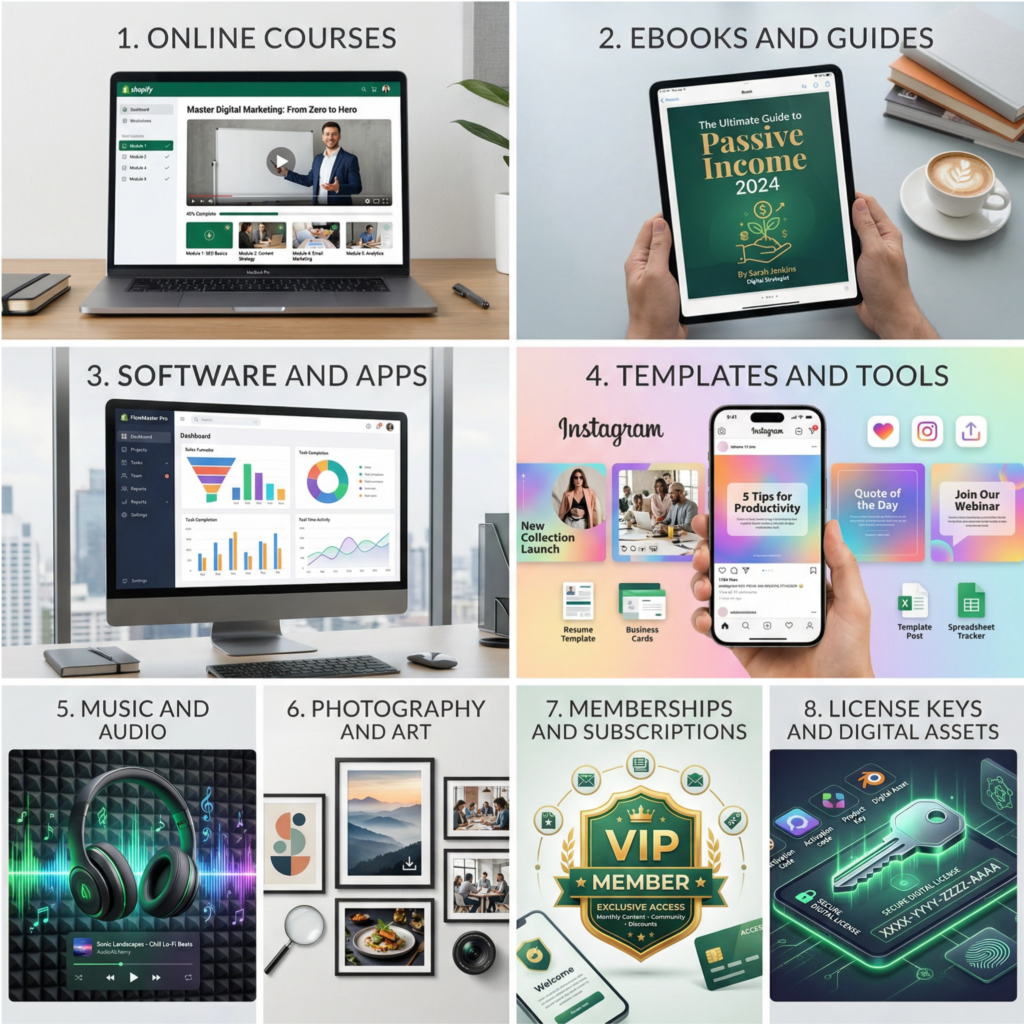
Shopify’s flexibility means you can sell almost any type of digital product imaginable. Here are some of the most popular and profitable categories:
- Online Courses and Workshops: Package your expertise into a comprehensive online course. You can sell video lessons, tutorials, and workshops on any topic you’re passionate about.
- eBooks and Guides: Write an eBook or a guide on a topic you know inside and out. This is a great way to establish yourself as an expert in your field and generate passive income.
- Software and Apps: If you’re a developer, you can sell your software, apps, and license keys directly to customers through your Shopify store.
- Templates and Tools: People love products that save them time and effort. You can sell everything from website themes and social media templates to project management tools and Notion templates.
- Music and Audio: Musicians and podcasters can sell their music, albums, and audio files directly to their fans, keeping a much larger portion of the revenue than they would on streaming platforms.
- Photography and Art: Sell your stock photos, digital prints, and other artistic creations. You can even use a print-on-demand app to sell physical versions of your art without having to worry about inventory or shipping.
- Memberships and Subscriptions: Build a recurring revenue stream by offering exclusive content to your subscribers. This could be a private community, a monthly newsletter, or access to a library of premium content.
Customizing Your Shopify Store for Digital Products
While Shopify is a powerful platform out of the box, its true strength lies in its extensive app store. There are thousands of apps that can help you customize your store and add new features. For digital product sellers, there are a few must-have apps that will make your life a whole lot easier.
Shopify’s own Digital Downloads app is a great place to start. It’s free, and it allows you to easily upload and sell digital files. However, if you’re serious about your business, you’ll want to invest in a more powerful app that offers more features and better security. Here are some of the best apps for selling digital products on Shopify:
- Digitally: This is one of the most popular and feature-rich apps for selling digital products. It offers secure file delivery, PDF stamping to prevent piracy, download limits, and detailed analytics.
- SendOwl: SendOwl is another powerful app that’s packed with features. It’s great for businesses that sell a variety of digital products, and it offers advanced features like video streaming and drip content.
- Courses: If you’re selling online courses, this app is a must-have. It allows you to create and sell courses directly from your Shopify store, with features like quizzes, certificates, and student management.
- Sky Pilot: This app is perfect for businesses that want to sell memberships and subscriptions. It allows you to create a recurring revenue stream by offering exclusive content to your subscribers.
These are just a few examples, but there are apps for almost everything you can imagine. From email marketing and social media integration to accounting and customer support, the Shopify App Store has you covered.
Teachable – Best Platforms to Sell Digital Products

Teachable is more than just a place to upload your videos; it’s a comprehensive platform that’s built to help you succeed. The platform is designed with the creator in mind, and it’s packed with features that make it easy to build a beautiful and engaging online course.
One of the biggest advantages of Teachable is that it handles all the technical stuff for you. You don’t have to worry about hosting, payment processing, or tax compliance; Teachable takes care of it all, so you can focus on what you do best: creating amazing content.
The success stories from Teachable creators are truly inspiring. Take Abagail Pumphrey, for example. She built a 7-figure business on Teachable with over 30,000 students. She made her first $100,000 in just 8 months and then doubled it 4 months later. And she’s not alone.
In 2020 alone, Teachable creators earned close to $400 million and launched over 154,500 new courses. These numbers show what’s possible when you have a great product and a powerful platform to back you up.
What Can You Sell on Teachable?
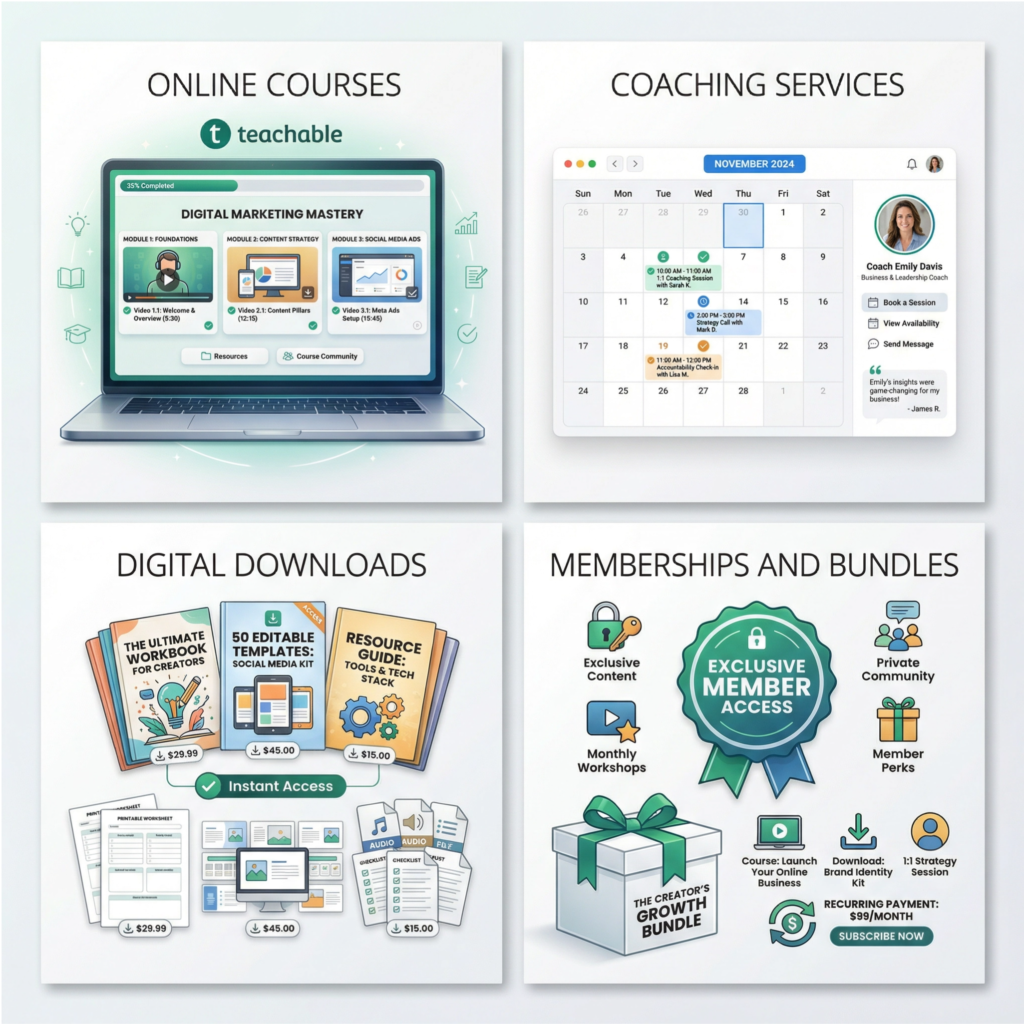
While Teachable is best known for online courses, it’s a versatile platform that allows you to sell a variety of digital products. Here’s a look at what you can create and sell on Teachable:
- Online Courses: This is Teachable’s bread and butter. You can create comprehensive courses with video lessons, quizzes, assignments, and more. The drag-and-drop course builder makes it incredibly easy to organize your content and create a professional-looking course.
- Coaching: Offer one-on-one coaching sessions to your students. You can schedule and manage your coaching sessions directly through the Teachable platform.
- Digital Downloads: Sell standalone digital products like eBooks, templates, worksheets, and other resources. This is a great way to offer additional value to your students and generate extra income.
- Memberships and Bundles: Create a recurring revenue stream by offering a membership that gives students access to exclusive content. You can also bundle your courses and other digital products together to create high-value packages.
Teachable’s Pricing Plans
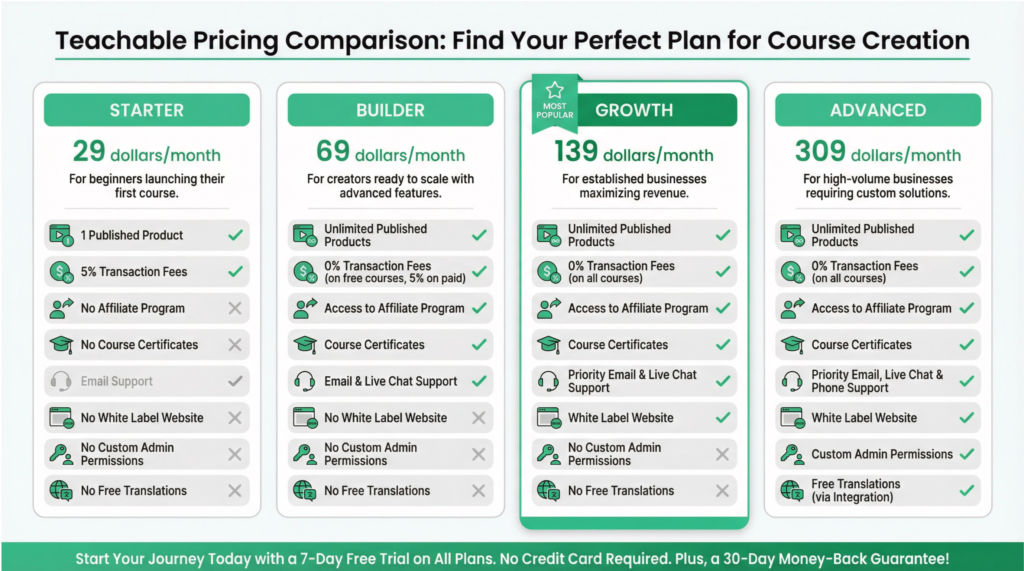
Teachable offers a range of pricing plans to fit every budget and business size. Here’s a quick overview of their plans:
- Starter Plan ($29/month): This plan is perfect for beginners who are just getting started. It allows you to publish one product and has a 7.5% transaction fee.
- Builder Plan ($69/month): This is a great option for creators who are ready to build out their business. It allows you to publish up to 5 products and has a 0% transaction fee.
- Growth Plan ($139/month): This is Teachable’s most popular plan. It allows you to publish up to 25 products and comes with advanced features like an affiliate program and course certificates. It also has a 0% transaction fee.
- Advanced Plan ($309/month): This plan is for established creators who are ready to scale their business. It allows you to publish up to 100 products and comes with even more advanced features.
All plans come with a 7-day free trial and a 30-day money-back guarantee, so you can try them out risk-free.
Thinkific – Best Platforms to Sell Digital Products

Thinkific is more than just a platform; it’s a partner in your success. The platform is designed to help yTou grow your business, and it’s packed with features that make it easy to create and sell your courses.
One of the biggest advantages of Thinkific is that it doesn’t charge any transaction fees. That means you get to keep more of your hard-earned money. And with its unlimited courses on all plans, you can create as much content as you want without having to worry about hitting any limits.
The success stories from Thinkific creators are truly inspiring. Take Jeff Ellis, a Grammy-winning engineer, for example. He built a 6-figure course business on Thinkific with his “Mixer Brain” course. And then there’s Virtual Vivian, who generated $400,000 teaching people how to become virtual assistants. These stories show what’s possible when you have a great product and a powerful platform to back you up.
What Can You Sell on Thinkific?
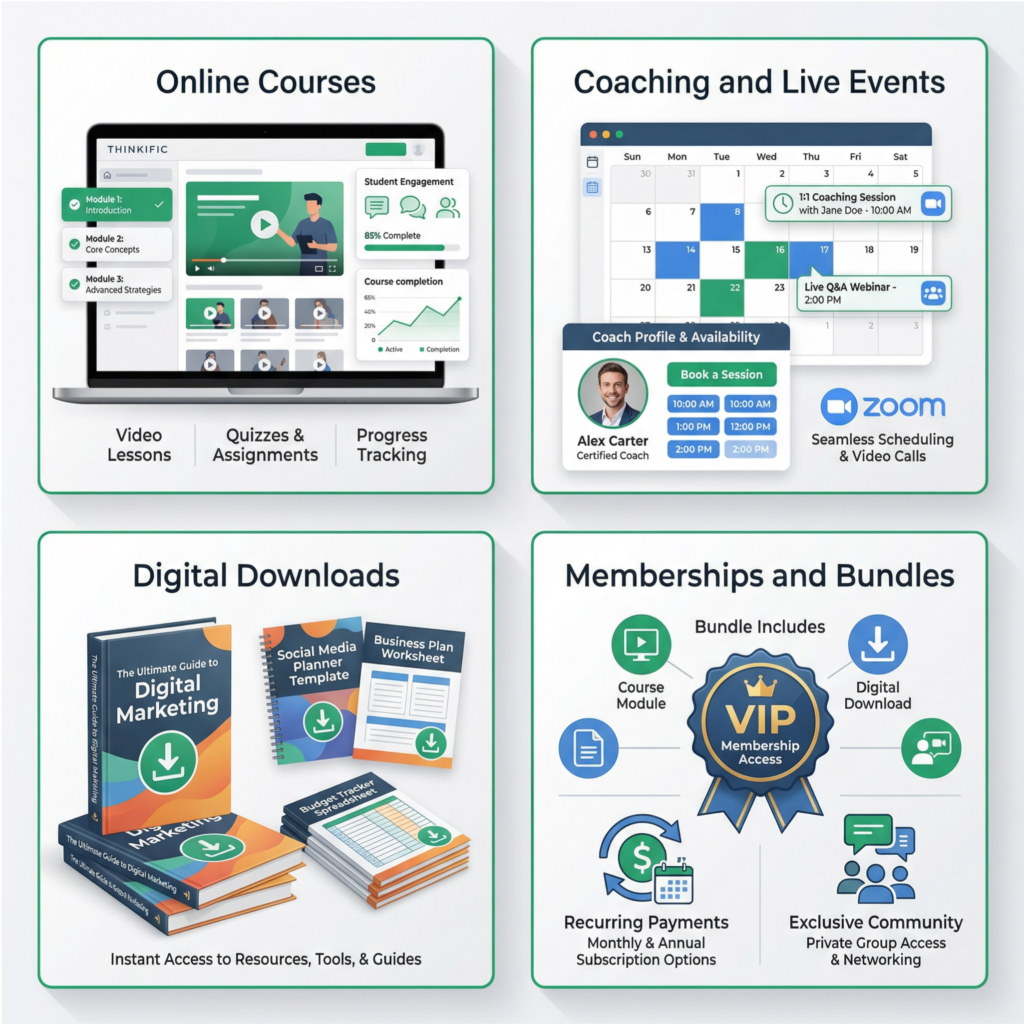
Thinkific is a versatile platform that allows you to sell a variety of digital products. Here’s a look at what you can create and sell on Thinkific:
- Online Courses: This is Thinkific’s specialty. You can create comprehensive courses with video lessons, quizzes, assignments, and more. The drag-and-drop course builder makes it incredibly easy to organize your content and create a professional-looking course.
- Coaching and Live Events: Offer one-on-one coaching sessions and host live events with Thinkific’s Zoom integration.
- Digital Downloads: Sell standalone digital products like eBooks, templates, worksheets, and other resources.
- Memberships and Bundles: Create a recurring revenue stream by offering a membership that gives students access to exclusive content. You can also bundle your courses and other digital products together to create high-value packages.
Thinkific’s Pricing Plans
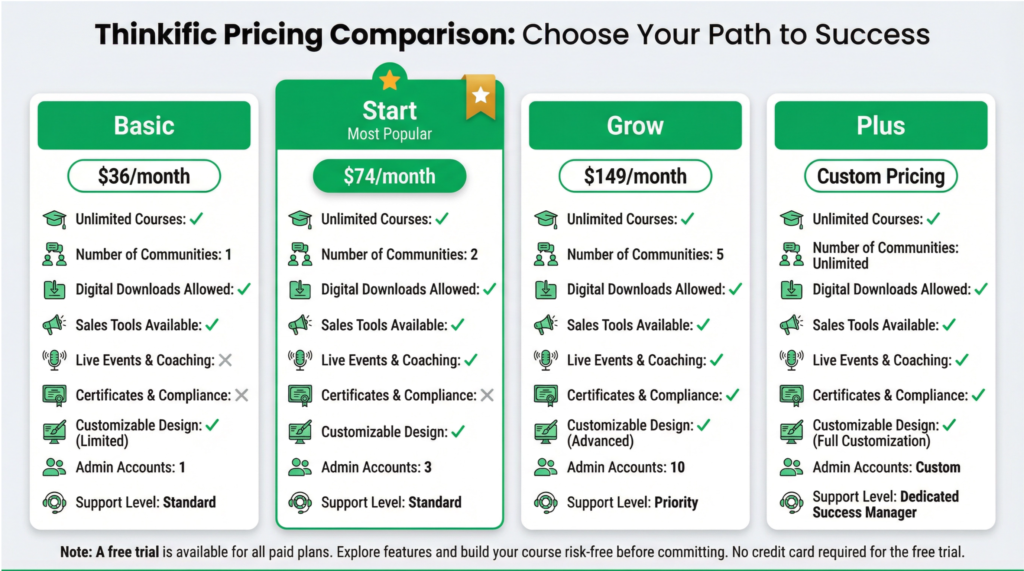
Thinkific offers a range of pricing plans to fit every budget and business size. Here’s a quick overview of their plans:
- Basic Plan ($36/month): This plan is perfect for beginners who are just getting started. It comes with all the basic features you need to create and sell your first course.
- Start Plan ($74/month): This is Thinkific’s most popular plan. It comes with advanced features like memberships and bundles, and it’s a great option for creators who are ready to build out their business.
- Grow Plan ($149/month): This plan is for established creators who are ready to scale their business. It comes with even more advanced features, like the ability to remove Thinkific branding and access to the API.
- Plus Plan (Custom Pricing): This plan is for high-volume businesses and comes with a dedicated success manager and advanced features like a branded mobile app.
All plans come with a free trial, so you can try them out risk-free.
AppSumo – Best Platforms to Sell Digital Products

AppSumo is a game-changer because it solves one of the biggest problems that entrepreneurs face: getting their products in front of a large and engaged audience.
With over a million monthly visitors, AppSumo gives you instant access to a massive pool of potential customers. And because the AppSumo audience is made up of entrepreneurs, you know that you’re reaching people who are actively looking for tools and resources to help them grow their businesses.
The success stories from AppSumo are truly incredible. One company made a staggering $990,000 in revenue in just one month after launching on AppSumo. Another team made $200,000 in sales in just two months. And it’s not just the big companies that are finding success on AppSumo. One indie hacker earned $60,000 in net revenue over 15 months. These stories show what’s possible when you have a great product and a powerful platform to back you up.
What Can You Sell on AppSumo?
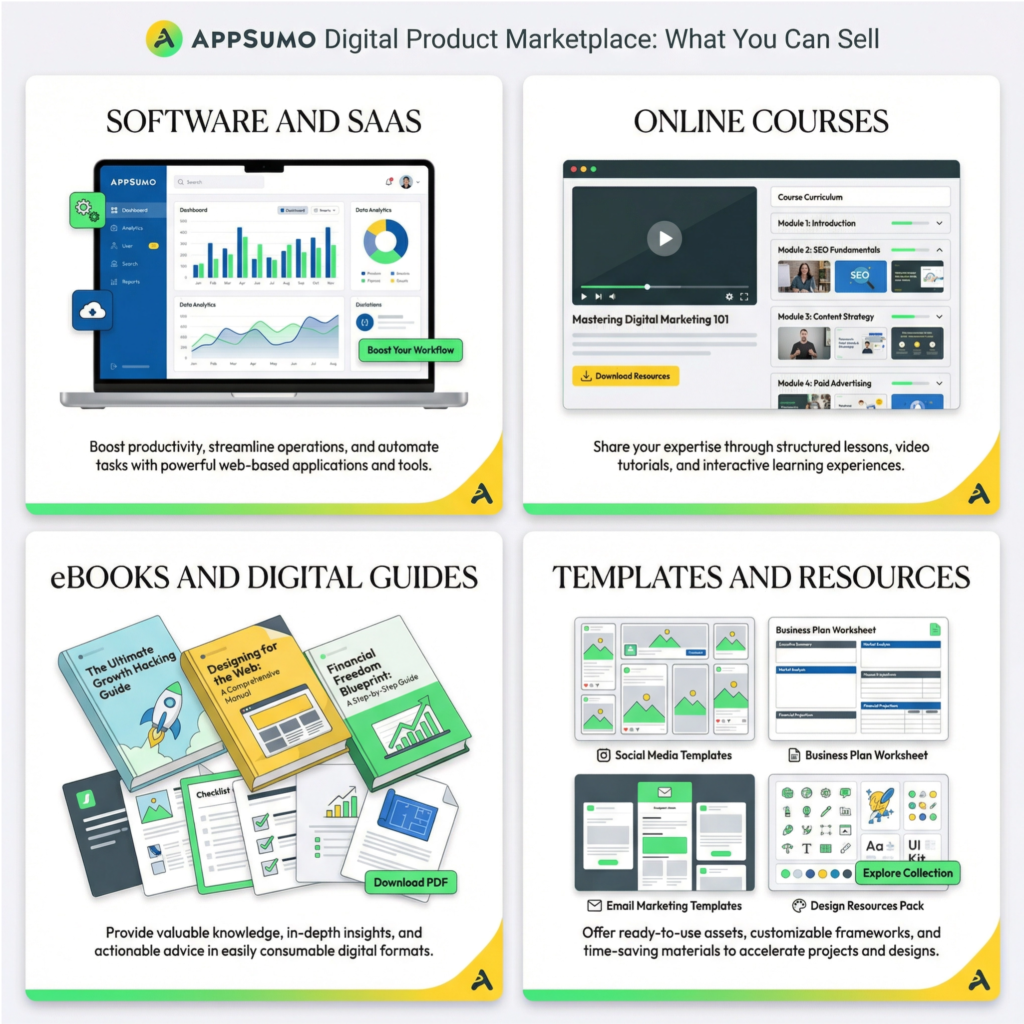
AppSumo is a marketplace for all kinds of digital products. Here’s a look at what you can sell on AppSumo:
- Software and SaaS: This is AppSumo’s bread and butter. If you’ve built a software tool or a SaaS product, AppSumo is the perfect place to launch it.
- Online Courses: Share your expertise with the world by selling your online courses on AppSumo.
- eBooks and Digital Guides: If you’ve written an eBook or a digital guide, you can sell it on AppSumo.
- Templates and Resources: Sell your templates, worksheets, and other digital resources on AppSumo.
If you’re looking for a platform that gives you complete control over your branding and your customer relationships, you might be better off with a platform like Shopify or Teachable. But if you’re looking for a platform that can help you get massive exposure and sales, AppSumo is the way to go.
Skillshare – Best Platforms to Sell Digital Products

Skillshare is a great choice for course creators because it gives you access to a massive and engaged audience of learners who are actively looking for new skills to learn and are willing to pay for quality education.
With millions of students worldwide browsing the platform every single day, Skillshare provides a ready-made market for your courses, which means you don’t have to spend months or years building your own audience from scratch like you would with your own website.
And because it’s a subscription-based platform where Skillshare handles all the marketing, payment processing, and student acquisition, you don’t have to worry about marketing your courses to individual students or dealing with complicated payment systems.
You just need to create great content that helps students learn valuable skills, and Skillshare will do the rest by promoting your classes to their massive user base and handling all the technical details.
The earning potential on Skillshare is also impressive when you consider that you’re earning passive income from content you create once but can sell forever. The top 10% of Skillshare instructors earned more than $42,000 in 2024, which shows that there’s real money to be made if you create high-quality classes that students love and want to watch.
Most teachers earn between $200 to $3,000 per month, which might not sound like a fortune, but it’s a nice side income that can grow over time as you create more classes and build your reputation on the platform. And with the new engagement rewards program that Skillshare introduced to encourage teachers to create better content and engage more with their students, you can earn even more by creating high-quality classes and engaging with your students through feedback and community discussions.
Top Teachers who have proven themselves as exceptional educators can earn $250 per positive review they receive from satisfied students, and Rising Teachers who are newer but showing great promise can earn $100 per positive review, which adds up quickly if you’re creating content that truly helps people learn.
What Can You Teach on Skillshare?
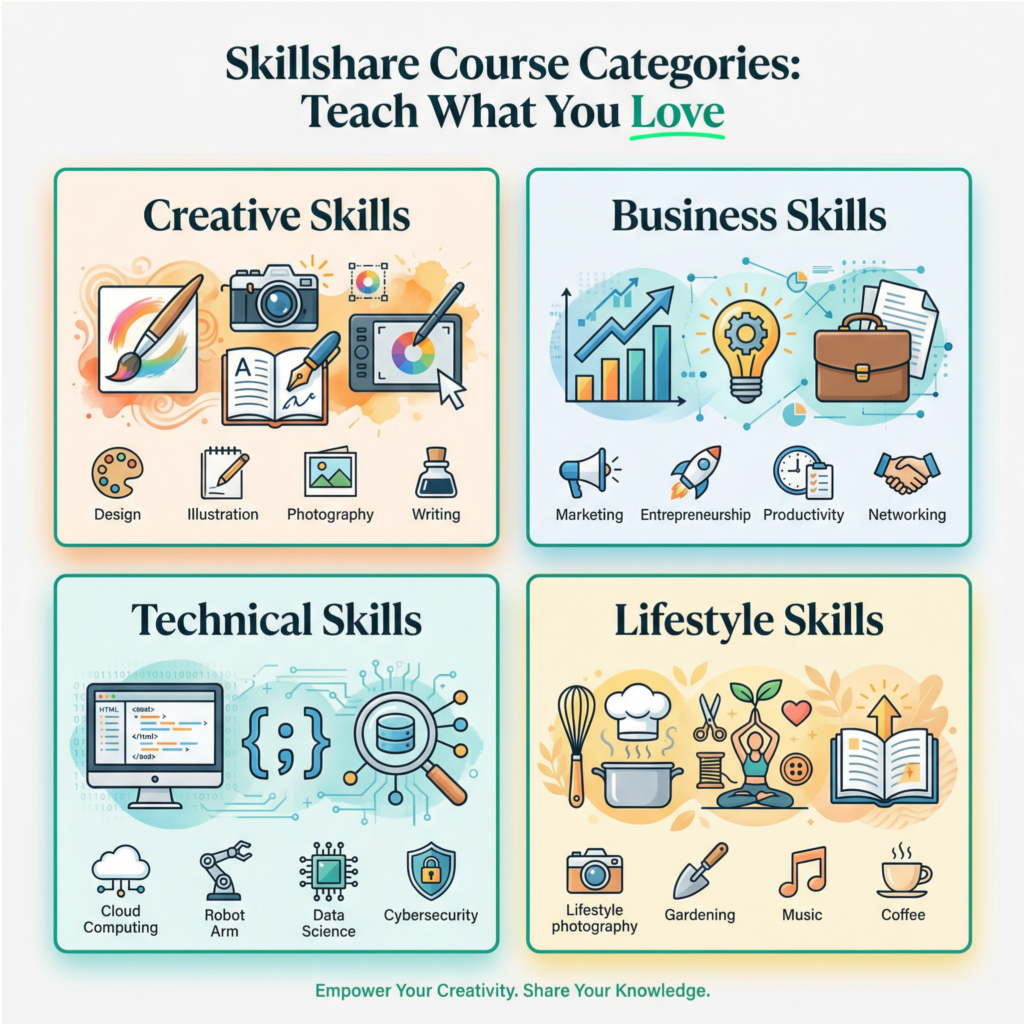
Skillshare is a platform for all kinds of creative and practical skills, which means if you have expertise in almost any area that can be taught through video lessons, you can probably create a successful class on Skillshare.
The platform is particularly strong in creative fields like design, art, and photography, but it’s also expanding into business, technology, and lifestyle categories as more students look for practical skills they can use in their careers and daily lives.
Here’s a detailed look at what you can teach on Skillshare and the types of classes that tend to perform well on the platform:
Creative Skills are the bread and butter of Skillshare, and this is where the platform really shines with thousands of classes covering every creative discipline you can imagine.
You can teach design skills like graphic design, logo design, brand identity, user interface design, and user experience design, or illustration skills like digital illustration, character design, watercolor painting, ink drawing, and procreate techniques.
Photography is another huge category where you can teach everything from photography basics and portrait photography to photo editing in Lightroom and Photoshop, and writing skills like creative writing, copywriting, content writing, and storytelling are always in high demand from students who want to improve their communication skills.
Business Skills are growing rapidly on Skillshare as more entrepreneurs and professionals look for practical knowledge they can apply immediately to their careers.
You can teach marketing skills like social media marketing, email marketing, content marketing, and SEO, or entrepreneurship topics like starting a business, building a brand, finding your niche, and scaling your income.
Productivity and time management classes are also popular because everyone wants to get more done in less time, and you can teach students how to use tools like Notion, Asana, or Trello to organize their lives and work more efficiently.
Technical Skills are another growing category on Skillshare, especially as more people want to learn coding, web development, and data skills to advance their careers or start new ones.
You can teach web development skills like HTML, CSS, JavaScript, React, and WordPress, or mobile development using tools like Swift for iOS or Kotlin for Android.
Data science and analytics classes are also in demand, where you can teach students how to use Python, R, Excel, or SQL to analyze data and make better decisions in their businesses or careers.
Lifestyle Skills round out the Skillshare catalog with classes on topics that help people live better, healthier, and more fulfilling lives.
You can teach cooking skills like baking, meal prep, international cuisine, or specific techniques like knife skills or fermentation, or crafting skills like knitting, crocheting, embroidery, jewelry making, and woodworking.
Wellness and personal development classes are also popular, where you can teach meditation, yoga, mindfulness, goal setting, or building better habits that stick.
Amazon Kindle – Best Platforms to Sell Digital Products

Amazon KDP is a game-changer for authors because it gives you direct access to the world’s largest community of readers who are actively searching for new books to read every single day.
With millions of Kindle readers around the world browsing Amazon’s massive digital bookstore, Amazon KDP provides a massive and engaged audience for your books that would be impossible to reach on your own.
And because it’s a completely free platform with no upfront costs, no subscription fees, and no hidden charges, there’s absolutely no financial risk involved, which means you can publish your book without spending a dime and you’ll start earning royalties immediately from the very first sale.
The earning potential on Amazon KDP is also impressive when you consider that you’re building a passive income stream that can continue generating revenue for years after you publish your book.
While many authors earn around $150 per month when they’re just starting out and building their audience, top sellers can earn over $20,000 per month from their book sales, and some successful authors even earn six or seven figures per year from their Amazon KDP publishing businesses.
And with the Kindle Unlimited program where subscribers pay a monthly fee for unlimited access to a vast library of eBooks, you can earn even more by making your book available to millions of subscribers who can read your book for free while you earn money based on the number of pages they read.
Think of Amazon KDP like having your own bookstore on the busiest street corner in the world. Instead of hoping readers will stumble upon your book in a small local bookstore, you’re placing your book in front of millions of potential readers who are actively searching for books just like yours. That’s the power of Amazon’s massive reach and distribution network.
What Can You Publish on Amazon KDP?
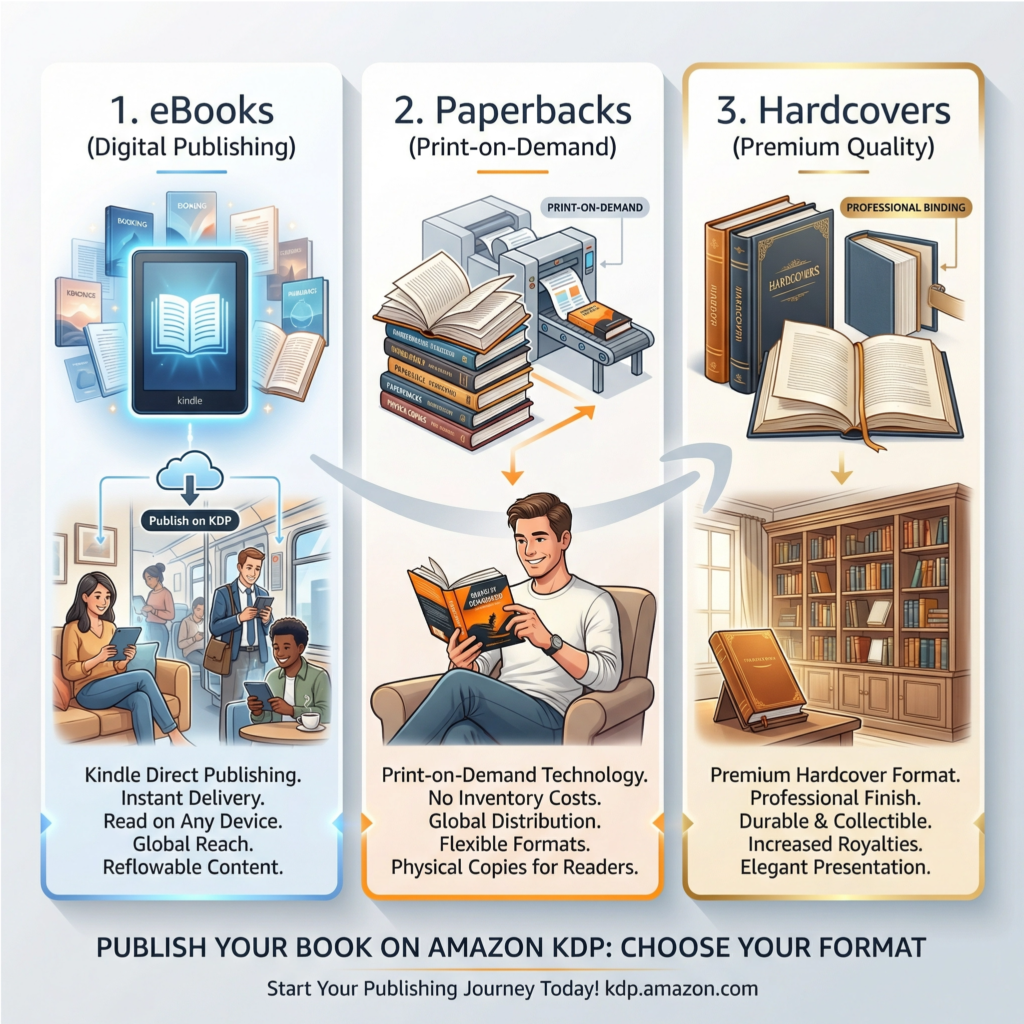
Amazon KDP is a versatile platform for all kinds of books, which means whether you’re a fiction writer, non-fiction expert, poet, or children’s book author, you can find success on the platform.
Here’s a detailed look at what you can publish on Amazon KDP and the different formats available to you:
eBooks are the most popular format on Amazon KDP because they’re easy to create, have no printing costs, and can be delivered instantly to readers anywhere in the world.
You can publish your book as a Kindle eBook and reach millions of Kindle readers around the world who read on Kindle devices, tablets, smartphones, and computers.
eBooks are perfect for fiction, non-fiction, self-help, business books, and any other type of content that can be read digitally.
The best part is that eBooks have the highest profit margins because there are no printing or shipping costs, which means you keep more of the money from each sale.
Paperbacks are also available on Amazon KDP through their print-on-demand service, which means you can also publish your book as a physical paperback and sell it on Amazon.com without having to worry about inventory, storage, or shipping.
Amazon will print your book on demand whenever a customer orders it, which means you never have to pay for printing upfront or worry about unsold inventory sitting in your garage.
This is perfect for readers who prefer physical books and want to hold your book in their hands, and it also gives you more credibility as an author because you have a “real” physical book.
Hardcovers are the premium option on Amazon KDP, and you can also publish your book as a hardcover and sell it on Amazon.com for readers who want a high-quality, durable, and collectible version of your book.
Hardcovers typically sell for a higher price than paperbacks, which means you can earn more per sale, and they’re perfect for special editions, gift books, or books that readers want to keep on their shelves for years to come.
Understanding Amazon KDP’s Royalty Structure
One of the most important things to understand about Amazon KDP is the royalty structure, which determines how much money you’ll earn from each sale of your book. Amazon offers two different royalty options, and choosing the right one can make a huge difference in your earnings.
The 35% Royalty Option is available for books priced at any price point, including books priced below $2.99 or above $9.99. With this option, you’ll earn 35% of the list price of your book on each sale, which means if you price your book at $4.99, you’ll earn about $1.75 per sale (35% of $4.99). This option is good for promotional pricing when you want to offer your book at a very low price to attract new readers, or for books that include public domain material that isn’t eligible for the higher royalty rate.
The 70% Royalty Option is available for books priced between $0.99 and $9.99, and it’s the most popular option for serious authors who want to maximize their earnings. With this option, you’ll earn 70% of the list price of your book minus a small delivery fee (usually a few cents), which means if you price your book at $4.99, you’ll earn about $3.45 per sale (70% of $4.99 minus the delivery fee). This is significantly more than the 35% option, which is why most authors price their books in the $2.99 to $9.99 range to take advantage of the higher royalty rate.
The sweet spot for pricing on Amazon KDP is typically between $2.99 and $4.99, which gives you the 70% royalty rate while still keeping your book affordable for readers. Many successful authors price their first book in a series at $0.99 or $2.99 to attract new readers, and then price the subsequent books at $3.99 or $4.99 to maximize their earnings once readers are hooked on the series.
Fourthwall – Best Platforms to Sell Digital Products

Fourthwall is a game-changer for creators because it’s an all-in-one platform that gives you everything you need to build a successful online business without requiring you to be a tech expert or spend thousands of dollars on setup costs.
With Fourthwall, you can sell digital products, physical merchandise, and memberships, all from one beautiful and customizable storefront that reflects your unique brand identity.
And because it’s a platform built specifically for creators, it’s packed with features that will help you grow your audience and your income, from social media integrations that let you sell directly on YouTube, Instagram, and TikTok, to powerful analytics that help you understand your customers and make data-driven decisions.
One of the biggest advantages of Fourthwall is that it’s completely free to get started, which means you can launch your online store without any upfront investment or monthly fees eating into your profits before you even make your first sale.
The Free plan gives you everything you need to build a beautiful storefront and start selling your products, with no monthly fees and no hidden costs, just a small percentage when you make a sale.
And when you’re ready to take your business to the next level and unlock even more powerful features, you can upgrade to the Pro plan for just $15 per month (billed yearly) and get access to incredible benefits like no fees on digital products, a free .store domain, $120 of free sample credit per year, and priority 24/7 customer support.
According to Fourthwall’s own data, over 200,000 creators are already using the platform to monetize their audiences and build successful online businesses, which is a testament to how effective and user-friendly the platform is for creators of all sizes and niches.
What Can You Sell on Fourthwall?
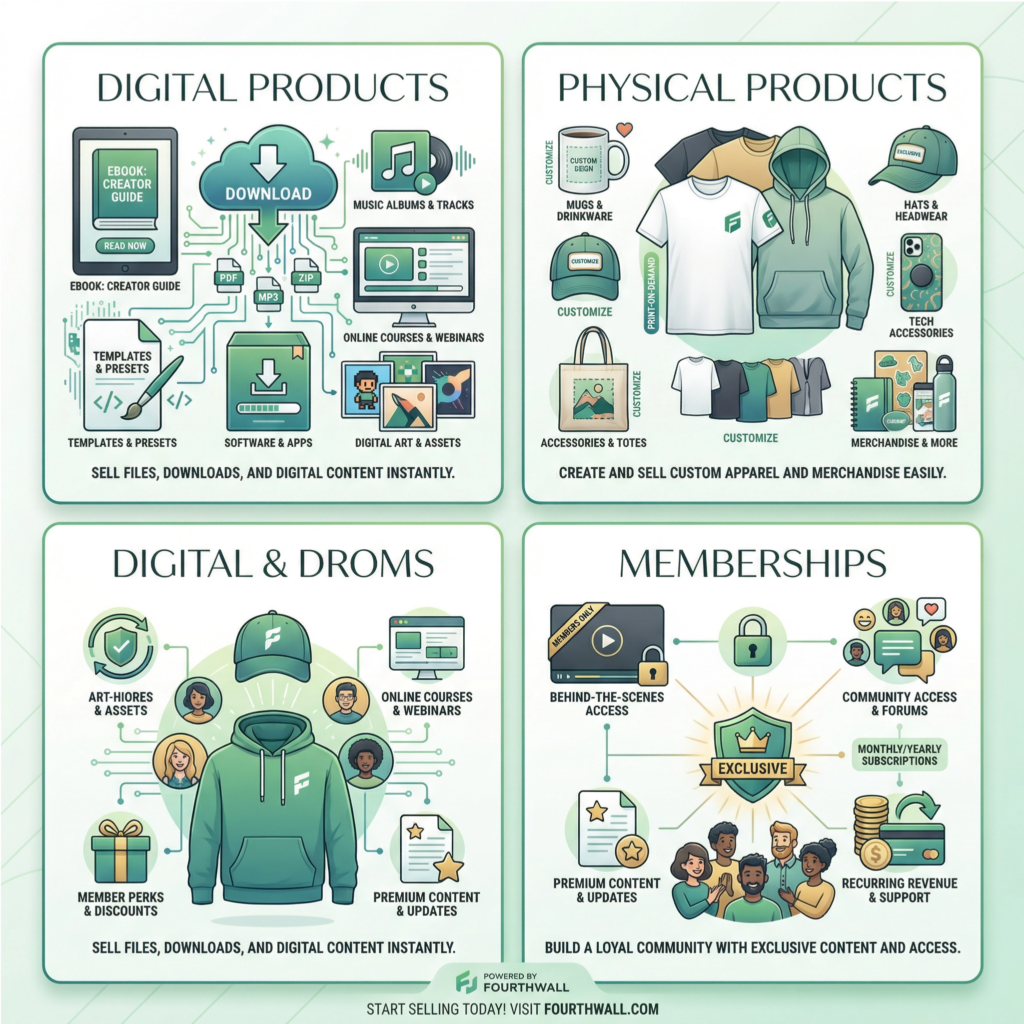
Fourthwall is an incredibly versatile platform that lets you sell a wide range of products, giving you the flexibility to create multiple revenue streams and maximize your earning potential.
Here’s a detailed look at what you can sell on Fourthwall and how each product type can help you build a thriving online business:
Digital Products: You can sell any type of digital product on Fourthwall, from eBooks and online courses to music, software, templates, digital art, presets, and any other digital files you can imagine.
The beauty of digital products is that you create them once and can sell them unlimited times without any inventory costs, shipping fees, or production delays, which means your profit margins can be incredibly high.
And with the Pro plan, you’ll pay absolutely no fees on digital product sales (aside from standard payment processing fees), so you get to keep 100% of your revenue minus the small payment processing fee, which is the same 2.9% + $0.30 that platforms like Shopify charge.
Think about it like this: if you’re a fitness coach, you could sell workout plans, meal prep guides, and training videos; if you’re a graphic designer, you could sell templates, fonts, and design assets; if you’re a musician, you could sell your albums, individual tracks, and exclusive remixes; if you’re a photographer, you could sell Lightroom presets and editing tutorials.
The possibilities are truly endless, and because digital products have no overhead costs, every sale is almost pure profit.
Physical Products: You can also sell physical products on Fourthwall, from t-shirts and hoodies to mugs, phone cases, hats, jewelry, and so much more.
Fourthwall has a catalog of over 200 premium products that you can customize with your own designs, and they’ll handle all the printing, fulfillment, and shipping for you through their print-on-demand service, which means you never have to worry about inventory, storage, or shipping logistics.
This is a game-changer for creators who want to offer merchandise to their fans without the hassle and financial risk of ordering bulk inventory upfront.
The print-on-demand model means that products are only created when a customer places an order, so you never have to invest money in inventory that might not sell, and you never have to deal with the headache of packing and shipping orders yourself.
Fourthwall takes care of all of that for you, including customer service for product-related issues, so you can focus on creating content and promoting your products.
Memberships: You can also offer memberships on Fourthwall and create a recurring revenue stream for your business, which is one of the most powerful ways to build a sustainable income as a creator.
With memberships, you can offer exclusive content, members-only products, behind-the-scenes access, early access to new releases, and even a custom mobile app for your members that’s available on both iOS and Android.
Memberships are powerful because they create predictable, recurring revenue that you can count on every month, unlike one-time product sales that can be unpredictable.
If you have 100 members paying $10 per month, that’s $1,000 in guaranteed monthly revenue before you even sell a single product.
And as you grow your membership base, that recurring revenue grows with you, creating financial stability and allowing you to invest more in your content and your business.
Fourthwall Pricing
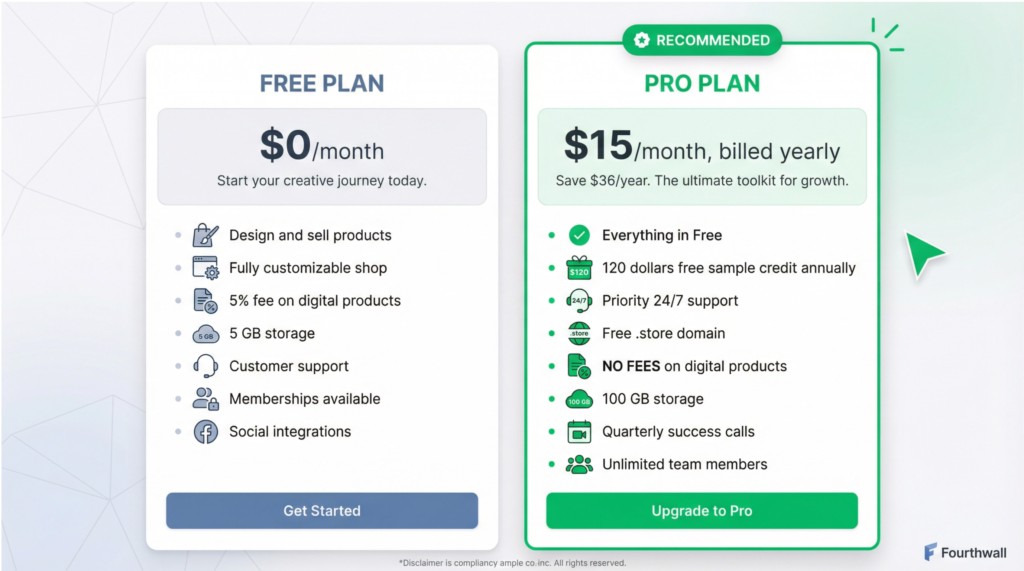
One of the most attractive aspects of Fourthwall is its pricing structure, which is designed to be accessible to creators at every stage of their journey.
Let’s break down the two pricing plans and what you get with each:
Free Plan ($0/month): Everything You Need to Get Started
The Free plan is perfect for creators who are just starting out or who want to test the platform before committing to a paid plan.
With the Free plan, you get access to all the core features you need to build and launch your online store, including the ability to design and sell high-quality products, a fully customizable shop with no coding required, customer support handled by Fourthwall, the ability to offer monthly memberships, promo codes and discounts, social media integrations, and easy-to-use analytics and reports.
The only fees on the Free plan are a 5% fee on digital product sales (with a 5 GB storage limit for digital files) and a 5% fee on membership revenue. Physical products from the Fourthwall catalog have no platform fees; you simply pay the base cost of the product and keep the profit margin you set.
All plans also include standard payment processing fees of 2.9% + $0.30 for US credit card transactions, which is the same rate charged by Shopify and other major ecommerce platforms.
Pro Plan ($15/month billed yearly or $20/month billed monthly)
The Pro plan is designed for creators who are serious about growing their business and want access to premium features that can significantly increase their revenue and streamline their operations.
With the Pro plan, you get everything in the Free plan, plus some incredible benefits that make the $15 monthly investment (when billed yearly) an absolute no-brainer for serious creators.
The Pro plan is especially valuable if you’re selling digital products, because the elimination of the 5% platform fee means you keep significantly more of your revenue, and that difference can add up quickly as your sales grow.
Payhip – Best Platforms to Sell Digital Products

Payhip is a creator’s best friend because it’s an all-in-one platform that simplifies the entire process of selling digital products and building an online business, taking away all the technical headaches and complicated setup processes that usually come with launching an ecommerce store.
With Payhip, you can sell a wide range of products, from digital downloads like eBooks and templates to online courses with video lessons and quizzes, memberships with recurring revenue, and even physical products like custom merchandise, all from one beautiful and fully customizable storefront that reflects your unique brand identity.
And because it’s a platform built specifically for creators rather than large corporations or enterprise businesses, it’s packed with features that will help you grow your audience and your income, from a built-in affiliate system that lets you recruit partners to promote your products to powerful email marketing tools that help you stay connected with your customers and seamless social media integrations that make it easy to share your products with your followers.
One of the biggest advantages of Payhip compared to other platforms is its simple and transparent pricing structure that doesn’t hide any fees or surprise you with unexpected charges.
The Free Forever plan gives you access to all features with no monthly fees whatsoever, just a 5% transaction fee on each sale, which means you only pay when you actually make money.
And as your business grows and your sales volume increases, you can upgrade to the Plus plan at $29 per month with a 2% transaction fee or the Pro plan at $99 per month with no transaction fees at all, giving you the flexibility to choose the plan that makes the most financial sense for your business at any given time.
According to Payhip’s official statistics, over 130,000 sellers are already using the platform to power their businesses and generate income from their digital products, which is a powerful testament to how effective and user-friendly the platform is for creators of all sizes, niches, and experience levels, from complete beginners who are selling their first eBook to established entrepreneurs who are running six-figure businesses.
What Can You Sell on Payhip?
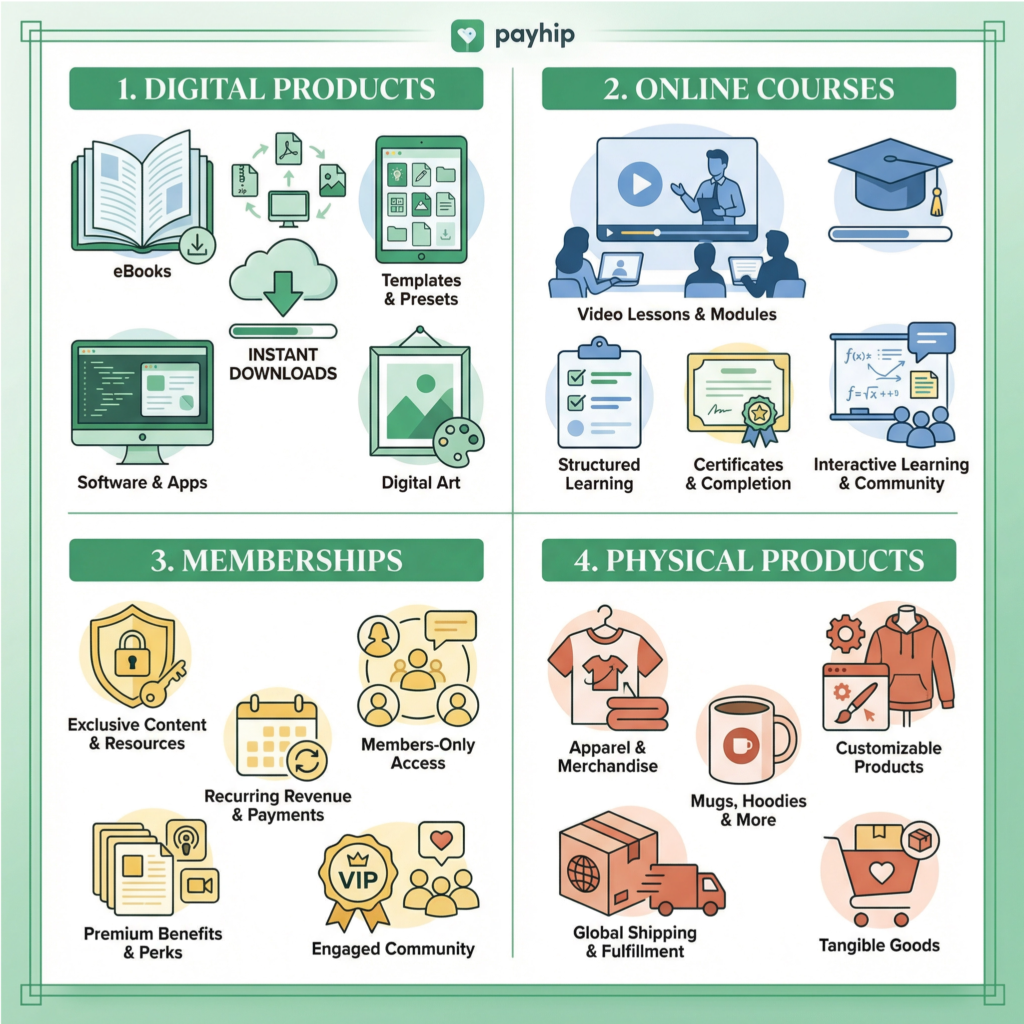
Payhip is an incredibly versatile platform that lets you sell a wide range of products, giving you the flexibility to create multiple revenue streams and maximize your earning potential by diversifying your product offerings and reaching different segments of your audience with products that meet their specific needs and interests.
Here’s a detailed look at what you can sell on Payhip and how each product type can help you build a thriving online business that generates consistent income:
Digital Products: You can sell any type of digital product on Payhip, from eBooks and PDF guides to online courses, music files, software applications, design templates, digital art, Lightroom presets, Photoshop actions, and literally any other digital files you can imagine or create, which gives you unlimited possibilities for monetizing your skills and expertise.
The beauty of digital products is that you create them once and can sell them unlimited times without any inventory costs, shipping fees, or production delays, which means your profit margins can be incredibly high, often reaching 90% or more after you account for platform fees and payment processing costs.
Online Courses: Payhip also has a powerful course builder that lets you create and sell online courses with ease, even if you’ve never created a course before and have no experience with learning management systems or course platforms.
You can create video courses with multiple lessons and modules, text-based courses with written content and downloadable resources, or a combination of both video and text to create a rich and engaging learning experience for your students that caters to different learning styles and preferences.
You can organize your content into modules and lessons to create a structured learning experience that guides your students through your material in a logical and progressive way, and you can also offer quizzes to test your students’ knowledge, assignments to give them hands-on practice, and certificates of completion to reward them for finishing your course and give them something tangible to show for their effort.
Memberships: You can also offer memberships on Payhip and create a recurring revenue stream for your business that provides predictable monthly income you can count on, which is one of the most powerful business models for creators because it creates stability and allows you to plan for the future with confidence.
With memberships, you can offer exclusive content that’s only available to paying members, members-only products at discounted prices, behind-the-scenes access to your creative process, early access to new releases before they’re available to the general public, and even a private community where your members can connect with each other and with you.
Memberships are a powerful way to build a loyal following of superfans who are deeply invested in your success and willing to support you month after month, and they create a predictable income stream that you can count on every month rather than the feast-or-famine cycle that many creators experience with one-time product sales.
Physical Products: In addition to digital products, you can also sell physical products on Payhip, from t-shirts and hoodies to mugs, phone cases, stickers, posters, and more, which allows you to create a complete brand ecosystem where your fans can support you in multiple ways and show their love for your work in the physical world.
You can create custom designs for your products that reflect your brand identity and appeal to your audience, and you can sell them directly from your Payhip store without needing to manage inventory or handle shipping yourself if you use print-on-demand services.
You can manage your inventory and shipping all from one dashboard, and you can even combine physical and digital products in bundles to create unique offerings that give your customers more value and increase your average order value.
Payhip Pricing Plans
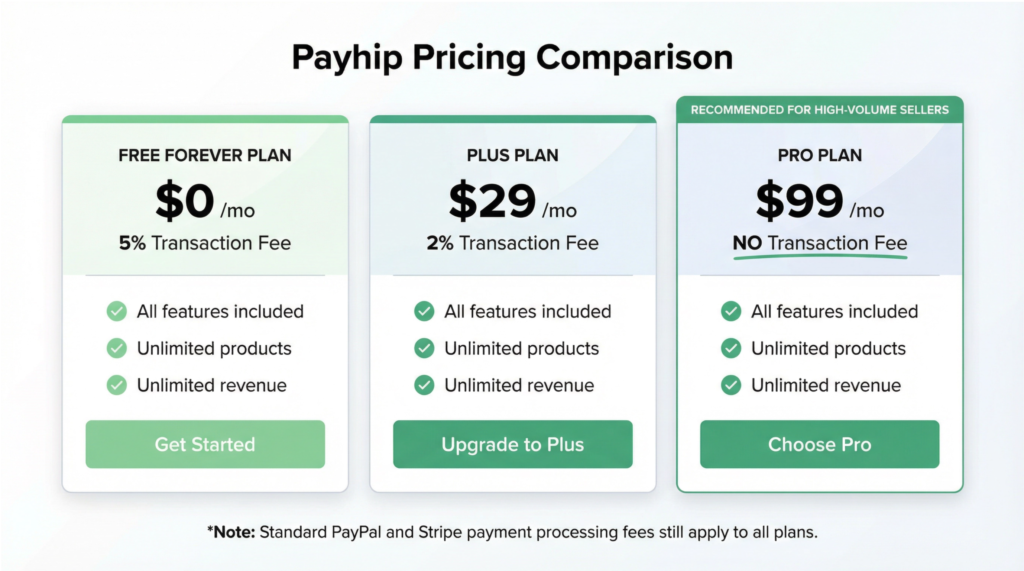
One of the most attractive aspects of Payhip is its simple and transparent pricing structure that’s designed to be accessible to creators at every stage of their journey, from complete beginners who are making their first sale to established entrepreneurs who are generating thousands of dollars in revenue every month.
Let’s break down the three pricing plans in detail and what you get with each one, so you can make an informed decision about which plan is right for your business:
Free Forever Plan ($0/month)
The Free Forever plan is perfect for creators who are just starting out or who want to test the platform before committing to a paid plan, and it’s one of the most generous free plans in the industry because it gives you access to all features without any limitations or feature-gating.
With the Free Forever plan, you get access to all features with no monthly fees whatsoever, just a 5% transaction fee on each sale, which means you can start your business with zero upfront investment and only pay a small percentage when you actually make a sale.
This is a huge advantage compared to platforms like Shopify that require you to pay a monthly fee even if you don’t make any sales, and it’s also better than Gumroad which charges a 10% transaction fee on their free plan, making Payhip’s 5% fee significantly more affordable.
With the Free Forever plan, you get unlimited products, unlimited revenue potential, the ability to sell digital products, courses, memberships, and physical products, access to the affiliate system, email marketing tools, customizable storefront, and all the other features that make Payhip such a powerful platform.
Plus Plan ($29/month)
The Plus plan is designed for creators who are starting to see consistent sales and want to reduce their transaction fees to keep more of their revenue, and it’s a great option if you’re making over $580 in sales per month because the savings on transaction fees will more than cover the monthly subscription cost.
With the Plus plan, you pay a flat monthly fee of $29 and a reduced transaction fee of 2% on each sale, which means you’ll save 3% on every sale compared to the Free Forever plan.
Let’s do the math to see when it makes sense to upgrade to the Plus plan. If you’re making $1,000 in sales per month, you would pay $50 in transaction fees on the Free Forever plan (5% of $1,000) but only $49 on the Plus plan ($29 monthly fee plus 2% of $1,000 which is $20), so you’d save $1 per month.
But if you’re making $2,000 in sales per month, you would pay $100 in transaction fees on the Free Forever plan but only $69 on the Plus plan ($29 monthly fee plus 2% of $2,000 which is $40), so you’d save $31 per month, which adds up to $372 per year in savings.
Pro Plan ($99/month):
The Pro plan is designed for high-volume sellers who want to eliminate transaction fees altogether and keep the maximum amount of revenue from their sales, and it’s a great option if you’re making over $3,300 in sales per month because the savings on transaction fees will be significant and will more than justify the higher monthly subscription cost.
With the Pro plan, you pay a flat monthly fee of $99 and no transaction fees on your sales, which means you keep 100% of your revenue minus only the standard PayPal and Stripe payment processing fees that every platform has to charge.
Let’s do the math again to see when it makes sense to upgrade to the Pro plan. If you’re making $5,000 in sales per month, you would pay $250 in transaction fees on the Free Forever plan (5% of $5,000) but only $99 on the Pro plan (just the monthly fee with no transaction fees), so you’d save $151 per month, which adds up to $1,812 per year in savings.
And if you’re making $10,000 in sales per month, you would pay $500 in transaction fees on the Free Forever plan but only $99 on the Pro plan, so you’d save $401 per month, which adds up to $4,812 per year in savings.
SendOwl – Best Platforms to Sell Digital Products

SendOwl is the go-to platform for serious creators because it’s a powerful and flexible digital sales engine that’s designed to automate your business and help you scale your revenue without adding more work to your plate, which is exactly what every entrepreneur dreams of achieving.
With SendOwl, you can sell a wide range of digital products, from eBooks and online courses to software, subscriptions, and even streaming content, all from your existing website or a custom storefront that you can set up in minutes.
One of the biggest advantages of SendOwl is its predictable and transparent pricing structure that makes it easy to forecast your costs and plan your business growth.
What Can You Sell on SendOwl?
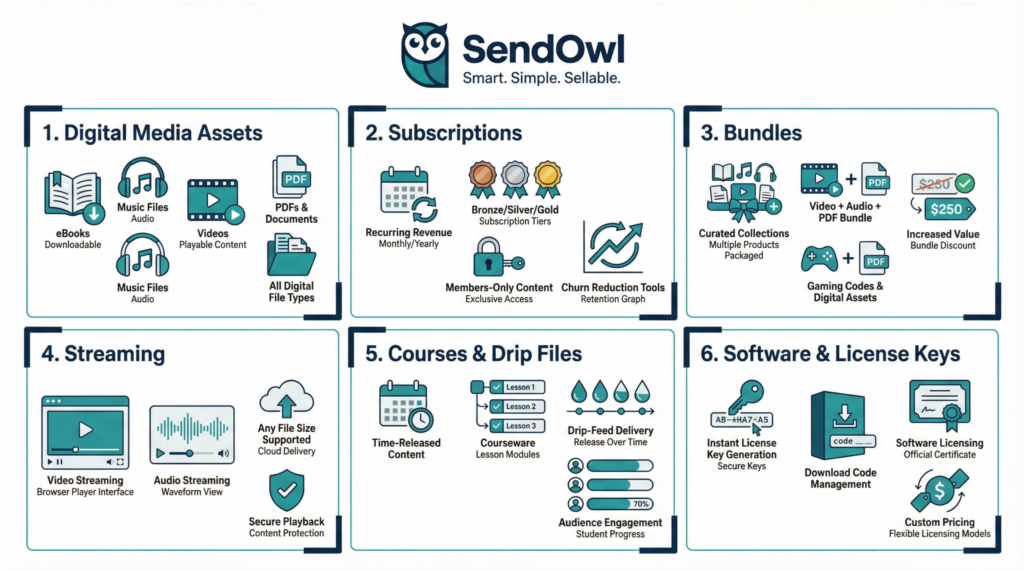
SendOwl is an incredibly versatile platform that supports a wide range of digital product types, giving you the flexibility to create a diverse product ecosystem and multiple revenue streams that cater to different segments of your audience and different price points that maximize your total revenue.
Here’s a detailed look at what you can sell on SendOwl and how each product type can help you build a thriving and automated online business that generates income while you sleep:
Digital Media Assets: You can sell any type of digital media asset on SendOwl, from music files and videos to images, PDFs, eBooks, and any other digital file you can imagine, which gives you unlimited creative freedom to monetize your work. SendOwl supports virtually all digital file types, including MP3, WAV, MP4, MOV, JPG, PNG, PDF, EPUB, ZIP, and dozens of others, so you can easily package up and sell your creative work regardless of your industry or niche.
And with secure file delivery and customizable download settings that let you control how many times a customer can download a file and how long the download link stays active, you can be sure that your products are delivered to your customers safely and professionally while protecting your intellectual property from unauthorized sharing.
Think of it like this: if you’re a photographer, you can sell your high-resolution images and Lightroom presets; if you’re a musician, you can sell your tracks, albums, and sample packs; if you’re a writer, you can sell your eBooks, short stories, and writing templates; if you’re a designer, you can sell your fonts, graphics, and design assets. The possibilities are truly endless, and SendOwl makes it easy to deliver all of these different file types to your customers automatically.
Subscriptions: SendOwl has a full suite of subscription management tools that let you sell recurring subscriptions to your customers and build a predictable monthly income stream for your business, which is the holy grail of online entrepreneurship.
You can offer different subscription tiers with different levels of access and benefits (like a Bronze tier for $9/month with basic content, a Silver tier for $19/month with premium content, and a Gold tier for $49/month with VIP access and one-on-one coaching), and you can manage your subscribers, track your churn rate, and get detailed reporting on your subscription revenue, all from one dashboard that gives you a complete view of your recurring revenue business.
Subscriptions are incredibly powerful because they create predictable income that you can count on every month, and they help you build a loyal community of customers who are invested in your success.
Bundles: With SendOwl, you can go beyond selling individual products and create curated bundles that package multiple digital products together at a discounted price, which is a proven strategy for increasing your average order value and providing more value to your customers.
This is a great way to increase your revenue per customer and provide more value to your customers who are looking for a complete solution rather than individual pieces. You can bundle together video files, audio tracks, PDFs, gaming codes, and any other digital products you sell to create unique and compelling offers that your audience will love and that position you as a comprehensive solution provider rather than just a single-product seller.
Streaming: SendOwl supports audio and video streaming of any file size, so you can offer your customers the ability to stream your content directly in their browsers without having to download it first, which is perfect for protecting your content from piracy and unauthorized sharing.
You can also choose to offer both streaming and download options, giving your customers the flexibility to choose how they want to consume your content based on their preferences and internet connection. This is a great option for creators who sell online courses, music, or video content and want to protect their work from unauthorized sharing while still providing a great user experience.
Streaming is particularly valuable for course creators because it prevents students from downloading your entire course and sharing it with others or requesting refunds after they’ve downloaded all the content.
With streaming, your content stays on your servers, and students can only access it while they have an active subscription or purchase, which protects your intellectual property and ensures that you get paid for your work.
Courses & Drip Files: SendOwl’s drip functionality lets you create and sell courses or a series of products that are released over time, which is a great way to keep your audience engaged and excited for more while also reducing refund rates and increasing course completion rates.
You can set a custom release schedule for your content, so your customers receive new files automatically over a period of days, weeks, or months, creating anticipation and ensuring that they don’t get overwhelmed with too much content at once. This is perfect for creators who want to offer online courses, challenges, or a series of tutorials that build on each other and require time for students to practice and implement what they’ve learned.
For example, if you’re teaching a 12-week photography course, you can set up your content to drip out one module per week, so students receive Module 1 on Day 1, Module 2 on Day 8, Module 3 on Day 15, and so on. This keeps students engaged throughout the entire 12 weeks, gives them time to practice each week’s lessons before moving on to the next module, and creates a sense of community as all students progress through the course at the same pace.
Software Downloads & License Keys: If you’re a software developer, SendOwl makes it easy to sell your software and manage your license keys with a level of automation that would otherwise require you to build custom systems or hire a developer.
You can instantly generate, issue, and manage download codes and license keys for your software with pricing and terms that you control, ensuring a smooth and professional experience for both you and your customers. This is perfect for indie developers, SaaS companies, and anyone selling software products, plugins, or digital tools that require license key activation.
SendOwl’s license key system can generate unique keys for each purchase, track which keys have been activated, allow customers to deactivate and reactivate keys on different devices, and even set expiration dates for time-limited licenses. This level of functionality would typically require thousands of dollars in custom development, but SendOwl includes it as a standard feature in all plans.
SendOwl Pricing
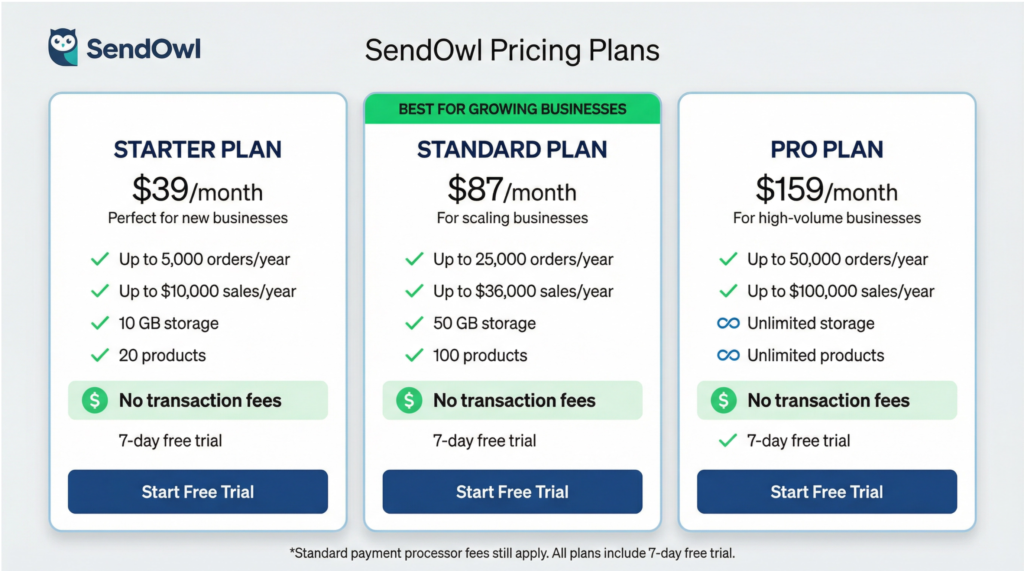
SendOwl’s pricing is designed to be simple, transparent, and scalable, so you can choose the plan that fits your business needs and grow with the platform as your revenue increases without any surprises or hidden fees. Here’s a breakdown of the three main pricing plans and what you get with each, along with guidance on which plan is right for your business stage:
Starter Plan ($39/month)
The Starter plan is perfect for small businesses and creators who are just getting started with selling digital products and want to test the waters without a huge financial commitment.
For a flat monthly fee of $39 (which is less than the cost of a nice dinner out), you get up to 5,000 orders per year (which is about 14 orders per day), up to $10,000 in sales per year (which is about $833 per month), 10 GB of storage (enough for hundreds of PDFs, eBooks, or audio files), and the ability to sell up to 20 products.
This plan is a great option if you’re just starting out and want a predictable monthly cost without any transaction fees, and it’s perfect for creators who are validating their product ideas and building their initial customer base.
To put this in perspective, if you’re selling a $47 eBook, you could make 212 sales per year on the Starter plan before needing to upgrade, which is a great starting point for most new creators. And because there are no transaction fees, you keep all of your revenue (minus standard payment processor fees of around 2.9% + $0.30 per transaction), which means you’re maximizing your profit margins from day one.
Standard Plan ($87/month)
The Standard plan is designed for growing businesses that have more customers and a higher sales volume and are ready to scale their operations.
For a flat monthly fee of $87, you get up to 25,000 orders per year (which is about 68 orders per day), up to $36,000 in sales per year (which is about $3,000 per month), 50 GB of storage (enough for thousands of files or several hours of video content), and the ability to sell up to 100 products.
This plan is a great option if you’re starting to see consistent sales and need more storage and product capacity to support your growing product catalog and customer base.
The Standard plan is ideal for creators who have validated their products and are now focused on scaling their revenue through marketing, partnerships, and product expansion.
Pro Plan ($159/month)
The Pro plan is designed for established businesses with a larger sales volume and a need for unlimited storage and products to support a comprehensive product ecosystem.
For a flat monthly fee of $159, you get up to 50,000 orders per year (which is about 137 orders per day), up to $100,000 in sales per year (which is about $8,333 per month), unlimited storage (so you can sell large video courses, software files, or high-resolution media without worrying about space), and the ability to sell an unlimited number of products.
This plan is a great option for high-volume sellers who want the most value and flexibility from the platform and who are running a serious online business that generates substantial revenue.
At this level, you’re likely managing a team, running sophisticated marketing campaigns, and treating your digital product business as a full-time income source or even a multi-person company.
The Pro plan removes all the artificial limits and lets you focus on growth without worrying about hitting capacity constraints.
Podia – Best Platforms to Sell Digital Products

Podia is the go-to platform for solo entrepreneurs because it’s a powerful and user-friendly all-in-one solution that’s designed to simplify your business and help you grow your revenue without adding more complexity to your life, which is something that every creator who’s ever felt overwhelmed by technology can appreciate and benefit from.
With Podia, you can sell a wide range of digital products, from online courses and digital downloads to coaching, webinars, and even memberships, all from one beautiful and professional storefront that you can customize to match your brand and make your own.
And because it’s an integrated platform where all of your tools work together seamlessly, from your website and email marketing to your payment processing and customer management, you can automate your business and focus on creating great products that serve your audience and generate revenue.
What Can You Sell on Podia?
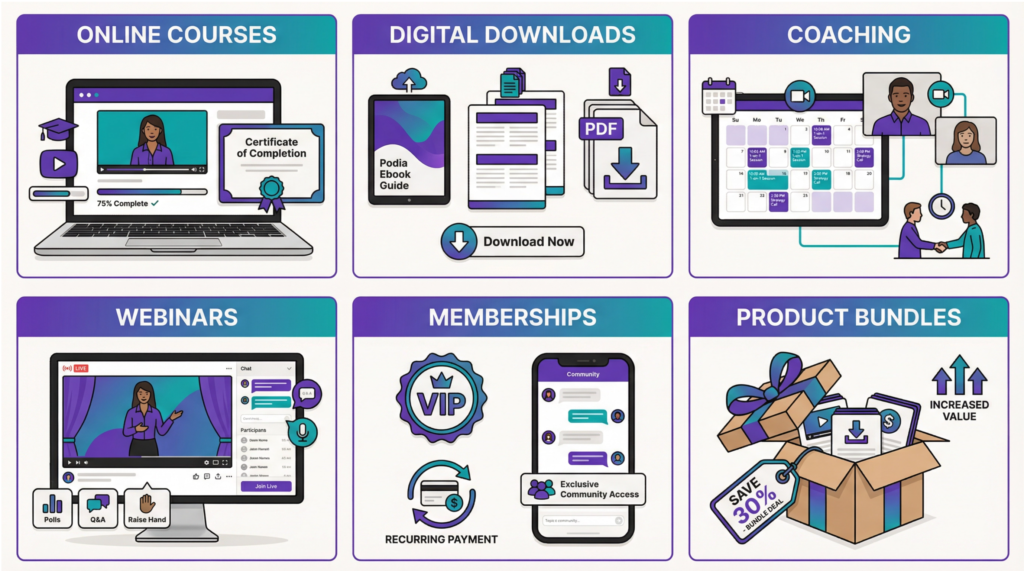
Podia is a true all-in-one platform that supports a wide range of digital product types, giving you the flexibility to create a diverse product ecosystem and multiple revenue streams that cater to different segments of your audience and allow you to monetize your expertise in various ways.
Here’s a detailed look at what you can sell on Podia and how each product type can help you build a thriving and simplified online business that generates consistent revenue and serves your audience in meaningful ways:
Online Courses: Podia makes it easy to create and sell beautiful online courses that your audience will love, and I’ve seen countless creators use this feature to transform their knowledge and expertise into profitable digital products that generate passive income and help people achieve their goals.
You can create self-paced courses where students work through the content at their own speed, cohort-based courses where students go through the material together as a group with specific start and end dates, or drip courses that release content over time to keep students engaged and prevent them from feeling overwhelmed by too much information at once.
You can include unlimited modules, lessons, videos, audio files, quizzes, and any other type of content you want, which gives you complete creative freedom to design the perfect learning experience for your students.
Digital Downloads: You can sell any type of digital download on Podia, from eBooks and templates to presets, audio files, worksheets, checklists, and any other digital file you can imagine, which makes it a versatile platform for creators in any niche or industry.
Podia handles the secure delivery of your files automatically, so you don’t have to worry about unauthorized sharing, download issues, or manually sending files to customers after they make a purchase.
And with unlimited file hosting included in all plans, you can sell as many digital downloads as you want without any additional costs or storage limitations, which is a huge advantage over platforms that charge based on the number of files you upload or the amount of storage you use.
Coaching: If you’re a coach or consultant who works with clients one-on-one or in small groups, Podia makes it easy to sell your coaching services and manage your clients from one centralized platform that keeps everything organized and professional.
You can create different coaching packages with different pricing and features, such as a 3-month package with weekly calls or a 6-month package with bi-weekly calls and email support, and you can use Podia’s built-in scheduling tools to manage your appointments and availability.
You can also use Podia’s messaging feature to communicate with your clients and provide support between sessions, which helps you build stronger relationships and deliver more value to your clients.
Webinars: Podia’s webinar feature lets you host live webinars and engage with your audience in real-time, which is a powerful way to build trust, demonstrate your expertise, and promote your other products and services.
You can use webinars to teach a live class, host a Q&A session where you answer questions from your audience, or run a product launch event where you introduce a new course or program and offer special pricing to attendees.
And with Podia’s built-in email marketing, you can easily promote your webinars to your audience and send automated reminders to increase attendance and reduce no-shows.
Memberships: With Podia, you can create a recurring membership and build a loyal community of supporters who pay you every month for access to your exclusive content and community, which is one of the most sustainable and predictable business models for creators who want to build long-term financial stability.
You can create different membership tiers with different pricing and benefits, such as a basic tier with access to your content library and a premium tier with access to live Q&A calls and personalized feedback.
And you can use Podia’s community feature to create a private space for your members to connect with you and each other, ask questions, share their progress, and build relationships that keep them engaged and reduce churn.
Product Bundles: Podia’s bundling feature lets you package multiple products together and sell them at a discounted price, which is a great way to increase your average order value and provide more value to your customers while also making it easier for them to buy multiple products from you at once.
You can bundle together your online courses, digital downloads, coaching sessions, and any other products you sell to create unique and compelling offers that your audience will love, such as a “Complete Transformation Bundle” that includes a course, a workbook, and a 30-minute coaching call, or a “Starter Pack” that includes three of your most popular digital downloads at a 25% discount.
Podia Pricing Plans
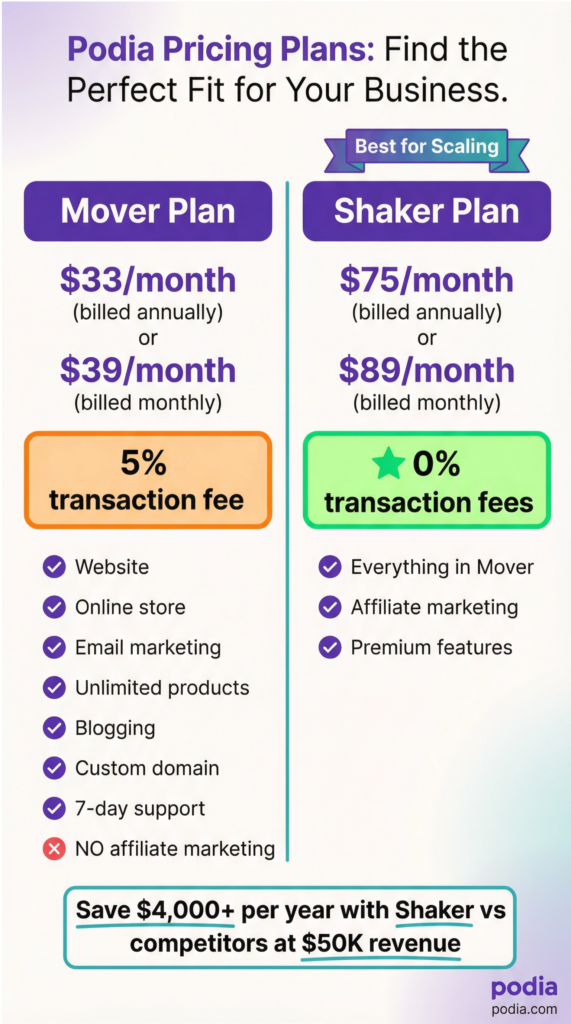
Podia’s pricing is designed to be simple, transparent, and affordable for creators at every stage of their business, from complete beginners who are just getting started to established entrepreneurs who are generating six figures or more in annual revenue.
Here’s a breakdown of the two main pricing plans and what you get with each, along with some calculations to help you understand which plan is the best fit for your business:
Mover Plan ($33/month annually or $39/month monthly)
The Mover plan is perfect for creators who are just getting started and want an affordable all-in-one solution that gives them everything they need to build and launch their online business without a huge upfront investment.
For a flat monthly fee of just $33 when paid annually (or $39 when paid monthly), you get a full website with unlimited pages and blog posts, an online store where you can sell unlimited products, email marketing with up to 100 subscribers included for free, and all the core features you need to start selling, including payment processing through Stripe and PayPal, customer management, and detailed analytics.
The Mover plan has a 5% transaction fee on sales, which means that for every $100 you earn, you’ll pay $5 to Podia in addition to your monthly subscription fee. This is a great option if you’re just starting out and have a lower sales volume, because you’re only paying transaction fees when you actually make sales, which means your costs scale with your revenue.
Shaker Plan ($75/month annually or $89/month monthly)
The Shaker plan is designed for established creators who have a higher sales volume and want to scale their business without paying transaction fees that eat into their profit margins.
For a flat monthly fee of $75 when paid annually (or $89 when paid monthly), you get everything in the Mover plan plus no transaction fees, affiliate marketing so you can recruit partners to promote your products and pay them a commission, and all of Podia’s premium features.
The Shaker plan is a great option if you’re making consistent sales and want to maximize your profit margins by eliminating transaction fees entirely.
To put this in perspective and help you understand when it makes sense to upgrade to the Shaker plan, let me walk you through some calculations.
If you’re making $50,000 per year in sales on the Mover plan, you’ll pay $396 per year in subscription fees ($33 × 12 months) plus $2,500 in transaction fees (5% of $50,000), for a total of $2,896 per year.
On the Shaker plan, you’ll pay $900 per year in subscription fees ($75 × 12 months) plus $0 in transaction fees, for a total of $900 per year. That’s a savings of $1,996 per year just by upgrading to the Shaker plan, which more than pays for the higher subscription cost.
Sellfy – Best Platforms to Sell Digital Products

What makes Sellfy stand out among the best platforms to sell digital products is its commitment to keeping things simple while still giving you all the tools you need to build a real business, and I love that you can literally have your store up and running in just five minutes, which is perfect if you’re the kind of person who wants to spend your time creating amazing products rather than figuring out how to configure server settings or install plugins.
What You Can Sell on Sellfy
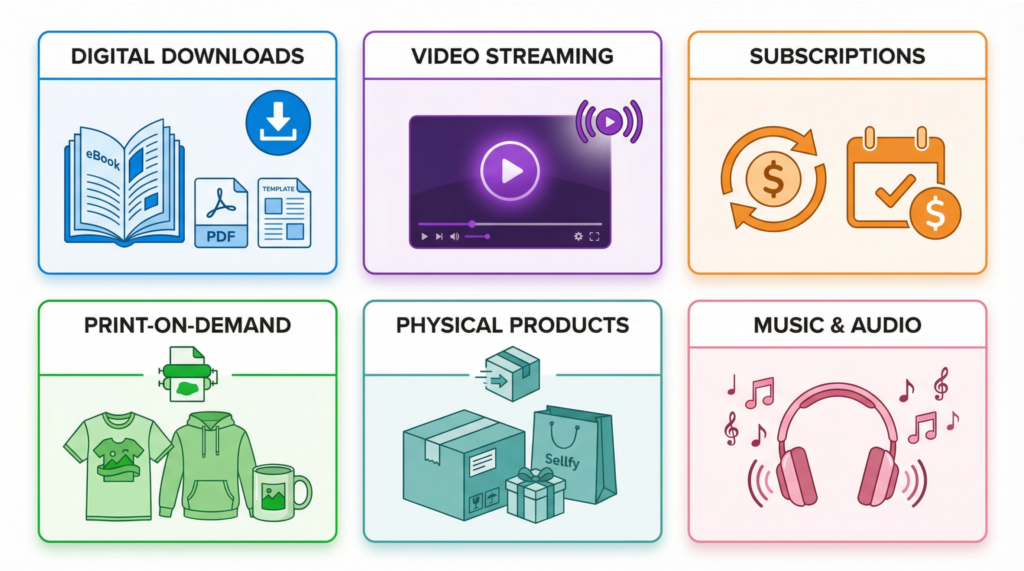
One of the reasons Sellfy ranks among the best platforms to sell digital products is its incredible versatility when it comes to the types of products you can offer to your customers, and I’m always impressed by how the platform supports everything from simple digital downloads to complex subscription models that generate recurring revenue month after month.
Digital Downloads
Digital downloads are the bread and butter of Sellfy, and you can sell absolutely any type of digital file you can imagine, including eBooks in PDF or EPUB format, video tutorials and courses, audio files and music tracks, design files like PSD and AI documents, photography presets and filters, software and apps, templates for websites or graphics, fonts and typography, stock photos and illustrations, and literally any other file type that your customers might want to download and use.
I love how Sellfy handles digital delivery completely automatically, which means that as soon as someone purchases your product, they immediately receive a secure download link, and you don’t have to lift a finger or worry about manually sending files to customers, which saves you countless hours and eliminates the risk of human error that comes with manual fulfillment.
Physical Products
While Sellfy is primarily known as one of the best platforms to sell digital products, it also supports physical products beautifully, which means you can sell tangible items like books, art prints, handmade crafts, or any other physical goods directly from your Sellfy storefront without needing to set up a separate ecommerce solution.
This flexibility is incredibly valuable because it means you can build your entire creator business on one platform rather than juggling multiple systems, and I’ve seen creators successfully combine digital and physical products to create compelling product bundles that increase their average order value and give customers more options to support their work.
Video Streaming
Video streaming is one of Sellfy’s most powerful features, and it’s perfect if you create video content and want to protect it from piracy while also eliminating the frustration that customers sometimes experience with large file downloads that can fail or take forever to complete on slower internet connections.
When you enable video streaming on Sellfy, your customers can watch your videos on-demand directly in their browser without downloading anything, which provides a Netflix-like experience that feels modern and professional, and the built-in piracy protection means that your valuable video content is much harder to steal or redistribute without your permission.
Subscriptions
Subscriptions are the holy grail of online business because they generate predictable recurring revenue that you can count on month after month, and Sellfy makes it incredibly easy to create subscription products that charge your customers on a weekly, monthly, or yearly basis for ongoing access to your content or services.
I think subscriptions are one of the smartest ways to monetize your expertise because instead of constantly hustling to find new customers, you build a loyal community of subscribers who pay you consistently over time, and Sellfy handles all the complicated billing and payment processing automatically so you can focus on delivering value to your subscribers rather than managing spreadsheets and payment reminders.
Print-on-Demand
Print-on-demand is an absolute game-changer for creators who want to sell merchandise without dealing with inventory, upfront costs, or shipping logistics, and Sellfy’s built-in print-on-demand integration lets you sell t-shirts, hoodies, mugs, and hats directly from your storefront with zero risk or investment on your part.
The way it works is beautifully simple: you design your merchandise using Sellfy’s tools, list the products in your store, and when someone orders something, Sellfy automatically sends the order to their print-on-demand partner who prints the item and ships it directly to your customer while you keep the profit, which means you can build a merchandise business without ever touching a single product or worrying about storage space in your garage.
Sellfy’s Pricing Plans
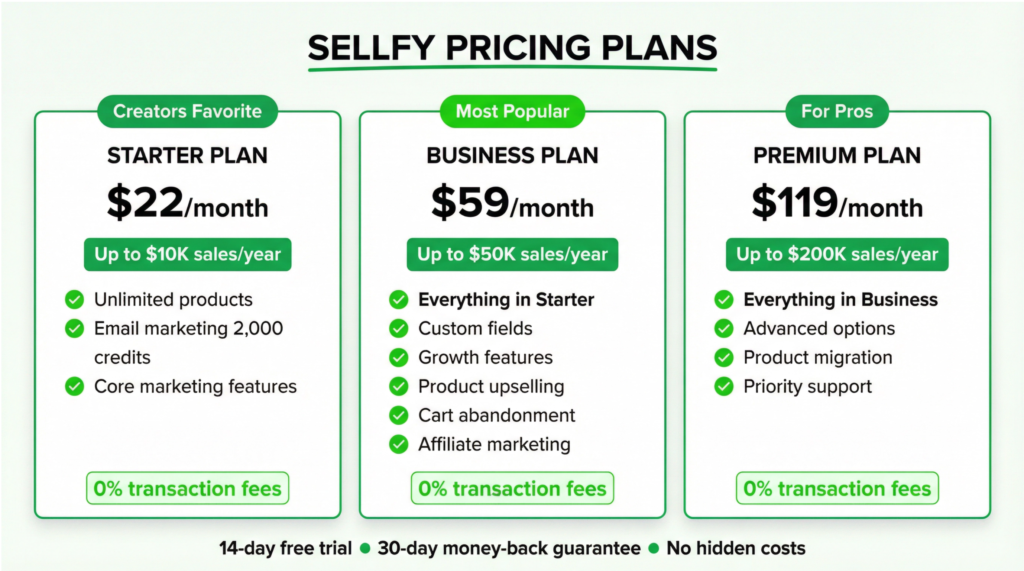
One of the biggest reasons Sellfy is considered among the best platforms to sell digital products is its transparent and creator-friendly pricing structure that doesn’t include any transaction fees on any plan, which means you keep more of your hard-earned money instead of watching a percentage of every sale disappear into platform fees.
Starter Plan – $22/Month
The Starter Plan is perfect if you’re just getting started with selling digital products and want to test the waters without making a huge financial commitment, and for just $22 per month, you get the ability to make up to $10,000 in sales per year, which is plenty of room to build a solid side income or even a full-time business if you’re selling higher-priced products.
This plan includes unlimited products, which means you’re not restricted in how many different items you can offer in your store, and you also get 2,000 email marketing credits per month so you can communicate with your customers and promote new products without needing to pay for a separate email marketing service.
The Starter Plan also includes core marketing features like discount codes and basic upselling, and most importantly, it charges 0% transaction fees, which means if you sell $10,000 worth of products, you keep all of that money minus only the standard payment processing fees from PayPal or Stripe.
Business Plan – $59/Month
The Business Plan is the most popular option for serious creators who are ready to scale their digital product business beyond the beginner stage, and for $59 per month, you can make up to $50,000 in sales per year while accessing powerful growth features that help you maximize your revenue and build a sustainable business.
Everything from the Starter Plan is included, plus you get 10,000 email marketing credits per month, custom fields that let you collect additional information from customers during checkout, product upselling features that automatically suggest related products to increase your average order value, cart abandonment emails that automatically reach out to customers who added items to their cart but didn’t complete their purchase, and a full affiliate marketing system that lets you recruit affiliates to promote your products in exchange for a commission on sales they generate.
The Business Plan is where Sellfy really shines as one of the best platforms to sell digital products because these growth features can dramatically increase your revenue without requiring you to work more hours, and the 0% transaction fees mean that as your sales grow, you’re not losing thousands of dollars to platform fees like you would on many competing platforms.
Premium Plan – $119/Month
The Premium Plan is designed for established creators and businesses who are generating significant revenue and need advanced features, priority support, and the ability to handle up to $200,000 in sales per year, which is serious money that requires serious tools to manage effectively.
For $119 per month, you get everything from the Business Plan plus 50,000 email marketing credits per month, advanced customization options that give you more control over your store’s appearance and functionality, product and design migration assistance if you’re moving from another platform, and priority support that ensures your questions and issues get resolved quickly so you can keep your business running smoothly.
The Premium Plan is perfect if selling digital products is your primary income source and you need a platform that can handle high volume while providing the support and features necessary to maintain professional standards, and once again, you pay 0% transaction fees, which means at $200,000 in annual sales, you’re saving tens of thousands of dollars compared to platforms that charge 5-10% per transaction.
WooCommerce – Best Platforms to Sell Digital Products

WooCommerce is a free, open-source ecommerce plugin for WordPress, which means that instead of being a guest on someone else’s platform, you’re building your own digital storefront on your own terms, with no limits on what you can create or how you can sell it.
With over 4 million online stores built on WooCommerce and 28% of the top 1 million ecommerce sites using the platform, it’s clear that this isn’t just a small-time solution but a powerful engine that drives a significant portion of the internet’s commerce.
The fact that 43% of the entire internet runs on WordPress gives you an idea of the massive ecosystem you’re tapping into when you choose WooCommerce, and the best part is that you get to keep all your profits because WooCommerce doesn’t charge any listing fees or take a percentage of your sales, which can save you thousands of dollars every year compared to other platforms.
What You Can Sell with WooCommerce
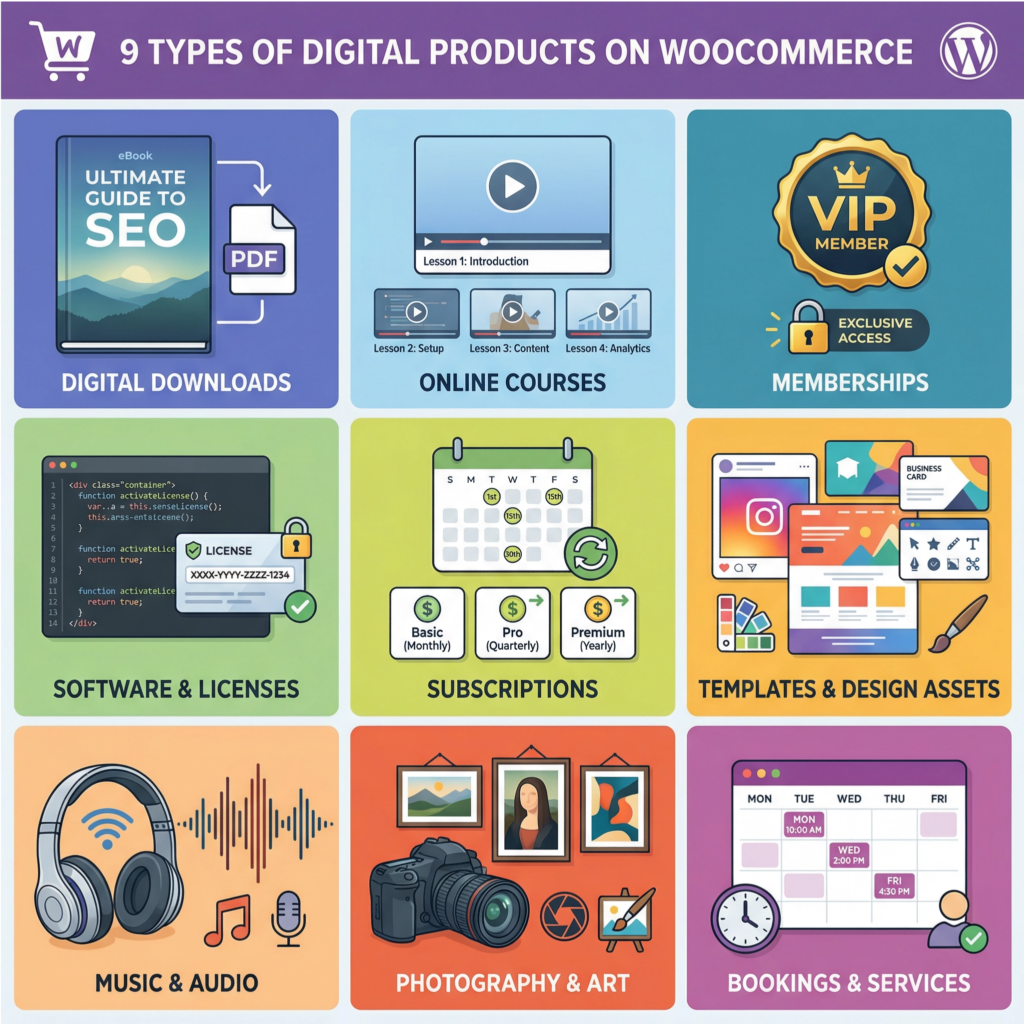
One of the most exciting aspects of using WooCommerce is that you can sell virtually any type of digital product you can imagine, and the platform’s flexibility means you’re not limited to just one or two categories. This makes it one of the best platforms to sell digital products for creators who have diverse interests or want to experiment with different types of products to see what resonates with their audience.
Digital Downloads
At its core, WooCommerce is perfectly designed to handle digital downloads right out of the box without needing any paid extensions. You can sell eBooks, PDF guides, software, apps, music, audio files, video courses, templates, design assets, stock photos, and any other type of downloadable file you can think of.
The process is incredibly simple: you upload your file, set your price, and when a customer makes a purchase, WooCommerce automatically provides them with a secure, unique download link, which means you can run your entire business on autopilot without ever having to manually email files to customers.
The beauty of digital downloads is that once you create the product, you can sell it an unlimited number of times without any additional costs, which means your profit margin can approach 100% after you’ve covered your initial hosting and platform costs. This is why digital products are such an attractive business model for creators, and WooCommerce makes it incredibly easy to get started with zero transaction fees eating into your profits.
Online Courses
If you’re an expert in a particular field, you can use WooCommerce to sell online courses and monetize your knowledge.
With the help of an extension like Sensei Pro, you can create a complete learning management system (LMS) directly on your WordPress site, allowing you to build engaging courses with video lessons, quizzes, assignments, and certificates of completion. This is a fantastic way to generate significant income because you’re selling your expertise, which is a high-value product that customers are willing to pay a premium for.
The global elearning market is projected to reach $848 billion by 2030, which shows just how massive the opportunity is for course creators who want to share their knowledge and skills with the world.
With WooCommerce, you can tap into this growing market without paying the high fees that dedicated course platforms charge, which means you get to keep more of your revenue and reinvest it back into creating even better content for your students.
Memberships and Subscriptions
Recurring revenue is the dream for many online entrepreneurs, and WooCommerce makes it possible with extensions like WooCommerce Memberships and WooCommerce Subscriptions.
You can create exclusive content that’s only available to paying members, offer subscription boxes with digital goodies delivered every month, or create a private community where members get access to you and other like-minded individuals. This is one of the most powerful ways to build a sustainable business because instead of constantly chasing one-off sales, you’re building a loyal community of subscribers who pay you every month or year.
Imagine waking up every morning knowing that you have predictable, recurring revenue coming in from your members, which gives you the financial stability to plan for the future and invest in growing your business. This is the power of the subscription model, and WooCommerce gives you all the tools you need to implement it without paying expensive monthly fees to dedicated membership platforms.
Software and License Keys
For developers and software creators, WooCommerce is one of the best platforms to sell digital products because it can handle the complexities of selling software with license keys.
Using an extension like the License Manager for WooCommerce, you can automatically generate, manage, and validate license keys for your software, which protects your intellectual property and ensures that only paying customers can use your products. This is a professional-grade solution that’s used by thousands of software companies to power their online sales.
The software industry is worth billions of dollars, and with WooCommerce, you can tap into this lucrative market without building your own complex licensing system from scratch.
The platform handles all the technical details for you, so you can focus on what you do best: creating amazing software that solves real problems for your customers.
Bookings and Services
WooCommerce isn’t just for selling downloadable files; you can also use it to sell your time and expertise through bookings and services. With the WooCommerce Bookings extension, you can sell one-on-one coaching sessions, consulting calls, virtual workshops, or any other service that requires scheduling.
Customers can see your availability, book a time that works for them, and pay for the session all in one seamless process, which makes it incredibly easy to monetize your skills and services.
This is perfect for coaches, consultants, therapists, tutors, and anyone else who sells their time and expertise, because it eliminates the back-and-forth of scheduling and ensures that you get paid upfront before you deliver your service.
The automation that WooCommerce provides means you can spend less time on administrative tasks and more time doing the work you love.
The True Cost of WooCommerce
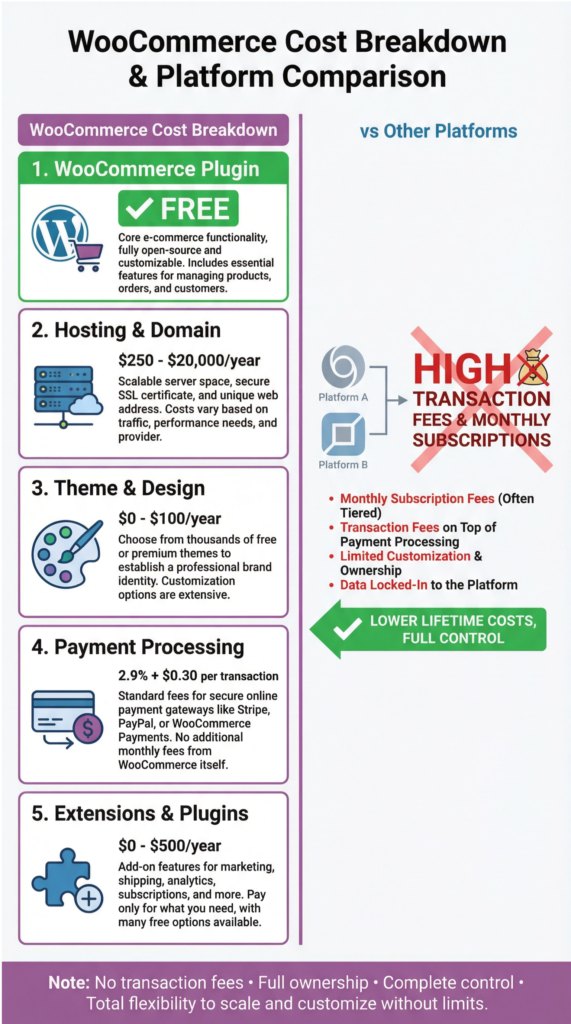
While the WooCommerce plugin itself is free, it’s important to understand that running a WooCommerce store is not entirely without cost, but the good news is that you have complete control over how much you spend, which is what makes it one of the best platforms to sell digital products for budget-conscious entrepreneurs.
Hosting and Domain
To run a WooCommerce store, you need a WordPress website, which means you’ll need to pay for hosting and a domain name. Quality hosting plans can start at around $250 per year, and a domain name typically costs about $15 per year.
While this might seem like a significant upfront cost compared to platforms that offer a “free” plan, remember that those platforms often make up for it with high transaction fees that can cost you far more in the long run.
With your own hosting, you have complete control over your site’s performance and security, and you’re not sharing resources with thousands of other stores, which can lead to a faster and more reliable experience for your customers.
Let me give you a real example to illustrate the cost savings: if you’re selling $50,000 worth of digital products per year on a platform like Gumroad that charges a 10% transaction fee, you’d pay $5,000 in fees.
With WooCommerce, you’d pay around $250 for hosting, $15 for your domain, and only the standard payment processing fees of 2.9% + $0.30, which would be about $1,465 in payment processing fees, for a total of $1,730 per year. That’s a savings of $3,270 compared to Gumroad, and the gap only widens as your revenue grows.
Themes and Design
WordPress offers thousands of free themes that you can use to design your store, so your design costs can be as low as $0.
However, if you want a more professional look or advanced design features, you might choose to purchase a premium theme, which typically costs between $50 and $100 per year.
The beauty of WooCommerce is that you have endless design options, from simple and clean to complex and highly customized, and you’re never locked into a cookie-cutter template that looks like every other store on the platform.
Many successful WooCommerce stores start with a free theme and upgrade to a premium one as they grow, which allows you to keep your initial costs low while still having the option to invest in a more professional design when your business can afford it. This flexibility is one of the key advantages of WooCommerce over platforms that force you into expensive monthly plans from day one.
Payment Processing Fees
No matter which platform you use to sell online, you’ll always have to pay payment processing fees to companies like Stripe and PayPal, which handle the actual transaction of moving money from your customer’s credit card to your bank account.
These fees are typically around 2.9% + $0.30 per transaction and are completely separate from any platform fees. The key difference with WooCommerce is that these are the only percentage-based fees you’ll pay, whereas other platforms often charge their own transaction fee on top of the payment processor’s fee, which can significantly eat into your profits.
For example, if you sell a $100 digital course, you’ll pay $3.20 in payment processing fees with WooCommerce, leaving you with $96.80. On a platform like Gumroad with a 10% fee, you’d pay $10 to Gumroad plus $2.61 in payment processing fees (calculated on the $90 you receive after Gumroad’s cut), leaving you with only $87.39. That’s a difference of $9.41 per sale, which adds up quickly when you’re selling dozens or hundreds of products per month.
Extensions and Plugins
One of the greatest strengths of WooCommerce is its massive library of extensions and plugins that allow you to add almost any feature you can imagine to your store.
While many essential plugins are free, some advanced features, like subscriptions or memberships, require paid extensions that can range from $50 to $300 per year.
The key here is that you only pay for the features you actually need, so you’re not subsidizing a bloated platform with features you’ll never use. This a la carte approach allows you to build a lean and efficient store that’s perfectly tailored to your specific business needs.
For a basic digital product store, you might not need any paid extensions at all, which means your only costs would be hosting and your domain. As your business grows and you want to add more advanced features like subscriptions or memberships, you can invest in the extensions that make sense for your specific business model, which gives you complete control over your expenses and ensures that you’re only paying for what you actually use.
LearnWorlds – Best Platforms to Sell Digital Products

LearnWorlds focuses on creating an interactive learning experience that actually keeps your students coming back for more, which is the secret sauce to building a long-term business.
According to recent industry data, the global elearning market is expected to reach a staggering $848 billion by 2030, and platforms like LearnWorlds are the reason why everyday creators are able to grab a piece of that massive pie. This isn’t just a small trend; it is a massive shift in how the world learns, and being on the right platform can mean the difference between a hobby and a life-changing career.
One of the coolest things I found is that LearnWorlds is now powered by advanced AI tools, which means the platform can actually help you write your course outlines, generate quizzes, and even translate your content into different languages with just a few clicks.
What You Can Sell on LearnWorlds
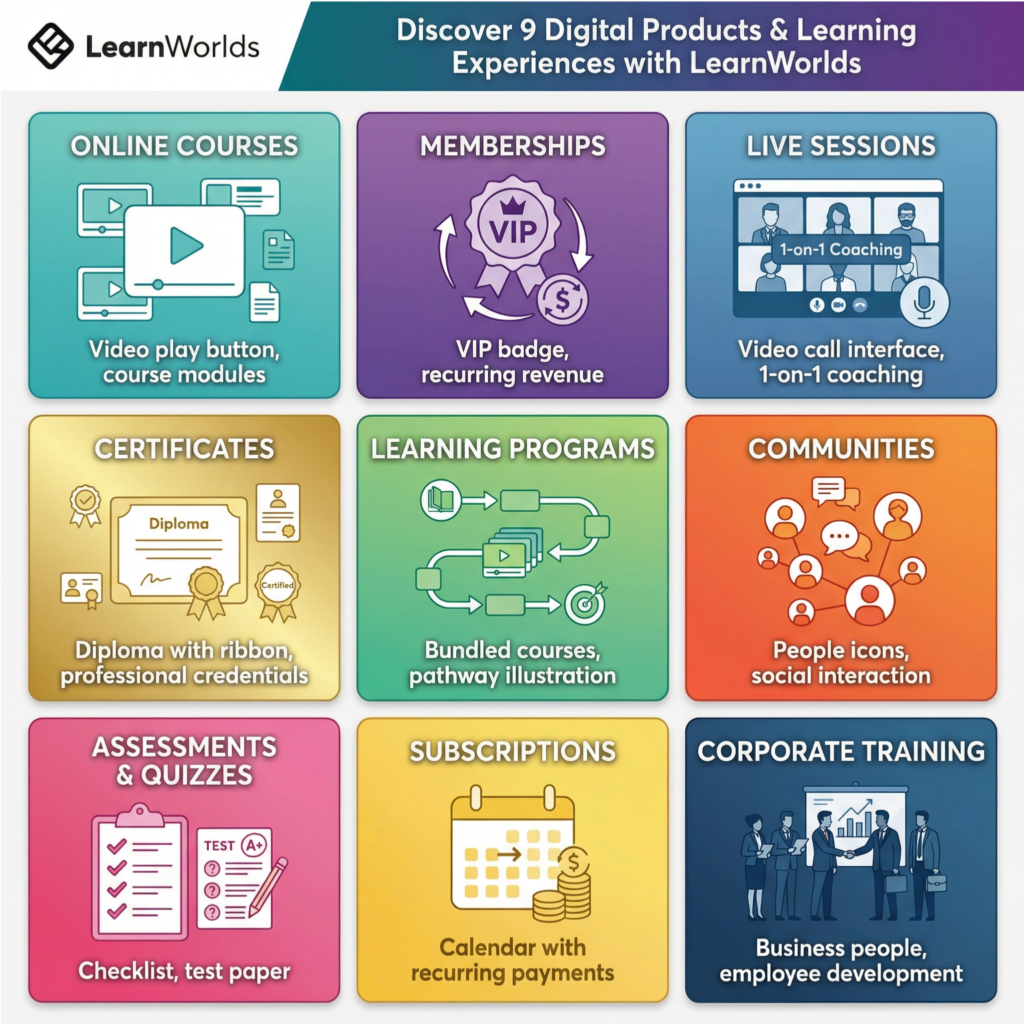
One of the biggest mistakes I see people make is thinking they can only sell one thing, but LearnWorlds is one of the Best Platforms to Sell Digital Products because it lets you mix and match all sorts of different offers to keep your revenue growing.
It is like having a giant department store where you can sell everything from a $10 eBook to a $5,000 premium coaching program. You are not limited by the technology; you are only limited by your own creativity and what your audience needs most from you.
Here is a breakdown of the different types of digital products you can launch on the platform:
| Product Type | Why It’s Great for Your Business | Real-World Example |
| Online Courses | The ultimate way to package your knowledge into video lessons, quizzes, and assignments. | A fitness coach selling a “12-Week Body Transformation” video course. |
| Memberships | Create a steady stream of “passive” income by charging a monthly fee for ongoing access. | A graphic designer charging $29/month for access to a library of templates. |
| Live Sessions | Offer high-ticket 1-on-1 coaching or group webinars directly through the platform. | A business consultant selling $500 strategy sessions via Zoom integration. |
| Digital Certificates | Build massive authority by giving your students professional credentials they can share. | A marketing expert providing a “Certified Social Media Manager” diploma. |
| Learning Programs | Bundle multiple courses together into a complete “pathway” for a higher price. | A music teacher selling a “Complete Piano Mastery” bundle of 5 courses. |
| Corporate Training | Sell bulk licenses to businesses who want to train their entire team using your content. | A leadership expert selling a “Manager Training Pack” to a 50-person company. |
LearnWorlds Pricing Plans
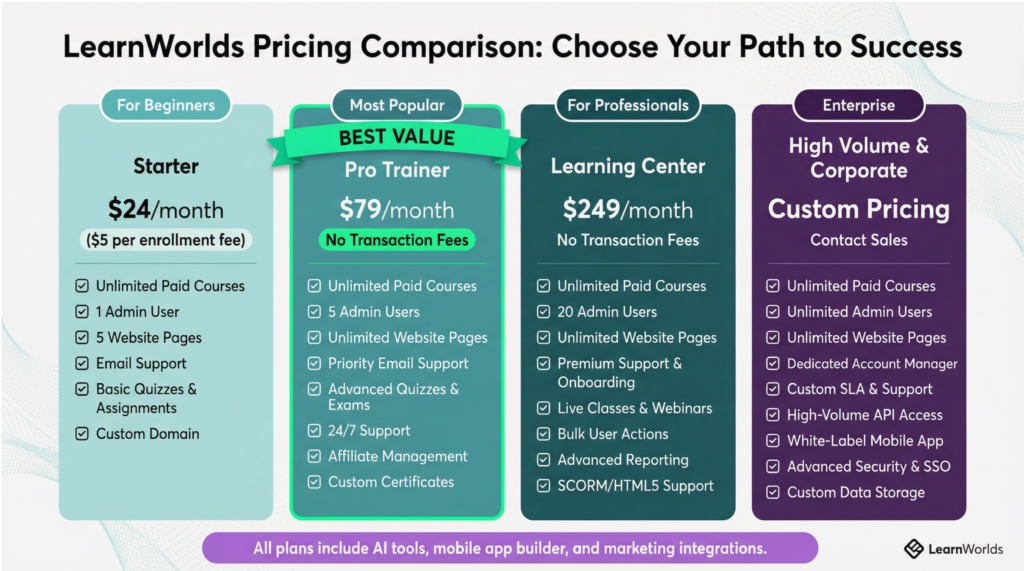
The great thing about LearnWorlds is that they have a plan for everyone, whether you are just starting out with your very first student or you are running a giant corporate training program.
You should view these costs not as an “expense,” but as an investment in a machine that is designed to make you more money in the long run.
Here is a simple look at their main plans when you pay annually (which saves you a lot of money!):
- Starter Plan ($24/month): This is perfect if you are just dipping your toes in the water. You can sell unlimited paid courses, but keep in mind there is a $5 fee for every course enrollment. It is like a “pay-as-you-grow” model that is great for beginners who want to keep their monthly costs as low as possible while they find their feet.
- Pro Trainer Plan ($79/month): This is the “sweet spot” for most creators because it has ZERO transaction fees. If you are selling more than 11 courses a month, this plan actually pays for itself compared to the Starter plan. You also get unlimited landing pages and the ability to set up an affiliate program so other people can sell your products for you! Imagine having an army of fans who are motivated to tell everyone about your courses because they get a small commission—that is how you scale quickly.
- Learning Center Plan ($249/month): This is for the heavy hitters who want the absolute best of everything. You get advanced AI features, interactive videos that can actually ask questions while they play, and the ability to completely remove all LearnWorlds branding. If you want to build a truly premium, high-end brand that stands out from everyone else, this is the plan for you.
- High Volume & Corporate: If you are a big company or have thousands of students, they can build a custom plan just for you with dedicated support and extra-strength servers. This is where you go when your business is booming and you need the highest level of reliability and security.
Udemy – Best Platforms to Sell Digital Products

Udemy is a powerful platform that democratizes education, allowing anyone with a skill to share it with a global audience and earn a living from their passion.
One of the biggest headaches for any new creator is finding students. Building your own website and driving traffic to it can take years and cost a lot of money.
With Udemy, a massive audience is already there, actively searching for courses. This is a huge advantage, especially when you are just starting out.
You don’t have to spend all your time and money on marketing; you can focus on what you do best: creating amazing content. Udemy handles all the heavy lifting of advertising and bringing students to the platform, which frees you up to be the best teacher you can be.
What You Can Teach and Sell on Udemy
Udemy is famous for its incredible variety of courses. When I looked at the types of digital products you can sell, I was amazed. It’s not just for tech gurus or business coaches; you can teach almost anything you are passionate about, as long as it helps people learn a new skill.
From painting to programming, from yoga to financial planning, if you have a skill, there’s likely an audience for it on Udemy.
Here are some of the most popular types of digital products (courses) you can sell:
| Course Category | What You Can Teach | Real-World Example |
| Development | Web development, mobile apps, programming languages, data science. | “Python for Data Science and Machine Learning Bootcamp” |
| Business | Entrepreneurship, finance, marketing, management, sales. | “The Complete Digital Marketing Course – 12 Courses in 1” |
| IT & Software | Network & security, hardware, operating systems, certifications. | “CompTIA A+ Certification Prep” |
| Personal Development | Productivity, leadership, mindfulness, fitness, happiness. | “Mindfulness-Based Stress Reduction (MBSR) Course” |
| Design | Graphic design, web design, UX/UI, photography, video editing. | “Adobe Photoshop CC: Your Complete Beginner to Advanced Class” |
| Marketing | Social media marketing, SEO, content marketing, advertising. | “Facebook Ads & Facebook Marketing Mastery Guide” |
| Music | Instruments, music production, singing, music theory. | “Learn Piano in 30 Days – Beginner to Advanced” |
| Health & Fitness | Yoga, nutrition, weight loss, self-defense. | “The Ultimate Yoga & Pilates Workout Program” |
Udemy’s Revenue Share
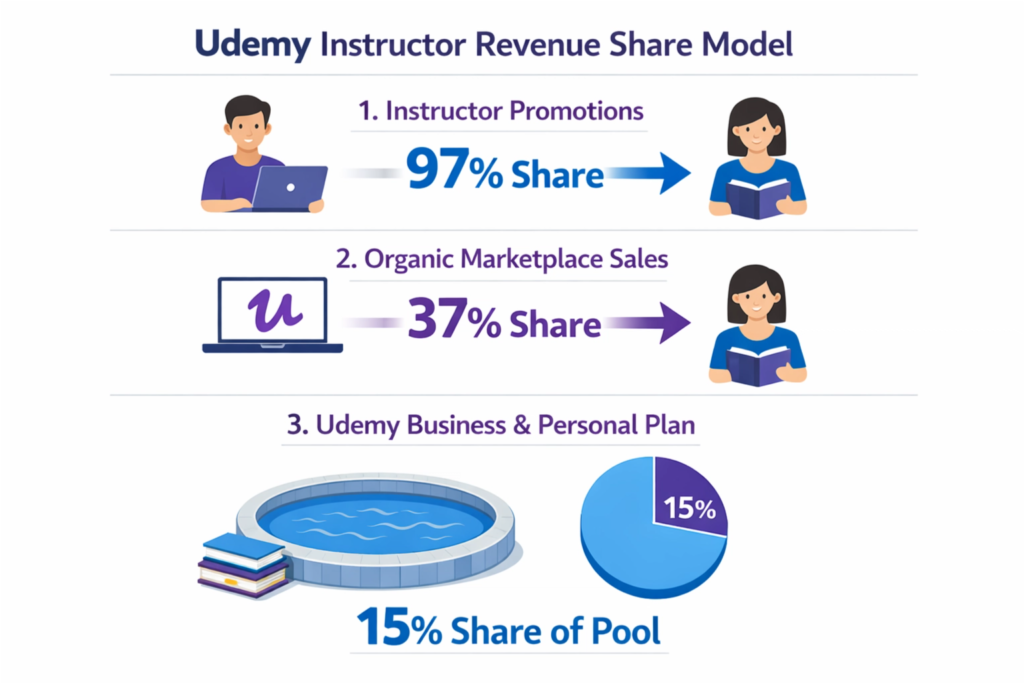
This is where things get a little bit more detailed, but I promise to make it easy to understand. Udemy has a few different ways instructors earn money, and it’s important to know the difference so you can maximize your earnings. This is a key factor when considering Udemy as one of the Best Platforms to Sell Digital Products.
Sales Through Your Promotions (97% Revenue Share)
This is the best-case scenario! If a student buys your course using a special coupon code or a referral link that you created and shared, you get a whopping 97% of the revenue. This is Udemy’s way of rewarding you for bringing students directly to the platform. It’s like you’re doing all the marketing work, so you get almost all the money. This is why I always tell instructors to actively promote their courses using their own links.
Organic Marketplace Sales (37% Revenue Share)
This is when a student finds your course by browsing the Udemy marketplace, searching for a topic, or clicking on a Udemy advertisement. In these cases, you receive 37% of the revenue. While 37% might seem lower than 97%, remember that Udemy is doing all the marketing and bringing the student to you. It’s like having a giant sales team working for you 24/7, and you only pay them when they make a sale. This is still a fantastic deal, especially for new instructors who don’t have a big audience yet.
Udemy Business & Personal Plan (15% Revenue Share)
Udemy also has subscription programs called Udemy Business and Personal Plan, where companies and individuals pay a monthly fee to access a library of courses. As of January 2026, instructors receive 15% of the revenue pool from these subscriptions. Your share of this pool depends on how many minutes students spend watching your courses compared to all other courses in the subscription. It’s like a giant pie, and your slice gets bigger the more students engage with your content. While the percentage might seem small, these programs can bring in a steady stream of passive income, especially if your courses are popular.
The “Net Amount” Explained
It’s important to know that these percentages are based on the “Net Amount.” This means the money a student paid minus any taxes or fees, like the 30% fee that Apple or Google charge for sales made through their mobile apps. So, if a student buys your course for $100 through the Udemy app on their iPhone, Apple takes $30, and then your percentage is calculated from the remaining $70. This is standard practice across many digital platforms, so it’s good to be aware of it.
ClickBank – Best Platforms to Sell Digital Products

ClickBank has been around for a long time, acting as a bridge between three key players: the product owner (that’s you!), the affiliate marketer, and the end customer. This unique model means you get access to a massive network of nearly 100,000 affiliates worldwide.
Think of it like having a huge sales team working for you, but you only pay them when they make a sale. This performance-driven approach is a game-changer, especially if you’re looking for relief from rising advertising costs.
Instead of spending a fortune upfront on ads, you’re only paying to acquire a customer after the sale is made. It’s a truly efficient way to scale your business.
What Kinds of Digital Products Can You Sell on ClickBank?
When I first heard about ClickBank, I thought it was just for a specific niche, but I quickly learned how diverse their marketplace truly is.
While it’s famously known for digital products, it also supports physical goods. For creators like us, the focus is often on digital offerings, and ClickBank excels in this area.
You can sell a wide variety of digital products, making it a versatile choice among the best platforms to sell digital products.
Here are some of the most popular types of digital products that thrive on ClickBank:
- Online Courses: If you have expertise to share, whether it’s about fitness, finance, cooking, or coding, you can package it into an online course. ClickBank provides the infrastructure to sell these educational products to a global audience.
- EBooks and Guides: Are you a writer, a researcher, or someone with valuable knowledge to impart? EBooks and comprehensive guides are a fantastic way to share your insights. From health and wellness to personal finance, there’s a vast audience waiting for your expertise. I’ve seen countless success stories from people who started with a simple eBook and grew it into a thriving business.
- Software and Apps: If you’ve developed a useful tool or application, ClickBank can be a great place to find affiliates to promote it. This includes everything from productivity software to specialized utilities.
- Memberships: Do you offer exclusive content, a community, or ongoing support? Membership sites are incredibly popular, and ClickBank can help you manage the recurring billing and affiliate commissions for these.
- Health and Fitness Programs: This is a huge niche on ClickBank. If you have a diet plan, an exercise routine, or a wellness guide, you’ll find a massive audience and a dedicated affiliate base ready to promote it.
- Financial Education: From investing strategies to debt management, digital products that help people improve their financial literacy are always in demand. ClickBank provides a platform for these valuable resources.
What I love about ClickBank is its flexibility. It allows you to focus on creating high-quality content and products, while it handles the complex world of affiliate marketing and payment processing. This means more time for you to innovate and less time worrying about the backend.
ClickBank Pricing and Commission Structure
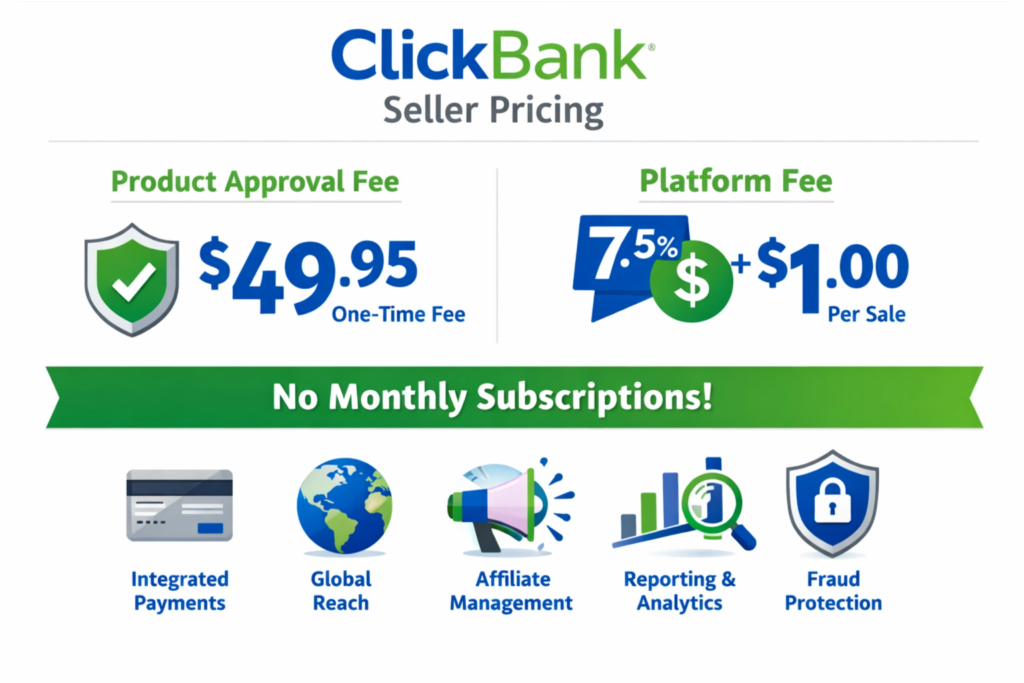
Now, let’s talk numbers, because I know you’re probably wondering about the costs involved.
When you’re evaluating the best platforms to sell digital products, understanding the fee structure is crucial. ClickBank has a straightforward model that I find quite appealing, especially for those who are just starting out or want to minimize upfront costs.
First, there’s a Product Approval Fee of $49.95. This is a one-time fee per product (after your first product is approved). I see this as a small investment that covers ClickBank’s rigorous compliance review. They make sure your product, sales funnel, and marketing materials meet all legal and ethical standards, which ultimately protects both you and your customers. It’s a stamp of approval that adds credibility to your offering.
Then, for each sale you make, ClickBank charges a Platform Fee of 7.5% + $1.00 per transaction. This might seem like a lot at first glance, but let me break down what you get for that. ClickBank handles all the payment processing, including managing various payment methods, dealing with chargebacks, and even remitting taxes.
They also take care of the 1099 contracts for your affiliates, which is a huge administrative burden lifted off your shoulders. When you consider the global reach, the affiliate management, and the fraud protection they provide, I believe this fee is a fair trade-off for the value you receive.
One of the biggest advantages, in my opinion, is that there are no monthly subscriptions for sellers. You only pay when you make a sale. This performance-based model is fantastic because it means your costs are directly tied to your revenue.
If you’re not selling, you’re not paying recurring fees, which significantly reduces your risk. This makes it an incredibly attractive option among the best platforms to sell digital products for entrepreneurs who want to keep their overhead low.
Beacons – Best Platforms to Sell Digital Products

Beacons is a mobile-first platform designed specifically for creators. What I love most about Beacons is how it combines a highly customizable link-in-bio page with a robust e-commerce engine.
You can create a stunning, on-brand page in minutes, and then add a “Store” block to start selling your digital products directly to your audience.
I used to think of link-in-bio tools as simple landing pages, but Beacons has completely changed my perspective. It’s not just a place to list your links; it’s a powerful, all-in-one creator platform that lets you build a beautiful storefront, sell your digital products, and even manage your email marketing and brand partnerships.
What Kinds of Digital Products Can You Sell on Beacons?
One of the things that impressed me most about Beacons is its versatility. It’s not limited to just one or two types of digital products; you can sell a wide range of offerings, making it a flexible choice for creators with diverse income streams.
Here are some of the digital products you can sell on Beacons:
- eBooks and Guides: If you’ve written an eBook, a comprehensive guide, or a collection of templates, you can easily sell them on your Beacons page. This is perfect for sharing your expertise and providing value to your audience.
- Online Courses: With the Creator Plus plan and above, you can host and sell video-based online courses directly on Beacons. This is a fantastic way to create a premium educational product and build a recurring revenue stream.
- Memberships: Want to create an exclusive community or offer recurring content? Beacons allows you to sell memberships, giving you a way to build a loyal following and generate predictable income.
- Appointments and Consultations: If you offer one-on-one coaching, consultations, or other services, you can use Beacons to let your followers book and pay for appointments with you. This is a great way to monetize your time and expertise.
- Digital Art and Presets: Are you a photographer or a digital artist? You can sell your Lightroom presets, digital art prints, or other creative assets on your Beacons page. It’s a fantastic way to turn your passion into profit.
What I find so powerful about Beacons is that it allows you to consolidate all your income streams in one place. You don’t need a separate platform for your courses, another for your eBooks, and yet another for your appointments.
You can do it all on Beacons, which simplifies your business and makes it easier for your audience to support you. This all-in-one approach is a major reason why I consider it one of the best platforms to sell digital products.
Beacons Pricing and Fees
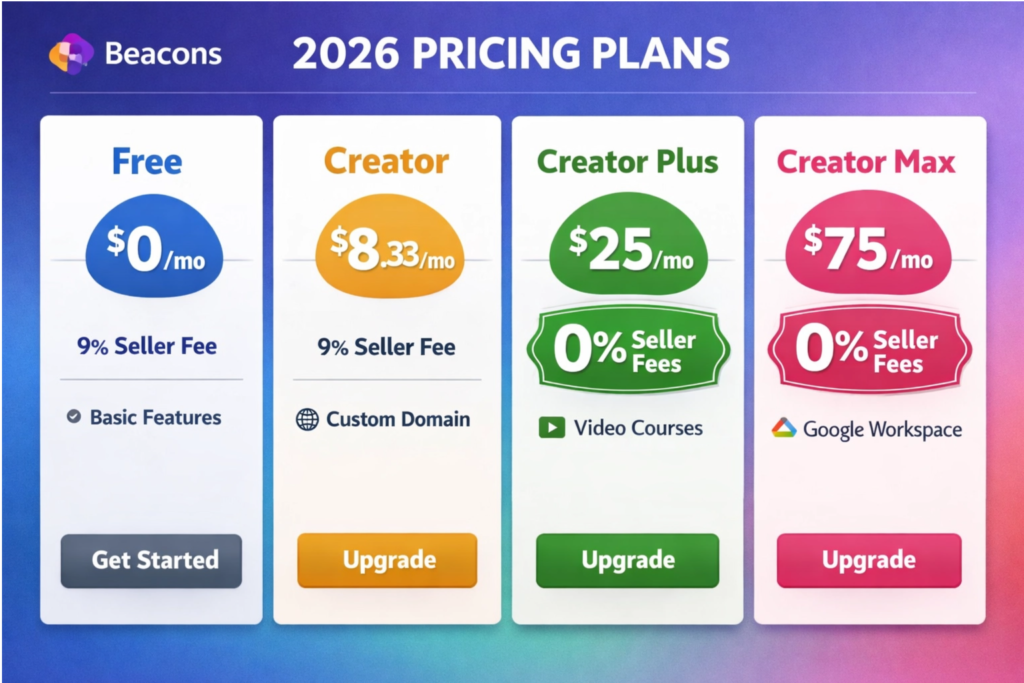
Now, let’s talk about the money side of things. When you’re choosing one of the best platforms to sell digital products, it’s essential to understand the pricing and fees involved.
Beacons offers a range of plans to suit creators at every stage of their journey, from those just starting out to those with established businesses.
I find their pricing to be very competitive, especially considering all the features they offer.
Here’s a breakdown of the Beacons pricing plans as of early 2026:
| Plan | Monthly Price (Billed Annually) | Transaction Fee | Key Features |
| Free | $0 | 9% | Unlimited digital products, affiliate links, basic media kit. |
| Creator | $8.33 | 9% | Custom domain, 300 daily AI credits, 500 email sends. |
| Creator Plus | $25 | 0% | Unlimited AI credits, video hosting for courses, memberships. |
| Creator Max | $75 | 0% | Google Workspace, white-glove onboarding. |
What’s amazing is that you can start selling unlimited digital products on the Free plan without paying any monthly fees.
You’ll only pay a 9% transaction fee on your sales, which is a great way to get started without any upfront investment. This low barrier to entry is a huge plus and makes Beacons one of the most accessible best platforms to sell digital products.
As your business grows, you can upgrade to one of the paid plans to unlock more features and lower your transaction fees.
The Creator Plus plan is particularly compelling, as it offers 0% transaction fees, which means you get to keep all the money you earn from your sales. This is a game-changer for creators with a high volume of sales, and it’s a feature that you won’t find on many other platforms.
The ability to eliminate transaction fees is a major reason why I believe Beacons is one of the best platforms to sell digital products for serious entrepreneurs.
Kajabi – Best Platforms to Sell Digital Products

Think of Kajabi as the central command center for your online empire. It’s an all-in-one platform designed specifically for experts, coaches, and course creators who want to monetize their knowledge and expertise.
Instead of paying for and managing a dozen different software subscriptions, Kajabi provides you with a single, integrated solution that handles everything from content creation to marketing and sales.
Kajabi is built for growth. It provides you with all the tools you need to not only create and sell your products but also to market them effectively. With features like unlimited landing pages, customizable sales funnels, and advanced email marketing capabilities, Kajabi empowers you to attract new customers, nurture your leads, and grow your revenue.
What Kinds of Digital Products Can You Sell on Kajabi?
Kajabi is an incredibly versatile platform that supports a wide range of digital products, making it a fantastic choice for creators with diverse offerings. This flexibility is another reason why I believe it’s one of the best platforms to sell digital products.
You’re not just limited to selling one type of product; you can create a whole ecosystem of offerings that cater to different segments of your audience.
Here are some of the main types of digital products you can create and sell on Kajabi:
- Online Courses: This is Kajabi’s bread and butter. You can create everything from simple mini-courses to comprehensive signature programs with video lessons, quizzes, assignments, and drip content. The course builder is incredibly intuitive and powerful.
- Coaching Programs: Kajabi has dedicated features for coaches, allowing you to create and sell one-on-one or group coaching programs. It integrates with scheduling tools, making it easy for clients to book sessions with you.
- Memberships: If you want to build a recurring revenue stream, you can create a membership site with exclusive content for your subscribers. Kajabi handles the recurring billing and content gating seamlessly.
- Communities: You can create a private community for your students or members, fostering engagement and building a loyal following. This is a great way to add value to your offerings and create a sense of belonging.
- Digital Downloads: Have an eBook, a template, a guide, or a set of worksheets to sell? Kajabi makes it easy to sell digital downloads as standalone products or as part of a larger offering.
- Podcasts: You can even host and monetize your podcast on Kajabi, whether it’s a public show or a private one for your members. This is a fantastic way to reach a new audience and build your brand.
What I love about Kajabi is that it allows you to bundle these different product types together. For example, you could create a high-ticket offer that includes an online course, access to a private community, and a series of one-on-one coaching sessions.
This ability to create complex and valuable offers is a key reason why Kajabi is one of the best platforms to sell digital products for creators who want to maximize their revenue potential.
Kajabi Pricing and Fees
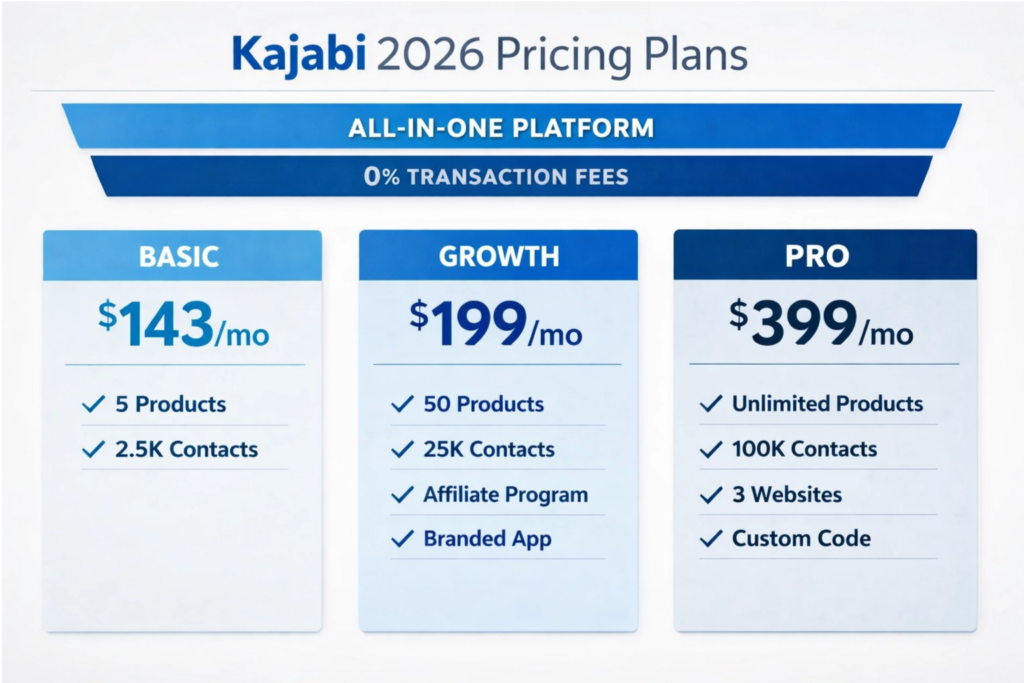
Now, let’s address the elephant in the room: the price. Kajabi is a premium platform, and its pricing reflects that.
However, when you consider that it replaces a multitude of other tools, the cost often becomes much more reasonable. When evaluating the best platforms to sell digital products, it’s important to look at the total cost of ownership, not just the monthly fee of one platform.
Here’s a breakdown of Kajabi’s pricing plans as of early 2026:
| Plan | Monthly Price (Billed Annually) | Monthly Price (Billed Monthly) | Key Features |
| Basic | $143 | $179 | 5 Products, 2,500 Contacts, 1 Website, Unlimited Landing Pages & Marketing Emails. |
| Growth | $199 | $249 | 50 Products, 25,000 Contacts, Affiliate Program, Branded Mobile App. |
| Pro | $399 | $499 | Unlimited Products, 100,000 Contacts, 3 Websites, Custom Code Editor. |
It’s important to note that Kajabi also has its own payment processor, Kajabi Payments, which has transaction fees that decrease as you upgrade your plan (from 2.9% + $0.30 on Basic to 2.7% + $0.30 on Pro).
If you choose to use a third-party payment provider like Stripe or PayPal, Kajabi charges an additional platform fee (from 2% on Basic down to 0.5% on Pro). While these fees are a consideration, the power of having everything integrated often outweighs the cost.
I see the investment in Kajabi as an investment in the long-term success of your business. By providing you with a stable, reliable, and powerful platform, Kajabi allows you to scale your business without worrying about technical issues or outgrowing your tools. This peace of mind is invaluable and is a major reason why I believe Kajabi is one of the best platforms to sell digital products for serious entrepreneurs.
PayLoadz – Best Platforms to Sell Digital Products

PayLoadz has been around for a long time, which means it has a proven track record of reliability.
While its interface might not be as modern or flashy as some of the newer platforms on the market, it is a stable and dependable solution that has been trusted by thousands of sellers over the years.
What I find particularly appealing about PayLoadz is its “bring your own platform” philosophy. It doesn’t lock you into a specific ecosystem.
Instead, it provides you with simple “Buy Now” buttons or links that you can place anywhere you want – on your WordPress site, your Squarespace blog, your social media profiles, or even in an email.
When a customer clicks that button, they are taken to a secure checkout page to complete their purchase. Once the payment is processed, PayLoadz automatically sends them an email with a secure, time-sensitive link to download their files.
What Kinds of Digital Products Can You Sell on PayLoadz?
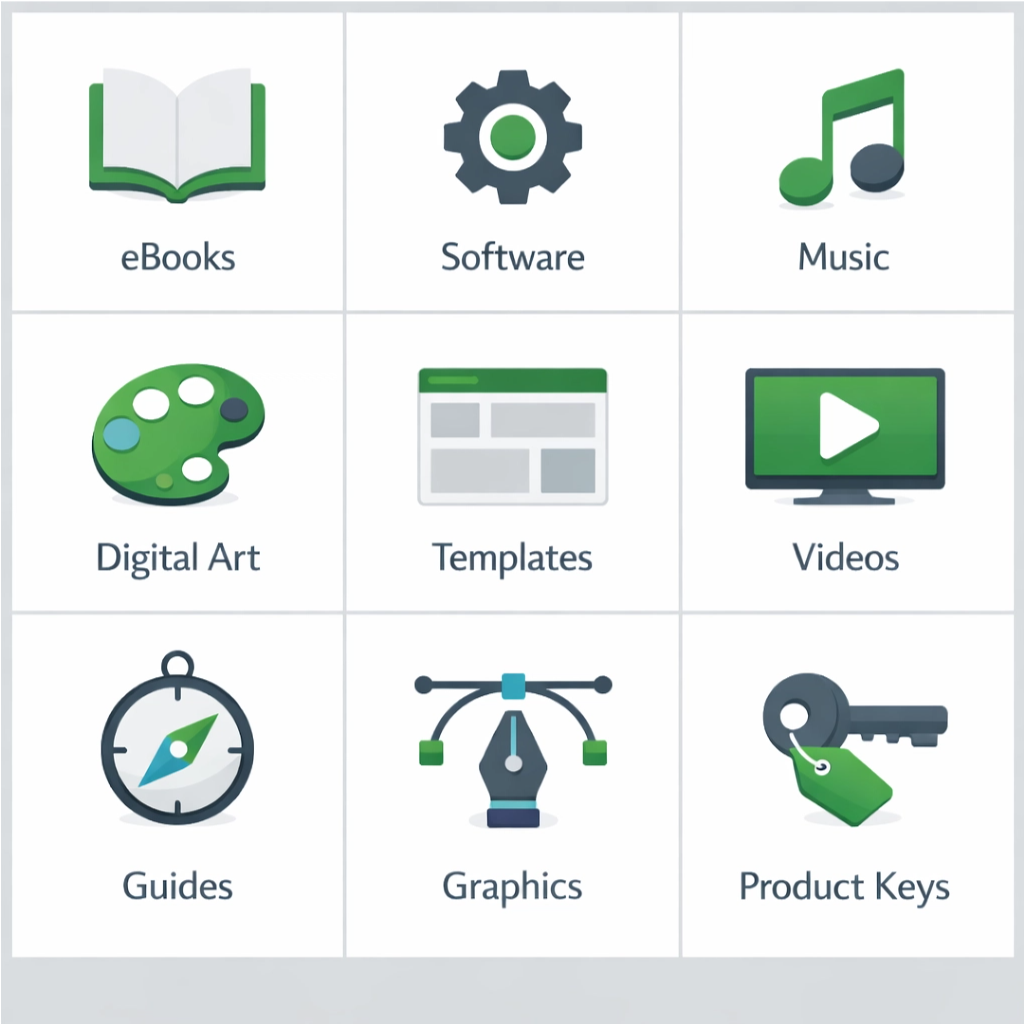
PayLoadz is designed to handle a wide variety of downloadable files, making it a flexible choice for many different types of creators. This versatility is another reason why I consider it one of the best platforms to sell digital products. If you can save it as a file, you can probably sell it on PayLoadz.
Here are some of the most common types of digital products that creators sell using PayLoadz:
- eBooks and Documents: This is a huge category, including everything from PDF guides and tutorials to ePub novels and research papers. If you’ve written something, PayLoadz can help you sell it.
- Software and Applications: For software developers, PayLoadz offers features like product key delivery and registration systems, making it a great choice for selling applications, scripts, and other code-based products.
- Music and Audio: Musicians and audio producers can easily sell their albums, singles, sample packs, or sound effects. PayLoadz handles the delivery of MP3s and other audio files with ease.
- Digital Art and Photos: Photographers and artists can sell their high-resolution images, digital paintings, stock photos, and other visual creations.
- Templates and Graphics: If you create templates for websites, documents, or social media, or if you design graphics like icons and illustrations, PayLoadz provides a simple way to sell them to your audience.
- Videos and Courses: While not a full-fledged course platform, you can certainly sell video files, such as tutorials, short courses, or stock footage, through PayLoadz.
What I appreciate about PayLoadz is its simplicity. You don’t need to worry about complex product setup options. You just upload your file, set a price, and you’re ready to go. This ease of use makes it one of the best platforms to sell digital products for creators who want to get started quickly and without a steep learning curve.
PayLoadz Pricing and Fees
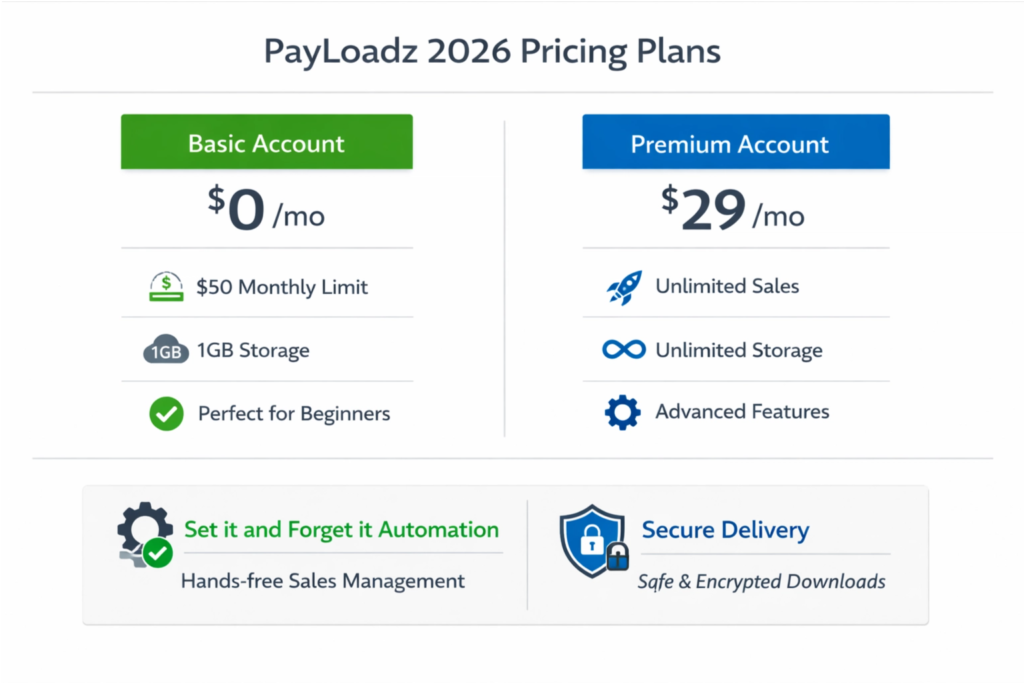
One of the most attractive aspects of PayLoadz is its affordability, especially for those who are just starting out.
When you’re looking for the best platforms to sell digital products, cost is always a major consideration, and PayLoadz offers a very accessible entry point.
Here’s a breakdown of the PayLoadz account types as of early 2026:
| Account Type | Monthly Fee | Transaction Limit (per month) | File Storage | Key Features |
| Basic Account | Free ($0) | $50 | 1 GB | A great starting point for new sellers with low sales volume. |
| Premium Account | $29 | Unlimited | Unlimited | Ideal for established sellers with higher sales volume and a need for unlimited storage. |
What’s fantastic about the Basic Account is that it’s completely free to get started. You don’t pay any monthly fees, and you can start selling your products right away.
You’re only limited by a total of $50 in sales per month and 1 GB of file storage. This is an incredible offer for anyone who wants to test the waters of selling digital products without any financial commitment. This free entry point is a major reason why I believe PayLoadz is one of the best platforms to sell digital products for beginners.
Once your sales exceed $50 in a month, you’ll need to upgrade to the Premium Account. At $29 per month, it’s still a very reasonably priced option, especially considering that it includes unlimited file storage and unlimited sales volume.
It’s important to note that PayLoadz also charges a transaction fee on the Premium Account (2.9% + $0.29), which is in addition to any fees charged by your payment processor (like PayPal). However, for the convenience and automation it provides, I find this to be a fair price.
Conclusion
To help you make an informed decision, I’ve compiled a master comparison table summarizing the key aspects of these best platforms to sell digital products.
This will allow you to quickly identify which platforms align with your priorities.
Making Your Final Decision
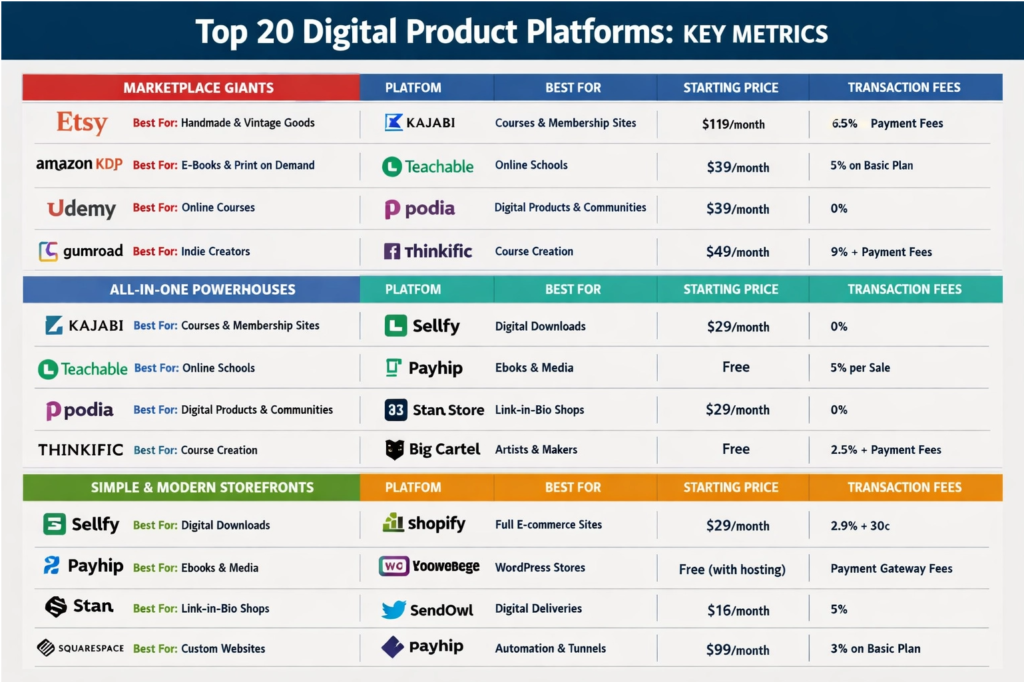
After exploring these 20 incredible options, you might still feel a bit overwhelmed. That’s perfectly normal!
The key is to stop looking for the perfect platform and instead focus on the right platform for you, right now.
Here’s my personalized roadmap to help you make that final, confident choice among the best platforms to sell digital products:
Step 1: Define Your Product and Audience
- What are you selling? (eBook, course, software, templates, art, coaching?)
- Who are you selling to? (Social media followers, students, tech enthusiasts, general public?)
- How many products do you plan to have? (One-off, a few, or a large catalog?)
Step 2: Assess Your Technical Comfort and Time Investment
- How comfortable are you with technology? (Do you want plug-and-play or full customization?)
- How much time can you dedicate to setup and maintenance? (Minutes, hours, or days?)
Step 3: Determine Your Budget and Revenue Goals
- What’s your starting budget? (Free, low monthly, or willing to invest more?)
- What are your revenue goals? (A few hundred dollars, thousands, or building an empire?)
Step 4: Use the Categories and Table to Narrow Down Your Choices
- If you need built-in traffic: Look at the Marketplace Giants (Etsy, Amazon KDP, AppSumo, Udemy, Skillshare).
- If you want an all-in-one solution for a knowledge business: Explore the All-in-One Powerhouses (Kajabi, Podia, LearnWorlds, Teachable, Thinkific).
- If you want a quick, stylish store: Check out the Simple & Modern Storefronts (Gumroad, Payhip, Sellfy, Beacons, Fourthwall).
- If you need integration and control: Consider the E-commerce & Utility Tools (Shopify, WooCommerce, SendOwl, ClickBank, PayLoadz).
Step 5: Test Drive Your Top 2-3 Choices
Most platforms offer free trials or free plans. Take advantage of them! Sign up, upload a product, and go through the entire process. See how it feels. This hands-on experience is invaluable and will often reveal the true “best” platform for you.
Final Thoughts
I truly believe that 2026 is an incredible year to be a digital creator. The demand for digital products is skyrocketing, and the tools available to help you sell them are more powerful and accessible than ever before.
Whether you’re sharing your knowledge, your art, or your unique skills, there’s an audience waiting for what you have to offer.
Don’t let the sheer number of options paralyze you. Use this guide as your compass. Pick a platform, commit to it, and start creating. The journey of a thousand sales begins with that first courageous step. I’m excited to see what you build!
Thank you for joining me on this extensive exploration of the best platforms to sell digital products. I hope this master guide empowers you to launch, grow, and thrive in the digital economy. Now, go forth and create your digital destiny!
We’ve barely scratched the surface of best platforms to sell digital products, with it having much more going on. There’s a reason it made it onto our digital product guide , and we highly recommend you check it out.