The Proven Blueprint for How to Sell Digital Products in 2026

Spread the love

Are you a creator with brilliant ideas, but constantly wondering how to sell digital products effectively in today’s crowded online world? 

Many talented individuals struggle to bridge the gap between creation and consistent income, feeling overwhelmed by the sheer number of platforms and marketing strategies. 

This comprehensive guide cuts through the confusion, offering clear, actionable insights into leveraging powerful channels like TikTok, Instagram, Pinterest, blogging, email lists, and YouTube tutorials. 

I’ll show you how to transform your expertise into a thriving digital business, providing the exact blueprint to connect with your audience, build trust, and drive sales for your unique digital creations.

TikTok videos – How to sell digital products 

TikTok videos - How to sell digital products 

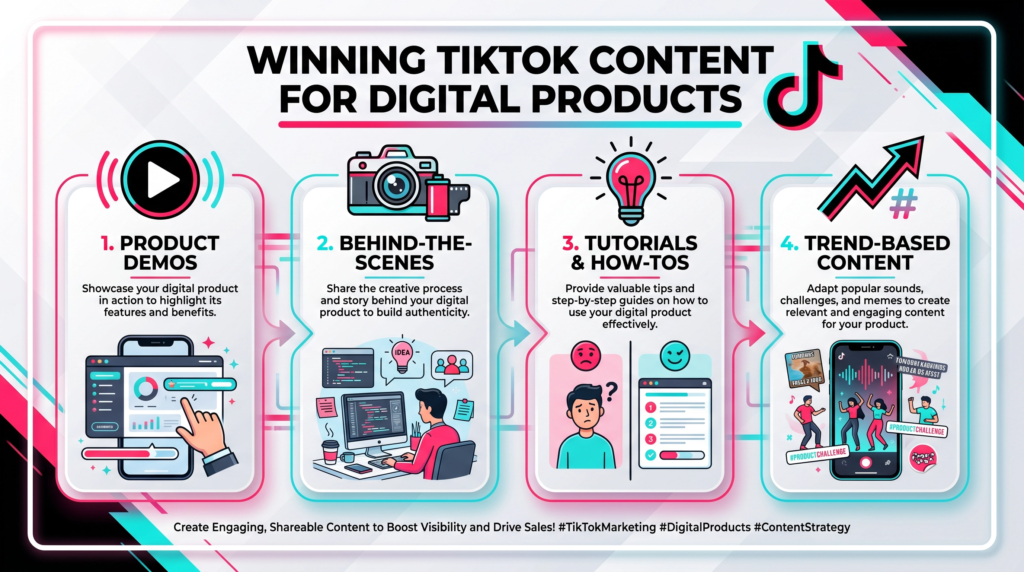
TikTok has become one of the most effective, and frankly, most exciting ways to connect with customers and sell your digital creations.

I know what you might be thinking. Isn’t TikTok just for dancing and funny memes? While it definitely has its fair share of entertainment, TikTok has evolved into a massive discovery engine where people come to learn, find solutions to their problems, and, yes, buy things. 

The beauty of this platform is that you don’t need a huge following or a big budget to succeed. What you need is a good product and a smart strategy, and that’s exactly what I’m here to help you with.

Setting Up Your TikTok Account for Success

Before you can effectively implement a strategy for how to sell digital products, you need to lay the proper foundation. This means optimizing your TikTok profile to act as a sales funnel.

Step 1: Switch to a Business Account

Your first move should be to switch your personal TikTok account to a Business Account. This is a simple but crucial step that unlocks a suite of powerful tools. 

A Business Account gives you access to detailed analytics, allowing you to see who is watching your videos, when they are most active, and which content is performing best. 

More importantly, it gives you the ability to add a clickable link in your bio (once you meet certain criteria, typically 1,000 followers, though this can vary). This link is the bridge between your TikTok content and your online store, making it an essential component of how to sell digital products.

Step 2: Craft a Compelling Bio

Your TikTok bio is your digital elevator pitch. You have a very limited space to tell people who you are, what you do, and why they should care. Your bio should clearly state your niche and the value you provide. For example, instead of just “Digital Creator,” try something like “I help students get organized with Notion templates.” This immediately tells your target audience that they are in the right place. Your bio is also where you will place your all-important link, so you need to direct people to it with a clear call to action (CTA), such as “👇 Get my best-selling planner here!”

The link in your bio is the most valuable piece of real estate on your TikTok profile. It’s the primary mechanism for how to sell digital products. You can’t just drop a random link there; you need a strategy. This is where link-in-bio tools come in. 

Platforms like Beacons, Stan Store, or Linktree allow you to create a simple, mobile-friendly landing page that can host multiple links. This is perfect for showcasing your main digital product, linking to a freebie to grow your email list, and connecting to your other social media profiles. 

Your link-in-bio page should be clean, on-brand, and make it incredibly easy for someone to find and purchase your digital product.

The Core Video Strategies for Selling Digital Products

Now for the fun part: creating the actual TikTok videos! The key to understanding how to sell digital products on this platform is to remember that you are not making commercials. 

You are creating valuable, engaging content that naturally leads to a sale. Here are the most effective video formats for 2026.

The “Problem/Solution” Hook

This is the most classic and effective marketing framework, perfectly adapted for short-form video. The first three seconds of your video are the most critical, and you need to use them to hook the viewer by presenting a relatable problem. 

For example:

  • Problem: “Are you tired of your messy and disorganized Google Calendar?”
  • Agitate: “You keep missing appointments and feeling overwhelmed.”
  • Solution: “I created a digital planner that syncs with your calendar and organizes your entire life. 

Here’s how it works…”

In the rest of the video, you would quickly showcase the beautiful design and key features of your planner. This format works because it immediately connects with the viewer’s pain points and presents your digital product as the perfect solution. This is a fundamental tactic for anyone learning how to sell digital products.

The “Behind-the-Scenes” Glimpse

People love to see the creative process. A video showing you designing your digital product, brainstorming ideas, or even packaging it up (metaphorically, of course) can build a powerful connection with your audience. This type of content establishes you as an expert and builds trust. 

For example, you could create a time-lapse video of you designing a new set of Lightroom presets or illustrating an eBook cover. This transparency makes your audience feel invested in your work and more likely to support you by purchasing the final product.

The “Educational Value” Post (Edutainment)

This is where you provide a quick tip, a mini-tutorial, or a valuable piece of information related to your niche, completely for free. 

For example, if you sell a course on social media marketing, you could create a 60-second video on “Three Ways to Write Better Instagram Captions.” 

At the end of the video, you can subtly mention your full course for those who want to learn more. This strategy positions you as a helpful authority and is a core principle of how to sell digital products through content marketing. 

You are giving value first, which makes your audience more receptive to your paid offerings.

The “Testimonial/UGC” Showcase

Social proof is one of the most powerful tools in marketing. 

When you start getting positive feedback from customers, showcase it! You can create a video featuring a screenshot of a positive comment, a screen recording of a customer using your template, or even a video reply to a happy customer’s comment. 

This shows potential buyers that your product is not only legitimate but also delivers real results for real people. 

Encouraging user-generated content (UGC) by asking customers to tag you in their videos is a fantastic, long-term strategy for anyone serious about how to sell digital products.

Optimizing Your Videos for the TikTok Algorithm

Creating great content is only half the battle. You also need to optimize your videos to ensure the TikTok algorithm shows them to the right people. This is often referred to as “TikTok SEO.”

  • Use Relevant Keywords: Just like Google, TikTok is a search engine. Use relevant keywords in your video captions, in the on-screen text, and even speak them in your video (TikTok’s auto-captions are indexed for search). Think about what your target customer would search for and include those terms.
  • Leverage Trending Sounds and Music: Using trending audio can give your video a significant boost in visibility. Scroll through your “For You” page and pay attention to the sounds that appear frequently. If you can creatively incorporate a trending sound into your content, the algorithm is more likely to favor it.
  • Master Your Hashtags: Use a combination of broad, niche, and product-specific hashtags. 

For example, a video about a budget template could use #budgeting (broad), #budgetingtips (niche), and #digitalbudgetplanner (product-specific). This helps the algorithm understand exactly what your video is about and who to show it to.

The Sales Funnel: From TikTok Video to Purchase

Let’s tie it all together. 

Here is the complete user journey, from the moment they see your video to the moment they become a customer. 

Understanding this funnel is the final piece of the puzzle in learning how to sell digital products.

  • Discovery: A user is scrolling their “For You” page and sees your engaging video about solving a problem they have.
  • Engagement: They watch your video, find it valuable, and maybe give it a like or a comment.
  • Profile Visit: Intrigued, they tap on your profile to see what else you have to offer.
  • Bio & Link: They read your compelling bio and see your clear call to action, prompting them to click the link-in-bio.
  • Landing Page: They arrive at your link-in-bio landing page, where your digital product is prominently featured.
  • Conversion: They click through to your product page (on a platform like Gumroad, Payhip, or your own website) and make a purchase.

Your job is to optimize every single step of this funnel. Create high-value videos, write a clear bio, build an effective link-in-bio page, and ensure your checkout process is as smooth as possible.

Instagram Reels – How to sell digital products 

Instagram Reels - How to sell digital products 

I know that Instagram might seem like a crowded space, and you might be thinking, “Do my short videos really stand a chance?” The answer is a resounding yes! 

Instagram’s algorithm, particularly for Reels, has evolved to prioritize content that resonates with individual users, regardless of your follower count. This means that even if you’re just starting out, your well-crafted Reel about a digital planner or an online course can reach thousands of potential customers. 

The key is understanding the platform’s nuances and creating content that truly connects. 

Optimizing Your Instagram Profile for Digital Product Sales

Just like setting up a physical storefront, preparing your Instagram profile is a critical first step in learning how to sell digital products successfully. 

Your profile acts as your digital shop window, and it needs to be inviting, informative, and optimized for conversion.

Step 1: Craft a Compelling Bio with a Clear Call-to-Action

Your Instagram bio is prime real estate. It’s the first thing people see when they land on your profile, and it needs to clearly communicate what you offer and for whom. Instead of a generic description, make it specific and value-driven. 

For example, if you sell digital art brushes, your bio could be: “Helping artists create stunning digital masterpieces with custom Procreate brushes. ✨ Get yours here! 👇”. The emoji adds visual appeal, and the clear call-to-action (CTA) directs visitors to your link. This directness is key for anyone figuring out how to sell digital products effectively.

The single clickable link in your Instagram bio is your most powerful tool for driving traffic to your digital products. Since Instagram only allows one external link, you need to make it count. This is where a dedicated link-in-bio tool like Linktree, Beacons, or Stan Store becomes indispensable. 

These tools allow you to create a mini-landing page with multiple links, directing your audience to your main digital product, a free lead magnet, your other social media channels, or even a direct checkout page. 

Ensure your link-in-bio page is clean, mobile-friendly, and clearly highlights your digital products. This streamlined approach is fundamental to how to sell digital products efficiently from Instagram.

Step 3: Utilize Highlights for Product Showcases and FAQs

Instagram Story Highlights are a fantastic way to create evergreen content that lives permanently on your profile. 

Use them to showcase your digital products, share testimonials, answer frequently asked questions, and provide mini-tutorials. 

For instance, you could have a highlight reel titled “Product Demos” showing your digital planner in action, another called “Happy Customers” featuring glowing reviews, and an “FAQ” highlight addressing common queries. 

These highlights serve as a valuable resource for potential buyers and reinforce your credibility, making it easier for them to understand how to sell digital products from you.

Creating Engaging Reels Content to Drive Sales

Now that your profile is optimized, let’s talk about the heart of your strategy: the Reels themselves. 

The goal isn’t just to get views; it’s to create content that educates, inspires, and ultimately leads to sales. 

Here are the most effective content strategies for how to sell digital products on Instagram Reels in 2026.

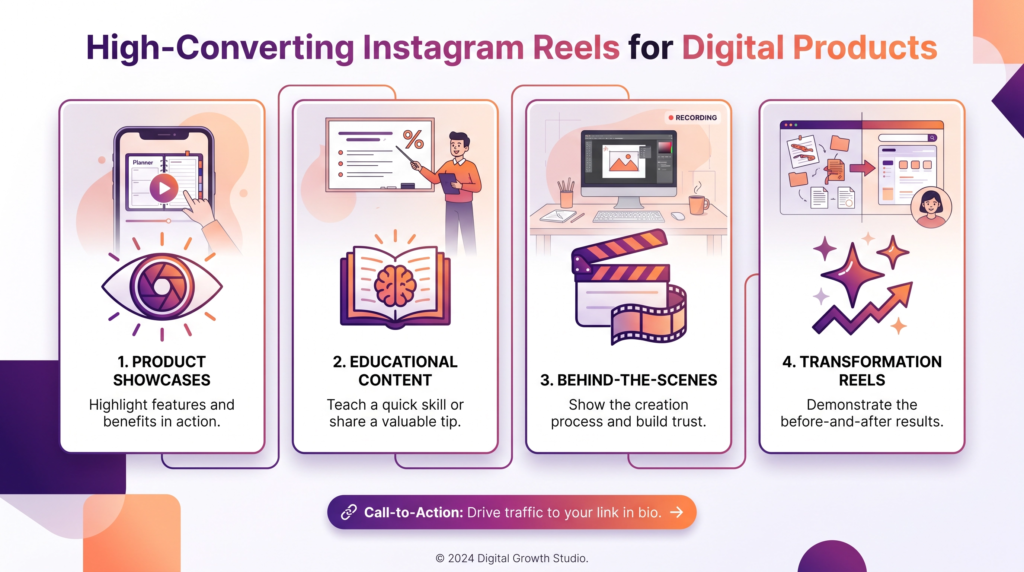
1. The “Specific Solution” Hook

This strategy is about identifying a very precise problem your target audience faces and immediately presenting your digital product as the solution. The first few seconds are crucial for grabbing attention. 

For example, if you sell a Notion template for content creators, your Reel could start with: “Struggling to keep track of your content ideas?” followed by a quick, visually appealing demonstration of how your Notion template solves that exact problem. 

This direct approach resonates deeply with viewers who are actively seeking solutions, making it a powerful method for how to sell digital products.

2. “Behind-the-Scenes” and Process Videos

People are inherently curious about how things are made. Showing snippets of your creative process—whether it’s designing a digital product, outlining a course module, or even just your workspace—builds authenticity and connection. 

These videos don’t have to be highly polished; in fact, a more raw, authentic feel often performs better on Reels. 

For instance, a time-lapse of you creating a new digital brush set for Procreate can be incredibly engaging and subtly highlight the quality and effort behind your product. This transparency helps in building trust, which is essential for how to sell digital products successfully.

3. Value-Driven Educational Clips (Edutainment)

This is where you provide immense value upfront, without asking for anything in return. Share a quick tip, a mini-tutorial, or a valuable insight related to your niche. 

For example, if you sell an eBook on healthy meal prep, you could create a Reel demonstrating a quick, healthy snack recipe. 

At the end, you can gently introduce your eBook as the comprehensive guide for more recipes and meal plans. 

This strategy positions you as an expert and a helpful resource, making your audience more receptive when you eventually present your digital product. This is a subtle yet effective way to demonstrate how to sell digital products by leading with value.

4. “Faceless Reels” for Camera-Shy Creators

If you’re not comfortable appearing on camera, don’t worry! 

Faceless Reels are a massive trend in 2026 and are incredibly effective for selling digital products. 

These videos typically feature aesthetic B-roll footage (e.g., hands typing on a keyboard, beautiful scenery, product mockups) combined with engaging on-screen text and trending audio. 

You can use this format to showcase your digital product, highlight its features, or share valuable tips without ever showing your face. 

This opens up a world of possibilities for creators who might otherwise hesitate to use video content for how to sell digital products.

5. Testimonials and User-Generated Content (UGC)

Nothing sells a digital product better than social proof. Encourage your happy customers to share their experiences and tag you. 

Reposting these testimonials, reviews, or videos of customers using your product on your Reels is incredibly powerful. It provides authentic validation and shows potential buyers that your product delivers real results. 

You can even create a Reel asking for testimonials or showcasing a compilation of positive feedback. This builds immense credibility and answers the unspoken question of “Does this actually work?” for anyone considering how to sell digital products from you.

Optimizing Your Reels for Instagram’s 2026 Algorithm

Creating compelling content is just one part of the equation. 

To truly master how to sell digital products on Instagram Reels, you need to understand and work with the algorithm. 

Here are the key optimization strategies for 2026:

  • Focus on Watch Time and Engagement: The Instagram algorithm prioritizes Reels that keep users watching until the end and generate high engagement (saves, shares, comments). Aim for concise, captivating content that hooks viewers immediately and encourages interaction. Ask questions in your captions to spark comments.
  • Use Trending Audio: Incorporating trending audio (music or sounds) can significantly boost your Reel’s visibility. Instagram actively promotes Reels that use popular audio. Always check the trending audio section in the Reels editor and see if you can creatively integrate it into your content. This is a quick win for increasing your reach when learning how to sell digital products.
  • Strategic Keyword Placement: While hashtags are still useful, Instagram’s AI is becoming increasingly sophisticated at understanding content through keywords in captions, on-screen text, and even spoken words. Ensure your captions are descriptive and include relevant keywords that your target audience might search for. For example, if you sell a fitness planner, use terms like “fitness planner,” “workout tracker,” “health journal” in your text.
  • Consistent Posting Schedule: The algorithm rewards consistency. Aim for a regular posting schedule (e.g., 3-4 Reels per week) to keep your audience engaged and signal to Instagram that you’re an active creator. Consistency builds momentum and helps you stay top-of-mind for your audience, which is crucial for how to sell digital products over time.
  • Utilize Instagram Shopping Features: If available in your region, leverage Instagram Shopping features like product tags directly within your Reels. This allows users to tap on your digital product within the video and go directly to its product page, creating a seamless shopping experience. This direct integration is a powerful tool for how to sell digital products efficiently.

The Instagram Reels Sales Funnel: From View to Value

Let’s put it all together and visualize the journey a potential customer takes from discovering your Reel to purchasing your digital product. 

Understanding this funnel is essential for anyone learning how to sell digital products effectively.

  • Discovery (For You Page/Explore): A user is scrolling through Reels and your captivating video appears, solving a problem or offering valuable insight related to their interests.
  • Engagement (Watch, Like, Comment, Share, Save): The user watches your Reel, finds it helpful, and engages with it. Saves and shares are particularly strong signals to the algorithm.
  • Profile Visit: Intrigued by your content, the user taps on your profile to learn more about you and what you offer.
  • Bio & Link Click: They read your optimized bio, see your clear call-to-action, and click on your link-in-bio.
  • Landing Page/Storefront: They arrive at your link-in-bio page or direct storefront, where your digital product is prominently displayed and easy to purchase.
  • Conversion (Purchase): The user makes a purchase, becoming a happy customer and potentially a repeat buyer.

Your mission is to optimize each step of this funnel. 

Create irresistible Reels, make your profile a welcoming storefront, and ensure your checkout process is as smooth as possible. 

This holistic approach is the secret to how to sell digital products successfully on Instagram Reels.

Pinterest pins – How to sell digital products 

Pinterest pins - How to sell digital products 

I understand that you might think of Pinterest as a “softer” platform compared to the fast-paced worlds of TikTok or Instagram. However, that’s precisely where its strength lies. 

Unlike social media feeds where content has a lifespan of a few hours, a single, well-optimized Pin can continue to drive traffic and sales for months, or even years, after you’ve posted it. It’s the ultimate “set it and forget it” marketing tool for digital product creators. 

Setting Up Your Pinterest Profile for Maximum Sales

To effectively use Pinterest for how to sell digital products, you need to treat your profile as a professional storefront. 

It should be optimized to attract your target audience and guide them seamlessly toward a purchase.

Step 1: Convert to a Business Account

If you haven’t already, your first step is to convert your personal Pinterest account to a free Business Account. This unlocks a wealth of essential features, including in-depth analytics, the ability to claim your website, and access to Pinterest Ads. 

The analytics alone are invaluable, providing insights into which of your Pins are performing best, what your audience is interested in, and how much traffic you’re driving to your website. This data is crucial for refining your strategy on how to sell digital products.

Step 2: Optimize Your Bio and Profile

Your Pinterest bio should be clear, concise, and keyword-rich. Tell visitors exactly who you are and what you offer. 

For example, if you sell digital planners, your bio could be: “Helping you achieve your goals with beautiful and functional digital planners, templates, and stickers.” This immediately tells your target audience that they are in the right place. 

Also, ensure your profile picture is a clear, professional headshot or a high-quality logo to build brand recognition.

Step 3: Create Keyword-Rich Boards

Think of your Pinterest boards as the categories in your online store. Each board should be dedicated to a specific topic or niche related to your digital products. 

For example, if you sell a variety of digital products for entrepreneurs, you might have boards titled “Social Media Marketing Tips,” “Branding for Small Businesses,” and “Productivity Hacks.” 

Use relevant keywords in your board titles and descriptions to help Pinterest understand what your content is about and show it to the right people. This organization is a fundamental part of how to sell digital products on the platform.

Designing Pinterest Pins That Convert

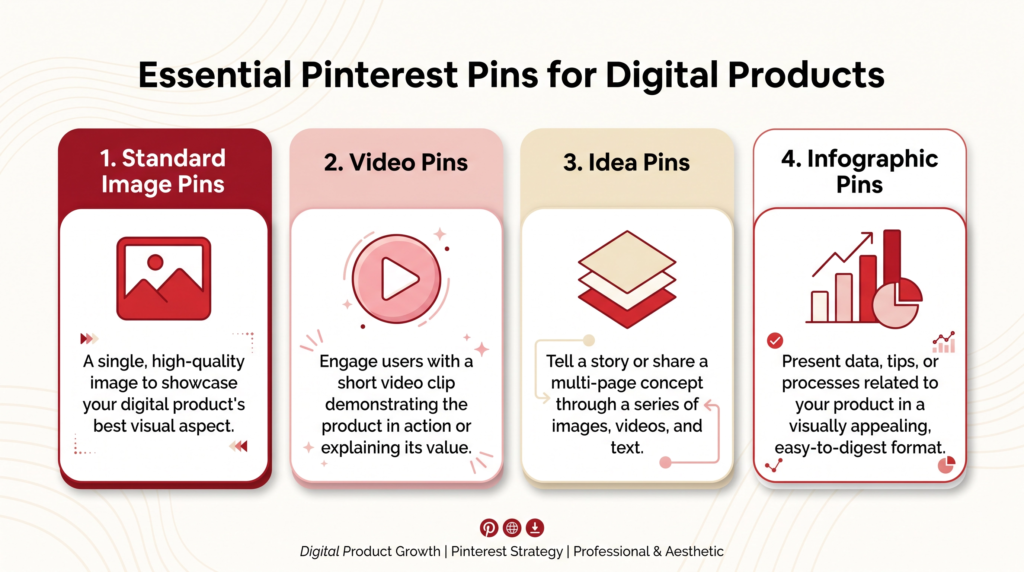
Your Pins are your digital salespeople. They need to be visually appealing, informative, and compelling enough to make someone stop scrolling and click. Here are the essential elements of a high-converting Pin for how to sell digital products in 2026.

1. Use the Optimal Pin Size

Pinterest is a vertical platform, so your Pins should be designed accordingly. The ideal aspect ratio is 2:3 (e.g., 1000 x 1500 pixels). This ensures your Pins take up maximum screen real estate on mobile devices, where the majority of Pinterest users are active. 

Avoid square or horizontal images, as they tend to get lost in the feed.

2. Create Stunning Visuals and Mockups

Since your product is digital, you need to bring it to life visually. Use high-quality mockups to showcase your digital product in a real-world context. 

For example, show your digital planner on an iPad screen, your eBook on a Kindle, or your presets applied to a beautiful photograph. This helps potential customers visualize themselves using your product and understand its value. This is a critical step in how to sell digital products that are intangible.

3. Add a Bold Text Overlay

Don’t assume people will read your Pin’s description. Your image itself should communicate the main benefit of your digital product. Use a bold, easy-to-read font to add a text overlay that clearly states what your Pin is about. 

For example, “The Ultimate Guide to Starting a Blog” or “5 Steps to a More Organized Life.” This text overlay is your headline, and it needs to be compelling enough to stop the scroll.

4. Brand Your Pins Consistently

To build brand recognition, ensure your Pins have a consistent look and feel. Use your brand’s colors, fonts, and logo on all your Pins. When a user repeatedly sees your branded Pins in their feed, they will start to recognize and trust your brand, making them more likely to click and purchase from you in the future. This consistency is key to a long-term strategy for how to sell digital products.

The Pinterest Sales Funnel: From Pin to Purchase

Understanding the user journey on Pinterest is crucial for optimizing your sales process. 

Here’s a breakdown of the typical sales funnel for how to sell digital products on the platform.

  1. Discovery (Search/Feed): A user searches for a solution on Pinterest (e.g., “how to create a budget”) and your visually appealing Pin appears in their search results or home feed.
  2. Engagement (Click/Save): The user is intrigued by your Pin’s design and compelling headline, so they click on it to see it in more detail or save it to one of their boards for later.
  3. Traffic (Website Click): After reading your Pin’s description, the user clicks the link to visit your website, blog post, or landing page.
  4. Lead Generation (Email Opt-in): On your landing page, you offer a valuable freebie (a lead magnet) in exchange for their email address. This is a crucial step for building a long-term relationship with your audience.
  5. Nurturing (Email Sequence): You send a series of automated emails that provide more value, build trust, and eventually introduce your main digital product.
  6. Conversion (Purchase): Having been nurtured through your email sequence, the user is now ready to purchase your digital product.

While you can link directly to a sales page from your Pins, the lead magnet funnel is often more effective for how to sell digital products, as it allows you to build a relationship with your audience and market to them directly in their inbox.

Mastering Pinterest SEO for Long-Term Success

To ensure your Pins are discovered for years to come, you need to master Pinterest SEO. 

Here are the key strategies for optimizing your content for how to sell digital products through search.

  • Conduct Thorough Keyword Research: Use the Pinterest search bar to find relevant keywords. Type in a broad term related to your niche and see what suggestions Pinterest provides. These are the exact terms that users are searching for. Sprinkle these keywords naturally throughout your Pin titles, descriptions, and board descriptions.
  • Write Compelling, Keyword-Rich Descriptions: Your Pin description is your opportunity to tell Pinterest exactly what your content is about. Write a few sentences that describe the value of your Pin and include your target keywords. Don’t just stuff keywords; write for humans first, and the algorithm will follow.
  • Leverage Pinterest Trends: Use the Pinterest Predicts tool to see what topics are projected to trend in the coming year. Creating content around these trends can give you a significant first-mover advantage and help you reach a massive audience. Aligning your digital products with these trends is a smart way to increase your sales potential.
  • Pin Consistently: Pinterest rewards creators who are active on the platform. Aim to pin consistently, whether it’s one new Pin a day or a few times a week. Using a scheduler tool like Tailwind can help you maintain a consistent pinning schedule without having to be on the platform 24/7.

Blog posts – How to sell digital products 

Blog posts - How to sell digital products

In a world of fleeting social media trends, a high-quality blog remains one of the most effective and reliable assets for building a business. 

I know that starting a blog can feel like a monumental task, especially when you see the fast-paced action on platforms like TikTok and Instagram. 

You might be wondering, “Is blogging still relevant in 2026?” The answer is a definitive yes, but the strategy has evolved. 

It’s no longer about just churning out content; it’s about creating high-value, strategic posts that serve your audience and seamlessly integrate your digital products.

Setting Up Your Blog for Sales Success

To effectively use your blog for how to sell digital products, you need to think of it as more than just a collection of articles. It needs to be a strategically designed sales funnel that guides visitors from reader to customer.

Step 1: Choose the Right Platform and Hosting

While there are many blogging platforms, a self-hosted WordPress.org site is the gold standard for serious bloggers. 

It gives you complete control over your website’s design, functionality, and monetization. Paired with a reliable hosting provider like Bluehost, SiteGround, or WP Engine, a self-hosted WordPress site provides the professional foundation you need for how to sell digital products.

Step 2: Design a Clean, User-Friendly Layout

Your blog’s design should be clean, professional, and easy to navigate. Avoid clutter and distractions. 

Your primary goal is to make it easy for visitors to read your content and find your calls-to-action. 

Ensure your website is mobile-friendly, as a significant portion of your traffic will come from mobile devices. 

A positive user experience is crucial for keeping visitors on your site and guiding them toward a purchase.

Step 3: Create a Compelling “About” Page

Your “About” page is one of the most visited pages on your blog. It’s your opportunity to connect with your audience on a personal level, share your story, and explain why you are passionate about your niche. 

A compelling “About” page builds trust and makes your audience feel like they know you, which is a powerful factor in their decision to buy from you. This is a key part of the human connection that is so important for how to sell digital products.

The Content Strategy: Writing Blog Posts That Sell

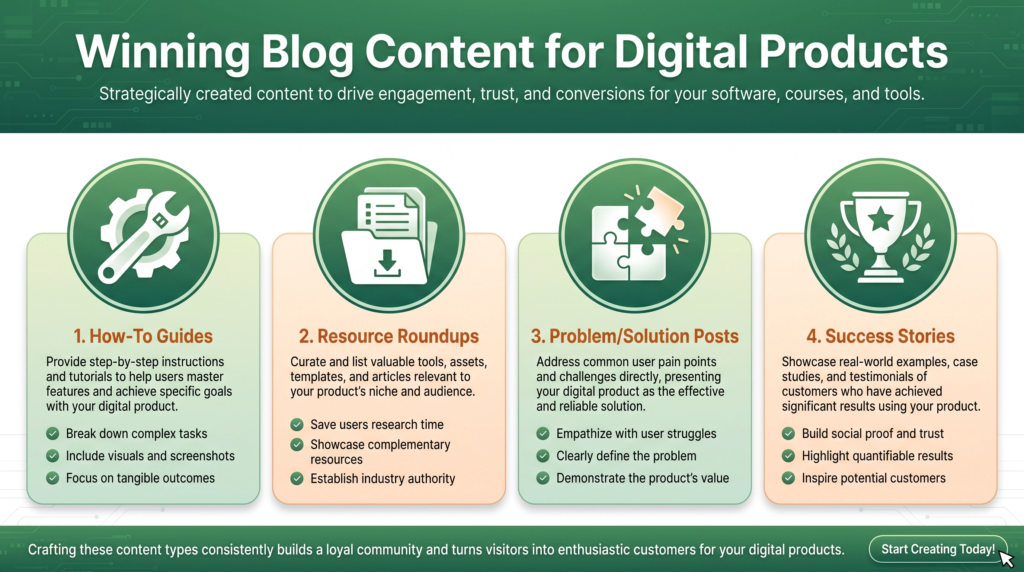
Now for the heart of your strategy: the content itself. Your blog posts are not just articles; they are strategic assets designed to attract, engage, and convert your target audience. 

Here are the most effective types of blog posts for how to sell digital products in 2026.

1. The “Ultimate Guide” or “Pillar Post”

This is a long-form, comprehensive post that covers a broad topic in your niche in great detail. 

For example, if you sell a course on email marketing, you could write an “Ultimate Guide to Email Marketing for Beginners.” This post establishes your authority and becomes a go-to resource for people interested in that topic. 

Within this guide, you can naturally introduce your course as the next step for those who want to master the subject. This is a powerful strategy for how to sell digital products by providing immense value upfront.

2. The “How-To” or “Tutorial” Post

This type of post provides a step-by-step guide to solving a specific problem. 

For example, if you sell a set of Lightroom presets, you could write a tutorial on “How to Edit Your Photos Like a Pro in 5 Easy Steps.” 

In the tutorial, you would use your presets to demonstrate the process, showing them in action and highlighting their benefits. This is an incredibly effective way to showcase the value of your product and make people want to buy it. This practical demonstration is key to how to sell digital products.

3. The “Case Study” or “Results” Post

Social proof is a powerful motivator. A case study post tells the story of how a customer used your digital product to achieve a specific result. 

For example, “How [Customer Name] Doubled Their Website Traffic in 30 Days Using My SEO Checklist.” This type of post provides tangible proof that your product works and helps potential customers visualize their own success. 

This is a compelling way to answer the question, “Will this work for me?” which is a common barrier when learning how to sell digital products.

4. The “Comparison” or “Alternatives” Post

This post compares different tools, methods, or products, with your digital product positioned as the best solution. 

For example, “Why My Digital Planner is Better Than a Paper Planner” or “The Best Tools for Organizing Your Life (And Why My Template is #1).”

 This allows you to address potential objections and highlight the unique features and benefits of your product in a direct and persuasive way. 

This is a more advanced strategy for how to sell digital products, but it can be very effective.

The Blog Sales Funnel: Turning Readers into Customers

Understanding the journey a visitor takes on your blog is essential for optimizing your sales process. 

Here is the classic blog sales funnel for how to sell digital products.

  1. Awareness (Traffic): A user discovers your blog post through a Google search, a social media share, or a link from another website.
  2. Interest (Engagement): The user reads your high-value blog post and is impressed by your expertise and the quality of your content.
  3. Desire (Lead Magnet): Within the blog post, you offer a “content upgrade” – a free, highly relevant resource (like a checklist, template, or mini-guide) in exchange for their email address. This is your lead magnet.
  4. Nurturing (Email Sequence): Once the user is on your email list, you send them a series of automated emails that continue to provide value, build the relationship, and eventually introduce your paid digital product.
  5. Action (Conversion): Having been warmed up by your valuable content and email sequence, the user is now ready and eager to purchase your digital product.

This funnel is the cornerstone of a sustainable strategy for how to sell digital products through blogging. It focuses on building a relationship first, which leads to much higher conversion rates than simply asking for the sale upfront.

Mastering SEO for Your Blog in 2026

To ensure a steady stream of traffic to your blog, you need to master the art of SEO. 

Here are the key strategies for how to sell digital products through search engine optimization.

  • Conduct In-Depth Keyword Research: Use tools like Ahrefs, SEMrush, or even the free Google Keyword Planner to find the exact phrases your target audience is searching for. 

Focus on long-tail keywords (longer, more specific phrases) as they often have less competition and higher conversion rates.

  • Optimize Your On-Page SEO: This includes using your target keyword in your blog post title, URL, headings, and throughout your content. 

Also, be sure to write a compelling meta description to entice users to click on your post in the search results.

  • Build High-Quality Backlinks: Backlinks (links from other websites to yours) are a major ranking factor for Google. You can earn backlinks by creating amazing content that other people naturally want to link to, or by guest posting on other blogs in your niche.
  • Focus on User Experience: Google wants to rank websites that provide a great user experience. This means your site should be fast, mobile-friendly, and easy to navigate. A positive user experience not only helps with SEO but also increases the likelihood that visitors will stay on your site and purchase your products.

Email list – How to sell digital products 

Email list - How to sell digital products

If you’re serious about building a sustainable and highly profitable business around your digital products, then understanding how to sell digital products effectively means mastering the art of email marketing. 

In a world buzzing with fleeting social media trends and ever-changing algorithms, your email list stands as your most valuable asset—a direct line of communication to your most engaged audience. 

I’m here to guide you through the exact strategies you need to build, nurture, and monetize an email list that consistently converts.

I know what you might be thinking: “Email? Isn’t that a bit old-school?” While social media platforms offer instant gratification, an email list provides unparalleled stability, control, and a deeply personal connection with your audience. 

It’s not about sending spam; it’s about delivering value, building trust, and guiding your subscribers toward solutions that genuinely help them.

Building Your Email List: The Foundation of Digital Product Sales

Before you can effectively sell digital products via email, you need an audience to sell to. 

Building a high-quality email list is the critical first step. It’s not about quantity; it’s about attracting the right people who are genuinely interested in your niche.

Step 1: Choose the Right Email Service Provider (ESP)

Your ESP is the engine behind your email marketing efforts. 

Popular choices like ConvertKit, MailerLite, ActiveCampaign, or Klaviyo offer robust features for list building, automation, and analytics. 

Select an ESP that fits your budget, offers the automation capabilities you need, and is user-friendly. 

This choice will significantly impact your ability to manage and grow your list effectively, which is fundamental to how to sell digital products through email.

Step 2: Create Irresistible Lead Magnets

A lead magnet is a valuable piece of content you offer for free in exchange for an email address. 

In 2026, the most effective lead magnets are “weirdly specific” quick wins that solve one small problem perfectly. Think beyond generic eBooks. 

Instead, offer:

  • Checklists: “The 5-Minute Morning Routine Checklist for Busy Entrepreneurs.”
  • Templates: “One-Page Budget Template for Freelancers.”
  • Mini-Guides: “3 Steps to Declutter Your Digital Workspace.”
  • Quizzes/Calculators: An interactive quiz that recommends a specific digital product based on their answers.

The goal is to provide immediate value and demonstrate your expertise, while also hinting at a larger problem that your paid digital product can solve. 

This strategy is key to attracting highly qualified leads who are already interested in how to sell digital products.

Step 3: Strategically Place Your Opt-in Forms

Once you have a compelling lead magnet, you need to make it easy for people to sign up. 

Place opt-in forms strategically across your digital presence:

  • On Your Blog: Use pop-ups, slide-ins, and in-content forms within relevant blog posts.
  • On Your Website: A dedicated landing page for your lead magnet, a prominent spot in your website header or footer.
  • On Social Media: Link directly to your lead magnet landing page from your link-in-bio on Instagram or TikTok.
  • In Your Digital Products: Offer a bonus lead magnet within your paid products to encourage repeat purchases or cross-promotion.

Making your lead magnet easily accessible is crucial for maximizing your list growth and accelerating your journey to how to sell digital products.

Nurturing Your List: Building Trust and Driving Sales

Once someone subscribes to your email list, the real work—and the real magic—begins. Nurturing your list is about building a relationship, providing consistent value, and gently guiding them toward your paid offerings.

1. The Welcome Sequence: Your First Impression

Your welcome sequence is a series of automated emails sent immediately after someone subscribes. This is your chance to make a great first impression, deliver the lead magnet, and introduce yourself and your brand. 

A typical welcome sequence might include:

  • Email 1 (Immediate): Deliver the lead magnet, thank them for subscribing, and set expectations.
  • Email 2 (Day 1-2): Share your story, explain your mission, and build a personal connection.
  • Email 3 (Day 3-4): Provide an additional piece of valuable content (e.g., a popular blog post, a short video) and subtly introduce a pain point your digital product solves.
  • Email 4-5 (Day 5-7): Introduce your core digital product as the ultimate solution, perhaps with a limited-time offer for new subscribers.

This sequence is vital for indoctrinating new subscribers and setting the stage for how to sell digital products effectively.

2. Consistent Value-Driven Content

Beyond the welcome sequence, consistently send valuable content to your list. This could be weekly newsletters, monthly updates, or occasional tips and insights. 

The goal is to continue providing value, building trust, and staying top-of-mind. This consistent engagement ensures your audience remains warm and receptive when you eventually make a sales offer. 

Remember, people buy from those they know, like, and trust, and consistent value builds all three.

3. Segment Your Audience for Hyper-Personalization

In 2026, generic emails are easily ignored. Leverage your ESP’s segmentation features to send highly personalized messages. 

You can segment your list based on:

  • Lead Magnet Downloaded: Send follow-up content related to their initial interest.
  • Engagement: Send special offers to your most engaged subscribers.
  • Purchase History: Offer complementary products to past buyers or re-engage those who haven’t purchased in a while.
  • Behavior: Send emails based on website visits (e.g., visited a sales page but didn’t buy).

This level of personalization dramatically increases open rates, click-through rates, and ultimately, your ability to how to sell digital products.

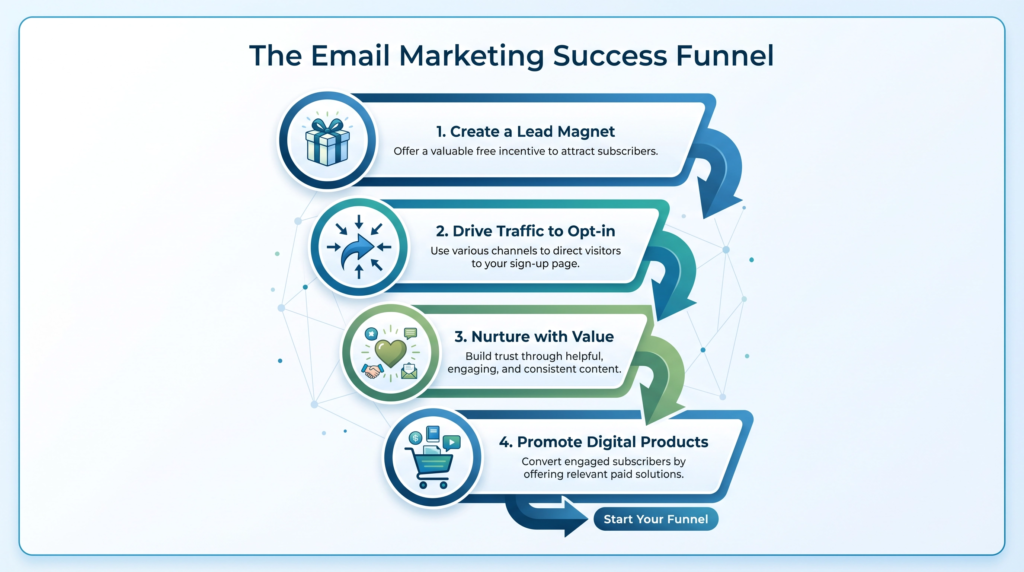
The Email Sales Funnel: From Subscriber to Customer

Let’s visualize the journey a potential customer takes through your email funnel. 

Understanding this progression is key to optimizing your sales process for how to sell digital products.

  1. Opt-in (Awareness/Interest): A visitor exchanges their email for your irresistible lead magnet.
  2. Indoctrination (Welcome Sequence): They receive a series of emails that introduce your brand, deliver value, and build trust.
  3. Education & Nurturing (Regular Content): You consistently send valuable content, further establishing your authority and keeping them engaged.
  4. Pitch (Sales Sequence/Soft Sell): You introduce your digital product, either through a dedicated sales sequence or a subtle call-to-action within your regular content.
  5. Conversion (Purchase): The subscriber, now a warm lead, clicks through to your sales page and makes a purchase.

This structured approach ensures that you’re not just blasting emails, but strategically guiding your audience through a journey that culminates in a sale.

To stay ahead of the curve, it’s important to be aware of the latest trends and best practices in email marketing for how to sell digital products.

  • AI-Driven Optimization: AI tools are increasingly being used to optimize subject lines, personalize content, and predict the best send times for maximum engagement [5]. Leverage these tools to enhance your strategy.
  • Privacy-First Approach: With increasing data privacy regulations, transparency and consent are paramount. Ensure your email practices are compliant and build trust by clearly communicating how you use subscriber data.
  • Interactive Emails (AMP for Email): Expect to see more interactive elements within emails, allowing users to take actions like filling out forms, browsing products, or even making small purchases directly within the email client. This reduces friction and improves conversion rates.
  • Clean List Hygiene: Regularly clean your email list by removing inactive subscribers. This improves deliverability rates, reduces costs, and ensures your emails are reaching an engaged audience. A smaller, highly engaged list is always better than a large, unengaged one.

YouTube tutorials – How to sell digital products 

YouTube tutorials - How to sell digital products

YouTube is a powerhouse for attracting a dedicated audience, building deep authority, and creating a consistent stream of sales for your digital creations. 

I’m here to give you the complete blueprint for turning your knowledge into high-value tutorials that not only help people but also seamlessly sell your products.

I get it—the idea of creating videos can feel intimidating. You might be worried about the equipment, being on camera, or competing with established channels. 

But here’s the secret for 2026: it’s not about having a Hollywood-level production; it’s about providing genuine value and solving real problems for your audience.

Setting Up Your YouTube Channel for Sales Success

To effectively use YouTube for how to sell digital products, you need to treat your channel as a strategic business asset, not just a place to upload videos. Here’s how to optimize it for conversions.

Step 1: Create a Professional and Branded Channel

Your channel’s appearance is the first impression you make. Invest time in creating a professional channel banner that clearly communicates your value proposition and a high-quality profile picture. 

Your branding should be consistent with your website and other social media platforms to create a cohesive and trustworthy online presence. This professionalism is key to building the credibility needed for how to sell digital products.

Step 2: Write a Keyword-Rich Channel Description

Your channel description is a prime piece of real estate for SEO. Use keywords related to your niche and the problems you solve to help YouTube understand what your channel is about. 

Clearly state who you help and how you help them, and don’t forget to include a link to your website or a primary lead magnet. This is a simple yet powerful way to improve your channel’s discoverability and drive traffic from day one.

Step 3: Organize Your Videos with Playlists

As you create more content, organize your videos into logical playlists. This not only improves the viewer experience by making it easier for them to find relevant content but also increases watch time, which is a key ranking factor for YouTube. 

You can create playlists around specific topics, skill levels, or even different stages of your sales funnel. This organization is a subtle but effective way to guide viewers toward a purchase.

The Content Strategy: Creating YouTube Tutorials That Sell

Now for the most important part: the videos themselves. 

Your tutorials are not just educational content; they are strategic sales assets designed to showcase your expertise and create a natural desire for your digital products. 

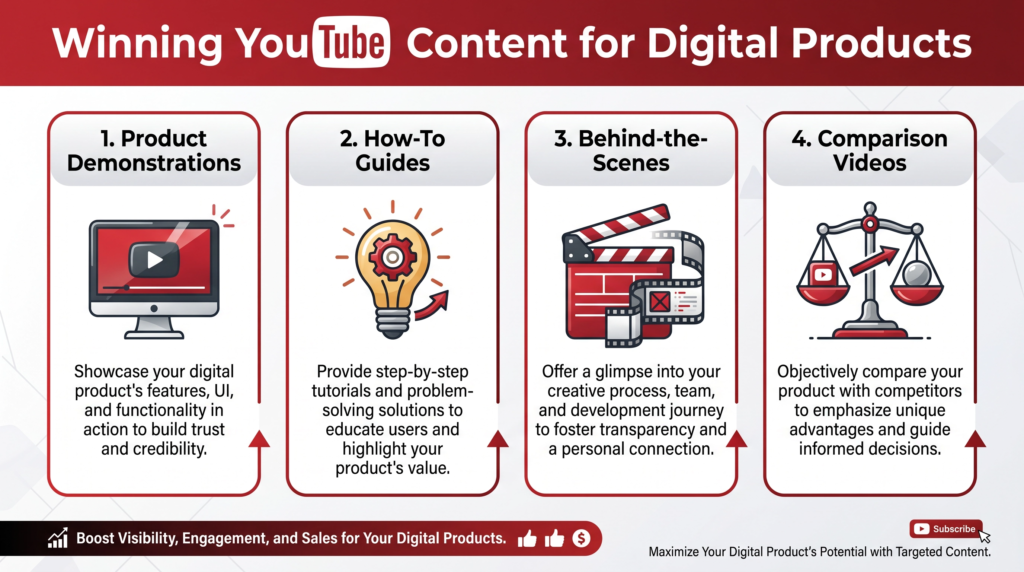
Here are the most effective types of tutorials for how to sell digital products in 2026.

1. The “Deep Dive” or “Comprehensive Guide” Tutorial

This is a long-form video (15-30 minutes) that provides a complete, step-by-step solution to a significant problem in your niche. 

For example, if you sell a digital course on graphic design, you could create a tutorial on “The Ultimate Guide to Creating a Brand Style Guide.” 

In the video, you provide immense value, and then you can naturally introduce your course as the next step for those who want to master the entire branding process. This is a powerful strategy for how to sell digital products by demonstrating your deep expertise.

2. The “Tool Walkthrough” or “Product Demonstration” Tutorial

This type of video shows your digital product in action. 

For example, if you sell a set of Notion templates, you could create a tutorial on “How I Organize My Entire Life with Notion,” where you walk viewers through your exact templates. 

This is incredibly effective because it removes all guesswork and allows potential customers to see the tangible value and benefits of your product before they buy. 

This practical demonstration is key to how to sell digital products.

3. The “Mistakes to Avoid” or “Problem-Focused” Tutorial

This video addresses common pain points or mistakes that your target audience makes. For example, “5 Common Mistakes New Freelancers Make (And How to Fix Them).” 

In the video, you provide solutions to these mistakes and then position your digital product (e.g., a “Freelancer Starter Kit”) as the ultimate resource for avoiding these pitfalls altogether. 

This strategy works well because it taps into the viewer’s desire to avoid pain and achieve success more easily.

4. The “YouTube Shorts Teaser” Funnel

YouTube Shorts are a fantastic way to reach a new audience and drive traffic to your longer tutorials. 

Create short, high-impact videos (under 60 seconds) that provide a single, powerful tip. 

At the end of the Short, direct viewers to your full tutorial for a more in-depth explanation. This creates a powerful funnel that moves viewers from quick consumption to deep engagement, where you have a much better opportunity to how to sell digital products.

The YouTube Sales Funnel: From Viewer to Customer

Understanding the journey a viewer takes on your channel is essential for optimizing your sales process. 

Here is the classic YouTube sales funnel for how to sell digital products.

  1. Discovery (Search/Browse): A user finds your tutorial through a YouTube search, a recommendation, or an embedded video on a blog.
  2. Consumption (Value Delivery): The user watches your high-value tutorial, has an “aha!” moment, and begins to see you as a trusted expert.
  3. Call to Action (The Pitch): During the video (and in the description), you verbally mention a relevant digital product or lead magnet that helps them take the next step.
  4. Click-Through (Traffic): The user clicks the link in your video description or pinned comment to learn more about your offer.
  5. Conversion (Purchase): The user lands on your sales page or lead magnet landing page and completes the desired action (a purchase or an email sign-up).

This funnel is the cornerstone of a sustainable strategy for how to sell digital products through YouTube. It focuses on providing value first, which builds the trust necessary for a confident purchase.

Mastering YouTube SEO for Your Tutorials in 2026

To ensure your videos are discovered by your target audience, you need to master the art of YouTube SEO. 

Here are the key strategies for how to sell digital products through search optimization on YouTube.

  • Conduct In-Depth Keyword Research: Use tools like TubeBuddy, VidIQ, or even YouTube’s own search bar to find the exact phrases your audience is searching for. Focus on “how-to” and problem-based keywords.
  • Optimize Your Video Title, Description, and Tags: Use your primary keyword in your video title and the first few sentences of your description. Add relevant tags to help YouTube understand the context of your video.
  • Speak Your Keywords: In 2026, YouTube’s AI transcribes and indexes the spoken words in your video. Be sure to say your target keywords naturally throughout your tutorial, as this is a powerful ranking signal.
  • Create Compelling Thumbnails: Your thumbnail is your video’s billboard. It needs to be eye-catching, easy to read, and create a sense of curiosity that makes people want to click. A high click-through rate signals to YouTube that your video is relevant and valuable.

Conclusion

Choosing where to start is the most common hurdle when learning how to sell digital products. I’ve created this comparison table to help you make a data-driven decision based on your current goals and resources.

ChannelPrimary StrengthContent LifespanProduction EffortBest Starting Point For…
TikTokViral DiscoveryVery Short (Hours/Days)Low to MediumBeginners needing fast traffic & feedback
InstagramBrand BuildingShort (Days/Weeks)MediumCreators with a strong visual/lifestyle brand
PinterestPassive TrafficLong (Months/Years)MediumVisual products (planners, templates, art)
BlogAuthority/SEOVery Long (Years)HighEducators & those wanting a long-term asset
Email ListConversion/ROILong (Owned Asset)MediumEveryone (should be built from day one)
YouTubeTrust/SearchLong (Years)HighExperts, teachers, and technical product sellers

Mastering how to sell digital products is not a sprint; it’s a marathon. It’s about consistently showing up, providing genuine value, and building a bridge between your expertise and the people who need it most. 

Whether you start with a 60-second TikTok or a 3,000-word blog post, the most important step is simply to start.

You now have the complete roadmap. You have the strategies, the tactics, and the insights for the most powerful marketing channels in the world. 

The only thing left is for you to take that first step. I believe in you, and I can’t wait to see the incredible business you build. Now, go out there and share your digital creations with the world!

We’ve barely scratched the surface of  how to sell digital products, with it having much more going on. There’s a reason it made it onto our digital product guide , and we highly recommend you check it out.


Spread the love